Showing posts with label Best of BLOG. Show all posts

Friday, May 01, 2009

Thanks Be To God for Things Such as These...

From my daughter's mouth (and heart) this evening, following evening prayers:
The Lord is my Shepherd,
He always loves me,
He takes care of me
In the storm, again...

And then when you die
He will wake you up again
If He comes again
And He walks on the water
When His disciples couldn't.

The Lord is my Shepherd,
And He loves me so best,
Yes, He loves me soooo...
Aaaamen.

Tuesday, April 07, 2009

The Metropolitan's Speech

The "Purple Demons" are out in force.

Firstly, the much-embedded video:

http://video.yahoo.com/watch/4812572/12841013

I was there. My little one is the one you hear at the very beginning saying things like, "Wan blow out candulsh" and, looking at a priest, "¡Es Padre!" Needless to say, this talk has made quite a splash in online Orthodox circles. Andrea Elizabeth calls the speech "Revolutionary," and Father Gregory states he is "unimaginably proud" of Metropolitan JONAH.

Truth be told, I am rather disappointed in His Beatitude.

What could have been a helpful, passionless appeal came across as something akin to an American political stump speech, something I've already heard described as similar to what you might have heard in Boston circa 1770 or Charleston or Richmond circa 1860. This, I think, is the last thing we need, as the "debate" (if we want to call it that) is already wrought with misstatements; His Beatitude did not need to make any more.

Not helping matters is Rod Dreher's "Cruchy Con" piece in the Dallas Morning News, wherein he pretty much takes the stance of the kid in the playground who, upon seeing two angry boys starting to face off, throws his hands up and yells, "Fight! FIGHT!"

Well, thanks for that, Rod.

What is evident here is that the situation with regard to how to unify the Church jurisdictionally -- something I'm convinced must be done, as arguments for keeping jurisdictions separate still seem to run only on fear and suspicion of sheep-stealing via a more attractive archdiocese or what have you for this or that niche Orthodox group...a "healthy competition" that is anything but (I'm not making any friends with this post, am I?) -- is one without canonical precedent, with multiple patriarchates "setting up shop" separately without consulting one another. Consequently, we have multiple bishops in a single city, something that is truly ridiculous and a horrid witness.

Our first option would be to "go Balkan," wherein we declare our own autocephaly and union independently of the Mother Patriarchate(s), and said autocephaly is then reluctantly approved hundreds of years down the road as a tacit, de jure nod to a living, de facto Orthodox body.

Another option would be to "take two steps back, one step forward," at least for the time being, and form a synod of bishops with a representative of the Ecumenical Patriarch as the "president" of said Metropolitan synod. The former idea was put forth by Metropolitan JONAH in his speech on Sunday, the other by the Very Reverend Archimandrite Dr. Elpidophoros Lambriniadis. What is ironic is that, in this document which Metropolitan JONAH wrote while still an abbot, he himself puts the latter idea forward as "the only way an ecumenical primacy could [actually] work." Food for thought.

Metropolitan JONAH, in my opinion, is absolutely correct in saying that there is, in fact, a living, Orthodox presence on this continent, and that it was planted here over 200 years ago through the prayers, the blood, and the perseverance of saints like Ss. Herman, Juvenaly, Tikhon, Peter the Aleut, John of San Francisco, Alexis Toth, and many others. If the EP tries to make a move to incorporate the bishops of North America, these saints and their work had best be recognized if he wants the "Amen" of the laity.

Metropolitan JONAH is also absolutely correct in saying that the local bishop, in his local diocese, with his local presbyters and local faithful, constitutes the One, Holy, Catholic and Apostolic Church, and that allegiance or submission to this or that Patriarch is not the sine qua non of Orthdoxy. He is absolutely correct in saying that the Ecumenical Patriarchate is not the "sole criterion" of Orthodoxy, and that we do not need to be directly under his omophorion in order to be legitimately Orthodox.

But, as usual, it's not what you say, it's how you say it. Check that: in this case, what my Metropolitan (and current diocesan locum tenens) said is, in some cases, incorrect, in my opinion.

One of the most inflammatory lines in His Beatitude's speech was in response to the EP's model of unity here: "I would submit that if we wanted a pope we would be under the real one." This, to me, is so unfair that I am at a loss as to where to begin. The EP is not proclaiming himself to be infallible. He is not proclaiming that all other, universally-recognized-as-autocephalous Patriarchs are merely deriving their legitimacy from him. Were the Ecumenical Patriarch to slip into preaching clear, christological heresy, he would no longer be worthy of commemoration, and all other Orthodox would have as their duty the task of rejecting him as Patriarch.

Yet, just as St. Peter was the rock due to his person and to his confession, so the EP is the "first among equals" in a college of Patriarchs so long as he is not confessing heresy. He, along with the other Patriarchs, are the ones who together will decide what happens to the Church, and it is not unreasonable to think that having the EP at the helm of all the metropolitans within this country as a quick way to unify us jurisdictionally with the end result being "turning us loose" down the road (no doubt much too slowly for most Americans), as is his custom.

Metropolitan JONAH speaks much about self-determination and how we must be allowed to do this. I would question how Orthodox the idea of a Metropolitan (or Metropolitans) telling their Patriarchs what we must do is realistic. Metropolitan JONAH puts our being Orthodox and our being American on equal footing, and thus speaks in very similar terms to American talk of separation from the British throne and Confederate separation from Washington D.C. To talk of self-determiation via an enlightenment-era document written by deists is one thing, and a natural one, at that. To talk of self-determination as if it were a "right" within the Orthodox Church is quite another, and a dangerous one, at that. Talk of the "right" to govern ourselves turns Fr. Alexander Schmemman's talk against "having rights" around against us; I am not sure how someone who, for all his God-given, wonderful insight as a monastic and pastor, would only attend a pan-Orthodox great Synod as the leader of a metropolia of the Russian Orthodox Church (as many still see Metr. JONAH) could actually hope to effect said self-determination short of schism...something I'm not sure I'd follow him into and which I'm VERY sure he would not, in fact, go through with if push came to shove. Nevertheless, are we justified in extending the language of the myth of American exceptionalism even to the Church?

If our bishops would still be here locally, if they would still be the local bishops of thus and such a city, if they would still be (by and large) "homegrown," and if the situation of the EP's involvement is primarily that of administrative unity (as opposed to some dream of automatically bestowing legitimacy via his very presence in said synod), then local churches would still be preserved. When Archbishop DMITRI was my local diocesan bishop, having a Metropolitan over the synod of OCA bishops in no way diminished Vladyka's role as my local bishop. I fail to see how a synodal president from the Phanar must needs be a "foreign despot" as Metr. JONAH claims unnecessarily.

Indeed, people in this country from ACROD, from the GOA, from the Ukrainians under the EP, with whom I have spoken have all told me that their being under the omophorion of the EP has not resulted in their losing their ethnic customs in the slightest. They have not been thoroughly hellenized, they have not been made to speak Greek (the secretary of the EP stated in his talk that he himself did not consider this necessary, though the option should be open, he thought). Local languages -- Arabic, Ukrainian, Russain, etc -- have been preserved under the EP, not obliterated. Do we really believe Patriarch BARTHOLOMEW so obtuse as to automatically assume that he will do this with English, especially given his track record elsewhere? Does the fact that Holy Cross Seminary -- the very place the EP's archdiocese trains its clergy -- conducts services in at least 50% English (according to my contacts there) serve to show us that he is not obsessed with "All Greek, all the time"?

Given what I've written so far, it does seem as though I'm thoroughly on the side of the EP here. I'm not, though I wanted to lead off with the above due to all of the unadulterated praise heaped on our Metropolitan by my fellow members of the OCA (and others). As it stands, given the secretary's speech, it is obvious to many that the EP's take on Orthodoxy in America is unacceptable to many Americans. While an EP head to a US Metropolitan synod is indeed a feasible, non-lethal model for Orthodox jurisdictional unity and not to be dismissed out of hand, it needs to be said that this must not be the only model allowed for, as such comes dangerously close to the papal model wherein the EP is, in effect, the only one allowed to engage in planting foreign mission churches, or else, at a minimum, must give his blessings for other, apostolic sees to do so.

The Ochlophobist makes some good points (about half way down, in a bulleted list) regarding captiulation to western dress and liturgical style, moral ideals and church praxis as seen in many jurisdictions in the USA. It is interesting that the Secretary of the EP makes so much of the Greek Archdiocese when so many of the western innovations (pews, choir robes, horrible iconongraphy, shaved and collared priests, truncated liturgy and distrust of Ephramite monasteries in particular and monasticism in general) has not been avoided by being under the EP and would probably not be solved by a synod's being under the EP. Some would question at this point, "Well, what's wrong with SCOBA"? As an idea, nothing that I can see. But who to chair it, and why...I defer to the Ochlophobist's thoughts on this, linked to above.

As Andrea Elizabeth has said, "I also think it boils down to how autocephalous are the Churches that Moscow, and Antioch for that matter, granted that title to?...I do not know why Moscow would hand us over, if that is the case. To me it undermines their own authority." This is the main reason why I do not believe that such a reactionary speech was called for or even justifiable. To further Andrea's thoughts re:Patriarch KYRILL, do we really think for one moment that, come this June, Patriarch IGNATIUS IV of Antioch is just going to hand over an archdiocese that is every bit as profitable for him (God, it hurts to talk about the Church like this!) as the GOA is for the EP? That the Serbian patriarch will just acquiesce to giving up direct oversight of his flock? The Romanian his Romanians? The Bulgarian his Bulgarians? There is more than enough suspicion on the part of several of these Patriarchs who will be meeting -- some of whom, like the Georgian Patriarch, do commemorate Metr. JONAH -- that the EP comes close to a papal role at times. I personally think there's enough of a safeguard there to keep unwarranted and unjustified fears at bay, at least for now.

Regardless, whether we are jurisdictionally united under the EP or persist in our present jurisdictional madness, neither outcome makes us any less Christ's Church, and I, for one, intend to look forward to the soon-coming bells of Pascha, wherein the "purple demons" are sent back where they came from.

Just in time for them to come back for the Apostle's Fast in June. Lord, have mercy.

Monday, March 09, 2009

Memory Eternal

During the Theophany season, my wife and I hosted an open house which many families from our parish attended. Our dear friends, the godparents of our oldest daughter, also attended. Their younger child, James, pictured above with our younger daughter at the open house, recently lost his life in a tragic accident. We traveled to attend the funeral this weekend, at which I was honored to be able to chant part of the psalter over what is far and away the smallest casket I have ever seen. The Orthodox maintain that, though the spirit has departed the body, the body yet remains a temple of the Holy Spirit (1 Cor. 6:19), Whom Jamie received upon being baptized and chrismated, and communed with the precious and immaculate mysteries of the Body and Blood of our Lord and Victor over death, Jesus Christ. We thus pray the psalter in its entirety over the body as a means of commending it to God through the words that speak what it seems no other corpus of words can speak.

Last night, we prayed an extended panikhida (memorial service for the departed), parts of which were repeated in this morning's funeral service. The local mission's choir led us all in the well-known hymns and melodies, and the sound filled the spaces with sweet mourning. There is a sense in which liturgy carries one when one cannot carry oneself, and both the parents as well as their non-Orthodox family members and friends seemed to be carried along as well by the current of our common work, the refrain of "Give rest to the soul of the infant, O Lord" serving as the lapping of the waves that carressed the ragged, shocked souls there. Jamie's father had said in the week preceding the funeral that, if any good would come from this, that people would be touched by the Holy Spirit through the Church's offering of the babe to Her Lord; may his words be made true.

The service for the burial of an infant is uniquely comforting, for it is, in essence, the acknowledgement of a true saint in our midst, for God "hast accepted this undefiled infant...before he had been tempted by earthly sweetness, counting him worthy of eternal good things, as the lover of mankind." Indeed, the weeping is infinitely greater for Jamie's parents, as these verses exclaim:
No one is more pitiful than a mother,/
and no one is more wretched than a father,
for their inward beings are troubled/
when they send forth their infants before them./
Great is the pain of their hearts because of their children,/
and still more when these are pleasing of speech,/
as they call to remembrance/
their words with the song://
Alleluia.

For often before the grave they beat their breasts and say:/
"O my son, and sweetest child!/
Hearest thou not what thy mother says?/
Behold, also, the womb that bore thee./
Why speakest thou not with us,/
as once thou didst speak?/
But thout art silent/
and speaketh not with us://
Alleluia!"

"O God, God, Who hast summoned me;/
Be Thou the consolation of my household now,/
for a great lamentation has befallen them./
For all have fixed their gaze on me,/
having me as their only-begotten one./
But do Thou, Who wast born of a Virgin Mother,
refresh the inward parts of my mother,/
and bedew the heart of my father with this://
Alleluia!"
Yet in the weeping, the funeral lamentation is: alleluia. The priest of the mission then stood following the reading of the gospel and read what Audra and I consider to be the best sermon either of us have ever heard. He began by saying that, a week ago, little Jamie had been scooting around the floor of the mission in his cute little way, giving big sloppy smacks to the icons and the cross, as he had not yet learned how to purse his lips in a "proper" kiss. He reminded us of how we were to approach the kingdom of God as Jamie did, as a child, trusting in what God has given us through our baptism into and clothing with Christ, through His giving us the Holy Spirit in chrismation, through His abiding in us through the mysteries of His body and blood.

Jamie, he said, related to Christ more deeply than any of us there, as with age and intellect need not always come wisdom or spiritual maturity. He had just taken his first steps a few days before and had just begun to put partial words together, "yet what is walking," Father asked, "when you can run in the Kingdom of God? What is running, when you can fly in the celestial realms? What is speech, when the language of the Kingdom of Heaven is silence?" Jamie, he stressed, now gazed into the face of the Ancient of Days, who is perfect Love and Peace. His infancy, far from making him less in the Kingdom of Heaven, made him infinitely more, and he would carry the touches, the voices, the scents, and the sights of all those whom he had encountered in this life into the next, where he would meet his God and ours, and from whence he would await the day when, rising in the body, he would shine like Christ on Mount Tabor, revealing the glory of his Creator as one of His holy ones.

The little one's death cannot be explained away, cannot be dealt with with reasons. God does not dismiss our pain, nor does He give us theological syllogisms from which to derive some sort of artificial comfort. We must mourn. Yet, in that mourning, our God enters into our pain, enters into our life, and Himself suffers. The most eloquent word of the Cross is the silence of the dead Christ, for, in providing no words or explanations, He nonetheless travels the painful road with us, as us, helping us to see that this painful road will end in Tabor's glory. His mother, likewise, who watched her only Son die, shows us the way in which we can hold both suffering and peace in our hearts by clinging to the Cross.

Father then instructed us on what the Orthodox call "The Last Kiss." All Orthodox funerals are open-casket, yet Jamie had a shrowd over his face so that only his forehead showed. Following the hymns all who wish to do so may come and kiss the body, thus venerating it one last time as holy temple. After I kissed his forehead, my words to him were, "Dear child, may God give you rest 'till the day you breathe again."

May the infant James' memory be eternal, and may he pray for us all.

Monday, March 02, 2009

"Draw Near Unto My Soul and Deliver It"

A blessed fast to all observing.

Why do we fast? So that we may be saved. Such an answer no doubt scandalizes Christians belonging to certain confessions, but it is indeed a truth that is overlooked in our contemporary culture so often that it is no wonder that indulgence and a subsequent addiction to constant satiety are hallmarks of said culture. In saying that we fast so that we may be saved, however, it is important to understand what is being said, as well as what is not being said.

I do not mean to say here that we fast so that fasting itself may save us, or that we, by fasting, may come to merit salvation. God saves. The Father, through a gracious act of His Son and by the power of His (the Father's) Holy Spirit, draws us to Himself and causes us men made of scorched earth to bloom once again with the blossoms of His eternal light.

Several different events as of late have caused me to think about these things. A very dear friend of mine who is an Evangelical Protestant asked me recently if the Orthodox ever "do evangelism." After outlining his "M.O.," so to speak (he was clear that this was a simple theme that could and should be varied through careful evaluation of the individual one was --hopefully--listening to), he then asked what we would say if someone, like the Philippian jailer, asked us what he must do to be saved. A couple of recent podcasts on AFR -- namely this one and this one -- confirmed what I'd mostly been thinking: if one were to ask me what they had to do to be saved, I would start off by telling them (first of all) that Life Itself (Himself, really) awaits, and that It (He) seeks to turn us back from eventual oblivion. What we must do is love His Light rather than our darkness, His Life rather than our death.

This is no easy task, for as one author puts it, we encounter this love and engage it "in fits and starts." Yet engage His unmoving Life and Love we must, for from that one living, loving presence we will eventually experience either everlasting punishment or times of refreshment that go from glory to glory, ever more radiant.

Great Lent is a time to remember that God is not the factor to be determined in our salvation; in one sense we're all already saved. The factor is our response to God. We encounter God's sovereign rule over Creation enacted not by any actual action He must take over it, but by His very, unmoving being over it. The psalmist reminds us that Creation is dismayed when He hides His face, dead and dust when He takes away our breath. When He "send[s] His Spirit, we are created, and He renews the face of the earth."

The introductory hymn of Great Lent is a petition: "Turn not Thy Face away from Thy child, for I am afflicted; hear me speedily; draw near unto my soul and deliver it." Here we hear the human soul's ultimate cry: we thirst for Him in a land barren, and untrodden, and unwatered; though we speak of Him as "turning His face away" and "drawing near," these obvious anthropomorphisms fall short of He who is everywhere present and filling all things. It is we who must needs open ourselves to His gracious presence and, in so doing, find salvation.

This salvation, more than simply a dealing with a checklist of transgressions our Creator has against us, is moreover a renewal of life and a reversal of the ancestral curse -- a curse which leads to an endgame of a perverse hesychasm whose silence and stillness is that of isolated torment and not of communal illumination.

Father Stephen Freeman stated the following (source):
The “Great Crisis,” if I can coin a term, is the threat of non-existence, or relative non-existence. Classical Orthodoxy, following St. Athanasius does not threaten humanity with pure non-existence, but with a dynamic movement towards a “relative” non-existence.

The Great Crisis is therefore not at all the same thing as an impending punishment from an angry God. This is not our fate. Rather it is the continued living in increasing modes of non-existence as we refuse to live in communion with the Only True God Who is the Lord and Giver of Life.

Because this is true, every work of our salvation begins in communion with God, continues in communion with God, and is fulfilled in communion with God. Thus our lives can never be defined extrinsically (from the outside), but only mystically and existentially.

The Great Crisis is answered in Pascha (the fullness of Christ’s resurrection) and has never been answered in any other manner.
So, then, the question remains...how? Well, a checklist could be made: catechism, baptism, chrismation, communion, prayer, confession, fasting, almsgiving...the last four of which we Orthodox Christians need to commit ourselves again to come this season, but there is still a sense in which that story -- that something is fundamentally wrong, not only with me, but with the cosmos, and that it was not always this way, and that it really should be some other, better way, and that somehow we all dream that Someone should and will come along and make all crooked paths straight -- needs to be accepted before anything could progress in this hypothetical dialogue. If one is convinced that this is the best of all worlds -- or that, if it is not, then I am surely not a direct part of its not being so -- then all else is wasted breath.

Such a convincing cannot be mustered up by an appeal to God's Law or a subsequent appeal to "square with the house." Salvation is not a mathematical, debit-and-credit equation. We are speaking here of One Who has already saved us, already told us He has shed Life on the graves and that we will rise...in some manner. To be saved, then, we must die before we die, and that dying is a daily thing. One of the ways we die with Him is through letting go of a little food, a little drink, a little time...a little of "me," in other words, and let Him warm whatever seeds have been planted in whatever way He knows how. Our job is to till, to water, to break open the soil of our hearts through prayer, fasting, repentance, almsgiving -- all the while waiting on the Lord to grant us healthful seasons and abundance of the fruits of the heart which will spring up to adorn His Vinyard.

This quote from Father Stephen, to close (source):

It is as though at death our bodies have a wisdom we have lacked for most of our lives. It knows that what it needs is not food - but something deeper. The soul seeks and hungers for the living God. The body and its pain become a distraction. And thus in God’s mercy the distraction is reduced.

Christianity as a religion - as a theoretical system of explanations regarding heaven and hell, reward and punishment, is simply Christianity that has been distorted from its true form. Either we know the living God or we have nothing. Either we eat His flesh and drink His blood or we have no life in us. The rejection of Hesychasm is the source of all heresy.

Why do we fast? We fast so that we may live like a dying man - and in dying we can be born to eternal life.

Friday, January 23, 2009

Credo

A catechumen was received into the Church this past Sunday; a former Episcopalian priest for some forty years, he had held out due to his post as a professor and as a pastor to those still continuing on in his flock. Deciding he could no more abide the position, he has now joined the Orthodox Church with more fervor than anyone I think I've seen in my relatively short Orthodox life. Prayers for Jared, as his family life is quite a hostile environment now.

When he was received, he recited the Nicene Creed by himself, in the presence of the faithful. Never have I heard that creed read with so much conviction; indeed, after one or two articles of faith, he choked up. It is this Creed which is quickly becoming my favorite part of any service in which it is found. That a confession with such a relatively general theological nature has become so much more meaningful as of late is something that both surprises and comforts me.

Steve Robinson has stated quite rightly in a comment on this blog that converts to the Orthodox faith (or any other, for that matter) make the worst apologists, at least at first, as they end up focusing almost exclusively on the often-esoteric distinctives of their new faith rather than its catholic core. Such a tendency is understandable, even if it is horribly wrong. Indeed, focusing on the universally-accepted tenants of the Creed would almost be anticlimactic, as one might be tempted to wonder why one would convert from what many consider one of several nicene faiths to another in the first place, much less a more exotic, less palatable one. Indeed, much more titillating is the idea of focusing on all of the exclusively Orthodox practices and theological distinctives, as one can use those to browbeat fellow nicean-constantinopolitan Christians into a hierarchical, sacramental, theosis-based soteriological corner wherein they must become Orthodox because they have been manhandled into that particular confession through a type of forced process of elimination. As one was taught, so one will teach, as it were.

So it is therefore a comfort to me that, when someone asks a question to the tune of, "So, what is it you Orthodox believe," I immediately begin with the person of Jesus Christ, His work on the Cross, His Resurrection from the Tomb, His Ascension into Heaven, His Second Coming, and the Resurrection offered to all who will have faith in Him. I do not talk about fasting for half the year, uncreated grace, essence v. energies, apostolic succession, the Real Presence, the filioque, icons, incense, liturgy, or bishops. While all the latter components of the faith were new to me (a former Southern Baptist), the strongly-preached kerygma of the Creed I had grown up with was something I'd taken for granted, whereas the former Father James (now John) was blessed beyond words to affirm in the assembly of like-minded faithful who would have him what those from whence he came were desperate to denounce as irrelevant. We may confess (correctly) that the Holy Spirit precedes from the Father, full stop, thus distancing ourselves from the West, and we may ascribe "belief" to the One, Holy, Catholic, and Apostolic Church -- belief which is equally ascribed to the Father, the Son, and the Holy Spirit, as well -- thus distinguishing ourselves from Protestants who have markedly lower ecclesiologies, but by and large, the rest of this Creed is affirmed by all of Christendom, and that is because it is the gospel, the power of God unto salvation for everyone who believes.

My three year-old has taken to lighting and holding candles (which we've "rescued" from being thrown out at church) during the Creed in our household morning and evening prayers. It is a wonderful focal point for her to slow down, say the Creed deliberately (praise God, she can say the whole thing herself with very, very little prompting) and focus on the light as she speaks luminous words. If this Faith is to be more than a form of godliness without the power thereof (and it can be and has been countless times over for innumerable souls), it must be because of the radiant συμβολο which stands at the center of our Faith and, in true symbolic fashion, unites us to that which it proclaims. May its radiance illumine the words we say and those we pray, as well as the work which our hands find to do.

Thursday, June 05, 2008

Christ is Ascended! He Has Gone Up with a Shout!

"The body of the Lord is not a spirit, but it is spiritual, that is, it has no part in any coarseness, and is governed by the spirit. For the body which we have now is animate [psychikon], governed by the soul and made alive by natural and animate attributes and faculties. But the body after the resurrection Paul calls spiritual, that is, made alive and governed by the divine spirit, and not by the soul, transformed in an ineffable and spiritual manner into incorruption and preserved incorruptible."

"By eating a piece of broiled fish, He indicates that He has consumed with the fire of his divinity our human nature which had been swimming in the salty sea of this life, and He has scorched away all the damp slime our nature had taken on as it sank into the depths and was battered by the waves. Thus He made our nature food fit for God, fashioning that which before was defiled into sweet food of which God can commune.... Another meaning, namely, active virtue which, aided by the coals of the asceticism of the desert and of the hesychast life, removes everything that is moist and fat. And the honeycomb suggests knowledge and divine vision, for the words of God are sweet. There is also another kind of comb, one full of wasps, which leave no honey. This signifies the wisdom of the pagan Greeks. But the honeycomb suggests the sweetness of divine wisdom[, left by Christ]. For Christ is like the bee, which is small in size (for the Word is concise and weak in worldly power...). Yet is beloved by both kings and commoners, who apply the product of its toils for their health and healing."

"He was carried up into heaven. It was written of Elijah that he was carried up as it were into heaven (IV Kings (II Kings) 2:11). For Elijah only seemed as if he were carried up into heaven. But the Savior ascended into heaven itself as the Forerunner of all men, to appear before the face of God together with His holy Flesh, and to reveal His Flesh co-enthroned with the Father. And now our nature in Christ is worshipped by the whole angelic host."

~ Bd. Theophylact on the feastday gospel reading from Luke 24

Sunday, May 04, 2008

What Wonderful Daughters

First up, let me show you what served as a distraction for dang near everybody in liturgy this morning. As if this child did not already look a lot like me; now we've got her in glasses. A couple of weeks ago, we noticed she'd been crossing her eyes (or just one, more often than not) when looking at us. The pediatric opthamologist we took her to told us she is extremely far-sighted and that these lenses (which, thanks be to God, she wears very well and for long stretches of time!) would, in undercorrecting the problem, help her still use her eye muscles to focus on things near her, but would not exhaust them to the point of their giving out and causing one eye to turn in. So this picture is just to brag on my beautiful, four-eyed babygirl who wears her new spectacles so well.

The toddler gets bragged on for whole 'nuther (but in my opinion, better) reason.

Tonight we had finished venerating the icons after evening prayers. Mommy had taken little one into her room to feed her and put her down for the night by the time big sis and I left the master bedroom (where la iglesia pequeña -- the little church, as we call our icon corner -- is located) and as we exited into the hall, I told Hope to keep quiet as we went by the room so Kate could go to sleep. As I entered the dining room from the hall, I noticed Hope stopping by Kate's door and raising her hand...in Papi fashion I waved her on, "no doubt" reminding her of something she'd "obviously" forgotten -- that it was "Kati's" bedtime.

Y'all, this is the kind of kid I've been blessed with: Not only did she immediately come when told, but then, with a hurt and disappointed look on her face, told me with a cracking voice and pouting lip, "But...I just wanted to bendecir su puerta!" ("bless her door," in Spanish) Her hand had not been raised to open the door, but to make the sign of the cross over it in order to help her baby sister sleep.

So I, rightly feeling every inch a moron and a sinner (families really are there to help us with our salvation, aren't they?), hugged my now softly sobbing toddler and told her just how proud I was of her and, after I'd asked her forgiveness (which the little saint gave right away), she and I went back to her door and, one right next to the other, we made the sign of the cross over Kate's door -- "En el nombre del Padre, y del Hijo, y del Espíritu Santo. Amen."

May God protect and further grow this thoughtfulness and generosity that resides in my elder daughter's heart, and may Kate's patience and good temperment follow her.

Wednesday, February 13, 2008

Eucharist, Again

On a forum I frequent, a (very eloquent and courteous) Evangelical was making a case for the Eucharist being solely a memorial meal. I responded with some scriptural passages and the Church's belief concerning Christ in the Eucharist but, since the sub-forum is not available to the public (one must register and then request access to said sub-forum), I thought I'd edit a few things and post here what I had written there.

************
Christ says that we must eat His flesh (literally, "to tear it with our teeth," if I'm not mistaken) and drink His blood. If He were speaking metaphorically, according to Jewish idiom, he would be telling those around him to revile Him--something I don't think would lend itself to eternal life and being raised up at the last day.

Nevertheless, it's clear from the text that no one really knew what in the world Jesus was talking about in John 6. Evangelicals often say that the phrase "My words are spirit and they are life" (emph. theirs) are key to interpreting the passage, as if the term "spirit" were synonymous with "incorporeal." In response, we would say that the words "flesh" and "spirit" are not used as synonyms with "corporeal" and "incorporeal," respectively, as such a view would lead to a gnostic hatred of all things material, and such a view could hardly be said to be one friendly to a divine incarnation.

Rather, we would say that the words He spoke to us--those of eating His flesh and drinking His blood--are words (or rather, a divine word or message of our Lord) that can only be understood when one is walking in the Spirit, as St. Paul said, instead of "in the flesh." And -- let me be clear yet again -- even this phrase "in the flesh" need not mean that the material body is somehow to be rejected as unfit for divine habitation, or that the material world is somehow incapable of communicating divine grace to Creation. The flesh of mankind, it has been said, is not so much the enemy as it is the battleground. When the Spirit of our God comes to reside in us, we are then to walk according to that reality, rather than the fallen one which still wars against our God. And where does it war? It just so happens that the war takes place in our fleshly members.

So, in our opinion, when Christ states that "the Spirit gives life; the flesh profiteth nothing," we would say that these are descriptions of the same two realities that St. Paul talks about--walking according to the natural man patterned after the old Adam and without Christ, and walking according to the newness of life offered by the new Adam and shot through with Christ's divine life. In both cases, though--and especially in the latter!--we see a whole mankind reunited--spirit, soul, and body!--through and in the divine power of the resurrected Christ.

So for us to insist that it's His actual body that merges with our flesh as we eat it, that it's His life-giving blood that flows in our veins, is not only an idea that has merit in our minds, but is absolutely crucial to a proper understanding of an incarnational worldview which allows for the redemption of the seen cosmos as well as the unseen.

And yet, some would ask, could it have been intended, after all, to be a purely memorial meal? True, there was talk about believing in Him in John 6, and some Reformed apologists want to take all the "eat My flesh, drink My blood" talk and boil it down to "just believe in your heart and confess with your mouth," but that doesn't explain why Christ brings up His flesh and blood in an edible context again in the upper room at the last supper. He said we have to eat His flesh; He said that what He held in His hands in that room was His flesh and gave it to them to eat. He said we have to drink His blood; He said that what He had in the cup was His blood of the New Covenant.

So...I would say this, as a starting point: even if an Evangelical is unwilling to concede to some sort of real presence of Christ in the Eucharist, it seems to be fairly obvious that Christ is continuing His discourse in John 6--that of eating His flesh and drinking His blood--specifically in this moment, in the upper room, by giving the Apostles a tangible way to accomplish this command. Apparently this was how He was going to make it possible--somehow--for men to eat His flesh and drink His blood...it was going to be through this Eucharistic meal.

I say "somehow" and want to emphasize that, for we don't actually have a "term" for how what happens, happens when the bread and wine become the Body and Blood. Transubstantiation sits well with some of us (though it's just a theological opinion one can have, not a dogma of the Church), though I prefer to see it simply as mystery: something that's been revealed to us as happening--namely, that the bread and wine are changed by the Holy Spirit into the mystical Body and Blood of Christ--yet the understanding of how it happens when, by all appearances, it still looks/smells/tastes like bread and wine remains (blessedly) hidden.

Some will say that, due to the memorial character of the prototype of the Lord's Supper (the Passover Seder), we should heed Christ's words that this meal was a memorial of what he did, with heavy emphasis and inference being drawn from the term memorial. To separate the Lord's Supper and it's function from the prototype, they say, further compounds the confusion.

This would be true, however, only if one were to work under the assumption that it is, ultimately, to be the Old Testament that informs the New, rather than the other way around. In fact, we must look back over the Old in light of the New; the reality doesn't have much to learn anymore from mere types and shadows. In spite of the merely symbolic character of the Old Testament Seder, St. Paul says that the bread which we break is our communion of the Body of Christ--the term κοινωνια which he uses specifically relates to a sharing or communion of more than one thing. We eat the bread; we have κοινωνια with the Body of Christ. We drink the blessed cup; we have κοινωνια with the Blood of Christ. It would seem that the memorial character of the Seder (which I agree, was heavily and probably exclusively memorialistic) did not transfer over to the Eucharist so thoroughly and exclusively as to preclude any kind of contact with Christ thereby.

This being our teaching--that Christ's sacrifice is somehow present in the Eucharist--it follows that one of the things that Roman Catholics and Orthodox are used to explaining "again and again" (and hopefully "in peace") is that we in no way teach that our experience of Christ in the Eucharist is in any way a re-crucifixion of the Lord. The sacrifice He made, He made once, for all, never to be repeated. It is that same sacrifice which is made present for all the faithful in the Eucharist.

Yet how can this be, if Christ was human, and a human body is limited by space and time? In confessing that one Man's human body can be distributed to thousands upon thousands of assemblies of the faithful (at least!) every Sunday, are we thus confusing the divine and human natures of Christ--something we are so quick to condemn in others? Not at all. We would say, first of all, that Christ's glorified body was much different than the pre-resurrected one the Apostle's witnessed, so much so that He was not immediately recognizable by all after He had risen. We have no problem with His being able to pass through doors and vanish; why is it such a stretch to grant His life-giving, resurrected flesh this miraculous property, as well? Christ is the bread of life, the bread of heaven; just as He multiplied the loaves for the multitudes, yet what was given was all of the original bread (a miracle), so is what is given to the faithful that same Christ, sacrificed in time once, 2,000 years ago, and multiplied and distributed to the faithful in a beautiful, glorious miracle that gives us access to the Fruit of Life that blossomed forth on the Tree of the Cross. We can now eat His flesh and drink His blood as He commanded. Eating it, we die not as did the old Adam, but shall live forever as promised by the New.

We are not, as has been said above, to equate the type and shadow of the Seder with the Eucharistic meal, and neither are we to equate the life-giving blood of our Lord with the mere, terrestrial manna of old in terms of life-giving properties. Our Lord Himself contrasts His own body with that manna of old when He says in John 6 that, "Your fathers did eat manna in the wilderness, and are dead...I am the living bread which came down from heaven: if any man eat of this bread, he shall live for ever: and the bread that I will give is my flesh, which I will give for the life of the world." It would seem that Christ is making a very sharp distinction between the two realities of manna and His life-giving flesh.

It is true that, in both the case of those who ate manna and that of those who eat the body of our Lord, the biological functions cease in the body, and, thus, the spirits of both groups depart from respective bodies. This aspect is acknowledged by the Church; we do not say that those who partake of the Lord's Body and Blood cannot in anywise experience death. We do, however, qualify said admission by saying that the sting of death is avoided, though death be still (temporarily) experienced. We are told by Christ that, even if we die physically, not even that (seeming) death will separate us from His love and that we "will be raised up at the last day"--something never promised to those who ate manna in the wilderness. Indeed, Christ concedes physical cessation of biological life while acknowledging a continuing--and, ultimately, victorious--life that no death can quell: "I am the resurrection, and the life: he that believeth in me, though he were dead, yet shall he live: And whosoever liveth and believeth in me shall never die." St. Paul would agree, that which is sown in corruption will be reaped in incorruption, but no eternal harvest will thus be yielded lest the seed go into the ground and die. As with our Lord, who offered His own body as the Protoseed that would become the Firstfruits of our own resurrection, so with us, His followers, who carry His gracious Body and Blood in ourselves, proclaiming His death to the point of our own departure from this life. Furthermore, having carried the Apocalypse's life-bearing Lamb and Word within ourselves even into the tomb, our still-corruptible bodies will, on the last day, rise to glory as our Lord states.

Tuesday, February 05, 2008

Eternal Security Tangent

A lengthy discussion of eternal security has been started in the "Do the Orthodox Know the Gospel?" combox. Comments regarding that have been moved here. Pardon our dust.

Thursday, January 31, 2008

Do Orthodox "Know the Gospel"?

The following is a comment I left on Jim's blog HERE. It's a fine post he's written, and I'd recommend reading it for context as to what I'm about to place (slightly modified) here.

I confess to being an AFR junkie; it’s almost all I listen to on my iPod. I am particularly fond of Dr. Bradley Nassif. I may not respond with such vehemency as he has to the state of Orthodox clergy, but I do see -- and I'm not alone in this -- a need for increased awareness not only of the content of Scripture among the faithful, but of the central, saving message of the gospel.

I think the awareness of the need for this within the Church is (at least) several decades old; Father Alexander Schmemann wrote of his own awareness of it in the seventies. Father Tom Hopko states repeatedly that “it’s all about God,” and not anything else. So folks in the “upper eschelons” of the Church here in America are aware that, when folks don’t know the basic Bible Story characters in the OT, or don’t know any of the parables of Christ, then something is wrong.

Granted, in my time as a Southern Baptist growing up, I met my fair share of similarly disinterested youth (and adults!) who came on Sunday morning and little else (or, if the youth came more often, it was for social purposes only; they seemed bored to tears during the worship and “sermonette” time). So I don’t want to come across as too one-sided.

Ultimately, though, I think what folks in the West are dealing with is (surprise, surprise!) two different extremes. On the one hand, the Evangelical world that dominates our American (and, in particular, southern) culture is severely truncated in its gospel message. Redemption, according to this particular stripe of Christianity, is seen almost always as a forensic “statement of intention” on God’s part, and nothing more. The Son has changed the Father’s mind about us through a contract written in Blood, so we have an ironclad guarantee that moves the Father’s hand away from the gate to paradise so that we can be allowed — snow-covered dung though we still are — to enter heaven. The Father looks on us with favor instead of vindictive wrath now, and all sin (whether it actually is still present in our hearts post-profession of faith) is forgotten by God, and we are granted passage to heaven. This gospel message is preached, long, loud and strong by Evangelicals, though without my post-convert ramifications added, I’m sure.

On the other hand, we have the Orthodox, whose idea of salvation is a body/soul/spirit infusion of the very life of God into the believer, and is rooted not only in Calvary, but in the Manger, the Mount Tabor, the Empty Tomb, the Mount of Olives (Ascension). The entire advent of Christ thus brings man from ontological death to actual life through a life-long cooperation with divine grace. This idea is intertwined in every hymn, every fast, every Scripture reading, every sacrament, to such a degree that we have at our disposal the most thorough Bible commentary and study resource available to mankind. The simple message at the core of all of our often “over-byzantined” worship, however — that “Christ came into the world to save sinners, of whom I am first” — though it be prayed in every divine liturgy, is quite often missed, the forest of this glorious statement being looked over for love of all the trees (icons, vestment and chant styles, rubrics, ethnic social activities, language issues, and more).

What this leads to, then, is Evangelicals looking at us and saying, “I like the way I do it better than the way you don’t.” Hmm. Harsh, but perhaps something we need to keep in mind. As Father Tom states in his talk on the book of St. John’s Apocalypse, everything in our worship service is meant to point us to the revelation of Jesus Christ. That’s why the Gospel and the Eucharist are the two ways in which Christ is brought out to us in the Divine Liturgy; He is revealed in the Apocalypse as the Word of God (the Gospel) and as the Lamb of God (the Eucharist). St. Ignatius, I believe, stated that our teaching is in agreement with the Eucharist, and the Eucharist confirms our teaching (I may be misquoting this; if so, forgive me and, please, correct the quote in the comments, as I can't seem to google it at the moment). Both the didactic proclamation of the good news given through hearing the written Word of God through reading and worship, as well as the intimate, physical, sacramental acts that unify us — body, soul and spirit — to our Incarnate Lord are needed to bring us into a holistic union with Him. It’s not that the Orthodox Way has been tried and found wanting, but rather that it’s been found difficult and left untried.

This faith is, let me say again, much harder than what Evangelicalism teaches. This may seem overtly hostile to many devout Evangelicals, and I am aware of many Evangelical groups that stress holiness of life and struggle against what we Orthodox call "the passions," but I believe this to be in spite of their soteriology, not because of it. God will not “guarantee” or “make” good works come out of someone. No false comfort is given to someone in the Orthodox Church to make him think that “he’s already believed, so good works will, ultimately, come”; God will never override free will and, as such, we must never be haughty, but fear, as our God, the Consuming Fire, will appear, and those of us who’ve loved His appearing will be purified in glory, while those of us who did not conform ourselves to Christ in spite of the grace given to us — perhaps even through laziness or a false sense of security brought on by all this “I know that I’m saved!” talk — will wish the rocks to fall on us.

This is another facet of the Gospel that the Orthodox Church preaches, yet I thank God that Her saints bear witness that our God loves mankind more than anything else and, though He will not ever trespass our free will in order to monergistically “establish good works,” always wills that we (continually!) repent and (continually!) come to the knowledge of the Truth.

Tuesday, January 29, 2008

Eucharist: The Embodiment of Truth

Father Stephen Freeman has a post that got me thinking about the Eucharist, which is, more than anything else, what drew me out of where I was as an Evangelical and made me hungry for something more -- the reality of God in this physical plane. I constantly tell folks that the main reason I joined the Orthodox Church was that, when I looked at the bishops of the first and second centuries AD, then re-read the Scriptures in light of their consensus, I came away with a drastically different view of what the reality of being "in Christ" actually means.

The Eucharist (no pun intended) embodies that reality. This is not something that can be "reformed," "rediscovered," or "recreated." It's either a reality that exists within a given community as the ultimate gift of God, the ultimate testament to a "one-storey universe" -- or it doesn't. And it doesn't--it can't!--exist just because such-and-such a group says they've "got it." There were (and are) certain qualifications for being a truly eucharistic fellowship and gathering -- all of which qualifications (the apostolic laying on of hands, the physical transmission of the faith from bishop to bishop, from babushka to baby, and others) are themselves also beautifully organic. These seeming limitations, supposedly confining God's saving presence in physical boundaries, nevertheless bring us to the realization that Christ's Church is, that it is to be joined, and that it cannot be manufactured. It is not a matter of parsing apart theological positions to ensure the "validity" of some self-made community's communion service. This reality of the presence of the God Who Is and Who Is with us -- is not something we make, but (to paraphrase Rich Mullins here) is something which is making us, which was given to mankind from the Outside, to be taken into our inside (not merely the stomach but also our heart of hearts), and which cannot be separated from the eternal life of our Creator, the One Who Gives.

I remember my moment of realization, when I realized that my assent to this Church of God made no difference. When I looked at an icon of the Theotokos and Child, the border of which was surrounded by saints that were (at that time) completely unknown to me, I realized that this Church has been what it's been for 2,000 years and has gotten along just fine without my approval -- or even my knowledge of its existence, for that matter. It was I who needed Her, not the other way around. I needed Her to give me the Bridegroom's Flesh and Blood, for it was to Her that such saving antidotes to the death that reigns in my members had been given.

I know the common cliché is that Evangelicals tend to stress "knowledge about God" whereas Orthodox actually "know God" through sacrament and living the Holy Spirit's life in the Church -- and, granted, the cliché can get far too simplistic if we make it the soundbyte I've seen it become in certain places -- but the flesh-to-flesh encounter with our Lord is too intimate to be excluded from our walk with Him. Christ, found in the Eucharist and received in faith by those united with Him in His death, is the seed of immortality that will blossom forth on the Last Day and give us Life (John 6:54) -- it is through this that the mortal puts on immortality (1 Cor. 15:54).

Wednesday, January 02, 2008

Icons, Icons, Everyone

A happy new year to all.

Firstly, please pray for the citizens of Kenya who, following a neck-and-neck election, suffered rioting and, most tragically of all, the death of dozens who were seeking sanctuary in a church (Story HERE). We Orthodox have been blessed with much growth in the Church in Africa in general, and Kenya in particular. Lord, have mercy.

Secondly, Fr. Stephen has just posted an excellent article on Iconoclasm and its persistence in history HERE. Worth a read, given what I'm about to post, as Fr. Stephen's posts are always much more eloquent and thorough than my ramblings...

The theme that caught my eye in Fr. Stephen's post is the same one that's been floating around for several weeks now: the theme of man as an icon of God, as the incarnate image of God. I remember when, a year or so ago, I read yesterday's gospel passage and had an epiphany of sorts that, truth be told, was embarrassing, since it took my becoming Orthodox to "get it," while there are many, many other Christians out there (I'm sure) who got it right away. The passage reads thus:

Then they sent to Him some of the Pharisees and the Herodians, to catch Him
in His words. When they had come, they said to Him, "Teacher, we know that
You are true, and care about no one; for You do not regard the person of men,
but teach the way of God in truth. Is it lawful to pay taxes to Caesar, or
not? Shall we pay, or shall we not pay?"

But He, knowing their hypocrisy, said to them, "Why do you test Me? Bring
Me a denarius that I may see it." So they brought it. And He said to them,
"Whose image and inscription is this?"

They said to Him, "Caesar's."

And Jesus answered and said to them,
"Render to Caesar the things that are Caesar's, and to God the things that are
God's." And they marveled at Him. (St. Mark 12:13-17).

Christ's rebuke places the emphasis on what it needs to be: man has lost the ability to lift himself, and all others, and all our lives up unto Christ our God, all the while thanking Him for a life in which he can know and be known by those who are outside of him, other than him, yet mystically be one with him. To take it that necessary step further, man no longer acknowledges that this life begins, abides, and finds its supreme end in mystical union with the One who is wholly Other, the One who is ever-apart yet breathtakingly imminent, the One who, in His artistry and craftmanship, bent over clay and breathed His icon into us. To borrow Chekov's phrase , the "blighted image" that we are now is an affront to that divine creativity and ends, of course, with everything from an impaling of the Firstfruit to a Tree to a burning of the brethren in Kenya.

We are commanded to "give honor to whom honor is due" by St. Paul, yet this in no way diminishes from the honor we are to give from God. "God is glorified in His saints," the Psalmist says--and here I cannot help but note the difference between the Greek text of the Old Testament and the Hebrew used by other communions: the Orthodox read God being glorified "in His holy ones" while other translations based on Hebrew declare God to be glorified "in His holy sanctuary" or "holy places"--certainly not with any other being, much less a created one! Yet it is this same psalmist who, as king, was honored along with God by the people of Israel -- truly, he was given glory for giving glory, and this was seen as good.

Fr. Stephen notes that iconoclasm usually is coupled with a stated "protection of God's honor." The gnostic heretics of the first few centuries of Christianity "protected" it from the appalling notion of God's taking onto himself matter, a body, which was considered beneath the Ideal One.

The iconoclastic heretics of the eighth and ninth centuries "protected" it from the idea that the Transcendent One could be physically depicted using physical means; such a "limitation," in their minds, circumscribed the uncircumscribable (though the Scriptures themselves bear witness to the fact that Christ Himself is the eikon tou theou -- the express image of the invisible God.

The puritans, as noted by Fr. Stephen, sought to purge England of statues, images, holy days, etc. This type of iconoclasm, begun by these reformers of reformers and contiunued on today, is a more developed iconoclasm which sought to destroy any sign of a "culture of faith" which carried the gospel. The faith, they said, could be (and must be) deconstructed and separated from any human cultural construct, since any contact with things not specifically mentioned in the pages of Holy Writ must needs be a corruption of the formerly pure expression of the faith (the fact that the faith honored and kept by Christ and passed onto the Apostles had undergone massive cultural influence from Persian and Babylonian sources somehow escaped them).

In this case, the "earthy," physical contribution of man through his art, through his music, through his architecture, was seen to be a suitable vehicle for communicating the faith through the world. Not the least of these things was seen to be the holy icons, whose "artistic language," developed over time, expressed the gospel in its fullness in spite of its not being explicitly delineated in Scripture and its being a development in which men played a part.
Icons are, truly, an incarnational expression of the faith, in which man has played a part in expressing the truth that Christ is, by nature, the glory of God made flesh, and the saints are, by grace, that same enfleshed glory. (Holy St. Seraphim, who in the flesh saw the light of Tabor, pray to God for us).

We are, in every aspect of our lives, to reflect this glory. Some things are already on their way -- for example, my friend and I were discussing the idea of the curandera in latin american cultures which has been largely ignored by the Roman Catholic Church. While we need to be careful of things which detract from the communication of the gospel (such as the syncretism that uses Christian forms to worship pagan gods which is prevalent in Latin America), we also need to be aware of things -- like, say, a trinitarian prayer for the healing of a sick person which is already in use by curanderas -- that could be "baptized" and used to communicate the faith to those who already have the cultural form available. Orthodox, not being so strictly tied to clerical necessity as the Roman Church tends to be (we can, for example, have laymen or lay monastics as spiritual advisors), would at least be more open to including something like this in communicating the gospel through this "lay ministry," affirming a revered figure in the already-existing culture (Granted, this may be an example of it being "easier to ask forgiveness than permission," as a priest or individual bishop may have to allow it at the local level before the Church at large would accept it later, but this, too, has precedent).

Other cultural aspects -- like the "joyful sorrow" in many bluegrass penitential songs -- are quite compatible already with Orthodox sensibilities.

How is all this to be accomplished? I see CD after CD of "Jesus Quotient" music cranked out by a music industry in the image and likeness of our culture's mass music industry; the idea, here, is to take a genre of music as presented by the major labels of this country, imitate it as closely as possible in all its commercial uniformity, and market it to Christian youth as "their" Christianity. All this is, however, is another step towards having no authentic paradosis, or tradition -- literally, the Greek means "that which is handed down from person to person" -- all is given to them by some faceless, pastless corporation with no capacity for embodying anything. To embody something, we must needs have a body. This is not a call to individualism; rather it is a call to radical community, to a radical determination to recover a family memory, to make true, kin-to-kin, ancestor-to-descendant paradosis possible.

My family hails from Texas, my wife's from Kentucky. She, more than I, was blessed with a closer memory of rural Kentucky life (one set of her grandparents still live in a very small town; the other surviving grandmother lives in a mostly blue-collar/old-money-aristocracy southern town. From both sides she's gleaned some of the songs and some of the sayings unique to this part of the States, and she's going to pass those onto our girls. (Side note: for those of you interested who've not yet read it, THIS POST from the Ochlophobist is worth a read to extrapolate on this idea). This uniqueness of expression, from local customs to dishes to crafts to instruments, is what makes us creative; the same creativity that molded Adam and animated his being is what still churns in us, still calls us to creativity, still calls us to pick up slide guitar or mandolin and play the old songs, using them to make new songs, to live in communion with ones who share our flesh and to communicate as an icon of culture the whole of our lives -- including and first and foremost the One Who Is our Life -- to those companions in the flesh.

Thursday, December 27, 2007

Icons, Icons, Everywhere

From those who deny them (my response to which is here in that combox) to those who celebrate them to those who limit them--gloriously--to their proper use (hat tip to John for the link), icons seem to be a topic of several blogs as of late. Allow me to come and join the mighty chorus.

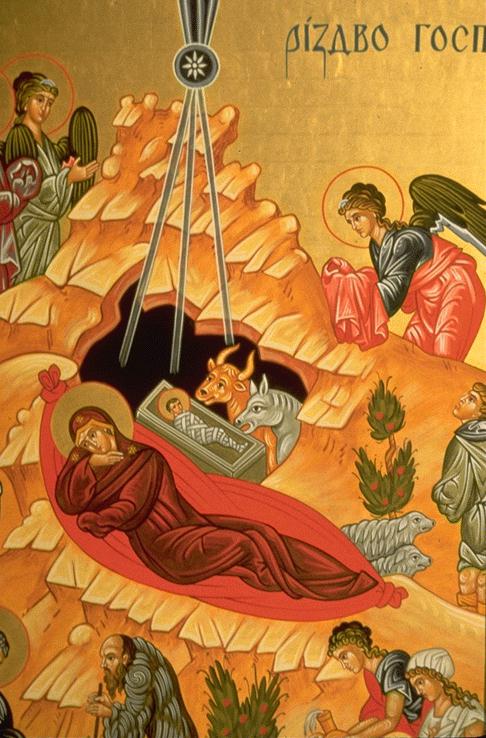
My daughter -- the elder, of course -- has been making connections left and right as of late between characters in, say the icon of the Nativity of our Lord and the standard icons in our iglesia pequeña ("little church," what we call our icon corner, though the Fathers speak of the household itself time and again as such). We're also blessed with a priest who has taken her up to blow candles out in front of the iconostasis at the end of every service my daughter attends and, in so doing, has given her a catechism of sorts using the icons up there.
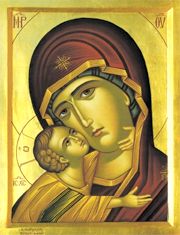
I was pleasantly surprised when, after noticing the icon of "bebé Jesús" on the screen (Fr. Stephen Freeman's site was up at the time), she asked to see "Gran Papá Jesús" (which is not "Grandpa Jesus," but rather "Big Daddy Jesus" or "Grown Up Jesus" -- think Three Bears). We scrolled down until we saw the icon there to your right; she pointed to the IC and said, "Dat say ... DJesus ... Keist," referring of course to the IC meaning IECOUC, or Jesus, and the XC on the other side meaning XPICTOC, or Christ. The icon, then, is already doing for her what it's always done: catechizing the illiterate in the gospel--giving them in colorful mosaic the proper portrait of the King that St. Irenaeus said the tradition of the Church would proclaim to the faithful, both through written gospel narrative and through worship and icon.

In a post a few years back, I talked about how icons can be approached coldly and intellectually, as well as worshipfully and spiritually, with radically different effects. The former, if the sole method of inquiry as to the riches of holy images, leads to an academic dead-end of arguing over minutae and intellectual burn-out. The latter, thankfully, can both be coupled with the former (leading to the cultivation of a multi-faceted and rich spiritual life seen in many of our seminaries, parishes, and monasteries) and stand alone (leading to the reason why our faith has been, for hundreds of years, the faith of countless illiterate peasants to whose piety I aspire). I have been progressing further through that train of thought--mostly thanks to the fact that I now have a two year-old to whom I must attempt, falteringly, to explain what Rich Mullins called "what is too good to be real, yet is more real than the air [she breathes]." Rather than begin at the christological, incarnational justifications for icons--though those are important--it's been more important to me that I kiss these icons because they're depictions of people I love. These are members of a community that will save me if I let them. That I can do something, physcially, that will allow me to express this love for them is gratifying. God grant also a heart that would live in a manner so that the love expressed would be without hypocrisy. The Lord is at hand, after all, and no where is this more apparent than in the holy icons.

Father Thomas Hopko, in his recent release "Praying with Icons," says that icons are a presence of the mighty works of God that are depicted therein. Whether it be the icon of the Nativity, Theophany, St. Nicholas, the Theotokos, or Christ Himself, icons stand as a visible reminder of the invisible reality in which we as believers find ourselves: that of baptized, sealed believers who, though we live in this visible world, are not limited to the seen, as we are by virtue of our baptisms and chrismations citizens of the invisible lasting City, wherein our worship actually takes place. While we don't "need" icons to pray--anyone truly seeking God can be said to be praying--for us as believers who've been initiated into the reality of God's mystical union with His Church, icons are necessary for prayer in its fullness, since all the universe, beginning with the flesh of Christ Himself, has been "shod with the grandeur of God," and it is in these images that we see created things proclaiming what all matter should proclaim and what even the rocks would proclaim if we were silent: that God has visited His people and has done great things for us, and holy is His Name.


All sorts of people are attempting to "get in touch" with nature these days, from the secular environmentalists to neo-pagan tree-worshippers. While both groups seem to think that there's some need to listen to what nature is saying, the former only hears its own voice echoing back to it, as it sees mankind (rightly) as part of the creation, yet sees that creation as the sum total of existence and, therefore, no more or less important than human beings. The second tends to go a little deeper and, while it does acknowledge hidden rooms in this "one-story universe" (to use Fr. Stephen's terminology), the hidden glory behind nature is a false one, for its impersonal, collective spirit (shared also by humanity) bears no witness to an actual Creator, a Source of all being. Icons do what all Creation used to do and one day will do: declare the glory of God in all its fullness, a glory which even now shines not etherially from some intangible source, but from the corporeal face of the Word of the Creator (2 Cor. 4:6).

Thursday, July 19, 2007

Blinking at Trees

G.K. Chesterton in his book Orthodoxy: The Romance of Faith spoke of those men who had been thoroughly convinced of what they believed in--and contrasted them with those who were only nominally convinced of the same--thusly:

"It is very hard for a man to defend anything of which he is entirely convinced. It is comparatively easy when he is only partially convinced. He is partially convinced because he has found this or that proof of the thing, and he can expound it. But a man is not really convinced of a philosophic theory when he finds that something proves it. He is only really convinced when he finds that everything proves it. And the more converging reasons he finds pointing to this conviction, the more bewildered he is if asked suddenly to sum them up. Thus, if one asked an ordinary intelligent man, on the spur of the moment, 'Why do you prefer civilization to savagery?' he would look wildly round at object after object, and would only be able to answer vaguely, 'Why, there is that bookcase . . . and the coals in the coal-scuttle . . . and pianos . . . and policemen.' The whole case for civilization is that the case for it is complex."

And so it is with Orthodoxy (big O) now that many paths, many inroads into my life have been made from various starting points (epistemology, aesthetics, work ethic, stewardship, sensory input, intellectual, emotional, and others). I believe that, were you to ask me "Why do you prefer Orthodoxy to Evangelicalism?" I would, in all honesty, have a hard time determining where to start my answer. Perhaps with the question, "How much time to you have?"

This was not the case in the beginning.

When I wrote the conversion story that's linked over in the sidebar, I wrote primarily about a group of particular theological issues that, due to a consensus concerning them in the Apostolic Fathers, I claimed as my basic reason for rejecting Protestantism and embracing Eastern Orthodoxy. If asked, I could (and would, and at the slightest provocation still do) prattle on about things like the early Church's treatment of the Eucharistic bread and wine as nothing less and nothing other than the Body and Blood of Christ Himself, made somehow mystically present in spite of the retention of the properties of bread and wine . . . the ability to trace one's bishop's ordination to one of the apostles as a hallmark of orthodoxy . . . salvation's being something that could be begun and thereafter lost . . . the practice of baptizing infants and seeing said moment as the moment wherein one is born again . . . Scripture's being by far the greatest influence on the Fathers' teachings yet not as a sole rule of faith and thus accompanied by oral traditions which encompassed (mainly) issues of how to worship, etc . . . the divinization of man through theosis and Incarnational theology . . . and so on . . .

I think it's fair to say, then, that my initial conversion, while hinging on a very real paradigm shift regarding several key theological issues within the context of my faith, nevertheless reflected something of a shallow artificiality for a while -- I look at those days as one would a newly-bound branch that's still held on to a tree through inorganic, unnatural means, without which support the branch would simply fall off. I think I converted, at least in part and temporarily, because I felt I had to based on theological arguments that had, to be honest, blindsided me. I was thus left in a limbo of sorts, wherein I had a place I knew I couldn’t be, but no place I could call my soul’s home. I had not been looking for or even desiring Orthodoxy specifically, and--again, honestly--when first confronted with the vast experience thereof in worship, neither recognized it nor desired it at all, finally converting more out of obligation and commitment to intellectual honesty (which, I realize, is admirable, albeit incomplete) than out of real desire for Orthodoxy as the life of God, as the Kingdom of Heaven. I liken the subsequent years of feeling Orthodoxy as the true life in Christ seep into me to that of a blind man receiving his sight all of a sudden, then being at a loss to describe what has been laid out before him, much less to be able to recognize the vision as beautiful and be thankful for it, blinking and squinting as he is for the first several moments.

Irenaeus said that the Faith is like a great mosaic of the King, and a heretic is not necessarily he who will take tiles from the mosaic and discard them; a heretic could be someone who simply takes all existing pieces and rearranges them into the image of a dog. When a man converts to what he sees as original, apostolic Christianity, it behooves him not only to recognize that not only must he regard the image of a King rather than that of a dog, but he must also learn to prefer the King to the dog—-no, moreover, he must learn to love the King through His proper image. I would dare say that this is the much more difficult step. It’s one thing for a man to embrace a faith because he’s aware that “the tiles just line up” in such and such a way; it’s another thing entirely to embrace said faith because he has stepped back, taken in the full image of the faith as newly presented icon, and been struck by the beauty of the scene. A man may convert out of obligation, out of commitment to correctness—-and anyone who converts to anything ought first to make sure he is regarding the proper image-—but there’s also a moment, or should be, wherein the man is taken in by a part other than his mind or his reason; said man has been caught by the Bridegroom Lover Whom he suddenly notices for the first time in this different way. Ask a man to tell you why he's in love; if he's really in love, he'll ask you how you could look at his beloved and not be. We have moved from the mind of logic to the eyes and heart of desire, and this latter is what must complete the former.

It is one thing to affirm the doctrine of the Incarnation; it is another to listen to the prayers blessing a little one whose infancy has been blessed by the Creator’s infancy and, weeping, rejoice. It is one thing to acknowledge the uniform shape of liturgical worship in the first decades of Christianity; it is quite another to stand in Divine Liturgy and awaken to the notion that you are standing in the Court of the King, and that with you in that Court are Daniel, Isaiah, Ezekiel, and St. John the Theologian and Evangelist, writing down what they're seeing in that Eternal Now.

A prominent Evangelical theologian has stated recently (and, most likely, often before that) that there is no uniform consensus in the fathers regarding any doctrine whatsoever except for -- possibly -- monotheism, and thus we are free to parse apart the Scriptures and bring them together in whatever way we feel makes more sense. I cannot imagine the micromanaging of the Fathers that must occur for someone to come to such a conclusion, but all I can say to that is that I have been convinced otherwise, both by the fact that the pieces of the Christian Mosaic do fit together in a way altogether foreign to the Reformers, and that the Church of the first few centuries agrees on and reveres the beauty within said arrangement. As much as I might jerk back to a "what about...?" reaction regarding a particular verse or what not, I have to ask myself why a tree should feel itself worthy to overrule its overall context within its forest. Christ may tell us that we are given to Him by the Father, but we are then told to choose Him and remain in Him. We are assured of our Father's love for us in Christ, yet we are warned against falling away from Him. We hear that God is not a man, nor is He like us, yet we hear of His rejoicing and His anger. As much as I might wonder about certain passages, what I've seen so far of the puzzle matches the front of the box, and that image, caressed by two thousand years of faithful lips, has taken me in. God grant I stay enthralled.

Why all this talk of knowing and loving what or Whom one studies? Why must we move from theological grocery lists to personal, breathing, penetrating Life? In essence, the latter allows us to bear witness as person, instead of as a litany of reasons. We thus become our witness, we embody that which God wills us to be, and thus provide "all things" within ourselves to all people through all the various facets of being a complete, Orthodox person rather than just a well-read answerman operating solely on the level of the mind.

Wednesday, July 11, 2007

Namings

Father came over on Wednesday and performed the short (and I do mean short, even for non-Orthodox...as in, say, five to ten minutes!) service of the signing and naming of the child. Orthodoxy is stone-cold sober when it comes to our spirituality, but both mother and father of the now-named Katherine Ruth couldn't help but tear up at the prayer given by Father, as this is our heart for both our daughters:
"O Lord our God, we entreat You, and we supplicate You, that the light of Your countenance be signed on this, Your handmaid, Katherine, and that the Cross of Your Only-begotten Son be signed in her heart and understanding, so that she may flee from the vanity of the world and from every evil snare of the enemy, and may follow after Your commandments. And grant, O Lord, that Your holy name may remain unrejected by her, and that, in due time, she may be joined to Your Holy Church, and that she may be perfected by the dread Mysteries of Your Christ, so that, having lived according to Your commandments, and having preserved the seal unbroken, she may receive the blessedness of the elect in Your kingdom: By the grace and love for mankind of Your Only-begotten Son, with Whom You are blessed, together with Your Most-holy, Good and Life-giving Spirit, now and ever, and unto ages of ages. Amen."
Anyone looking for an explanation of why we do this on the eighth day, as well as the basis for the naming ceremony in the first place should read this, from a site under the Church of Greece.

We were also blessed--and surprised!--to receive an icon of Ruth from a fellow parishioner! This beautiful icon was painted by a Father David in Seattle, and is a timely gift, since we were wondering when/how to purchase an icon of Kati's middle-name saint. This lovely icon--painted in a material I can't place--now hangs above her crib.

The service was attended by our parents, none of whom are Orthodox, so it was a bit awkward, but all were, as expected, very respectful. A good opportunity to bear witness to the very last thing most folks would consider "mere Christianity" yet which we would (in our best moments as converts) fit right into...

It's strange--sometimes I catch myself wondering how I wound up here..."What a long, strange trip it's been" and all that. Surely I never would have placed myself here if I had at all been in control of it or gone where I'd have immediately chosen to go...so I wonder, if I--being familiar with the services, the prayer life, the, well, the being Orthodox--have these moments, what must our parents have been thinking, feeling? Were they wondering where they went wrong? What they could have done differently? What the odds were that two similarly "odd" young people would find each other and go off together into this bizarre faith?

A poem I wrote in college during my catechumenate comes back to me now (I'm amazed I still have it). If you'll indulge me and--those who are better poets than I--forgive my probable triteness...

Orthodoxy

You don’t u n d o t w e n t y y e a r s
in one.


This fabric’s a complex, recent weave
with new materials
new fabrics
new patterns
new threads coming in

Some of those already woven in no longer fit,
but stretch
and bulge
and some just break clean off.

They must be disentangled
(careful, now)
by hands that fear the unraveling of it all.

This will not be done in a year, or ten.

No,
I will ever be surprised
(and often frightened)
by the patterns that appear
(and disappear)
throughout the years.

But,
Even when I cease
to weave these earthen tones and,
Weaver willing,
move to patterns everlasting,

I shall still be weaving.

*****

Yes, there're lots of names being called, and it's not only limited to that of our newborn. We call on the name of the Lord, that Name that shines forth from those eternally present icons of the River Jordan. The name of He Who has brought us here, for reasons we most likely can't even fathom yet. We call on Him, having taken names ourselves of ones who now are, by God's presence, what God is by His very nature. Their glory--and our hope!--is Christ in them, causing their souls to shine as sunlight even as they wait for what Rich Mullins has described as "skin as clear as the stained glass panels that make their skin, and [we] will shine like they do now...." should we keep that Name on our lips to the end, should we live up to those names called over us at our baptisms, those names called over us by our Lord and His holy ones as we approach His Cup...