Thursday, July 19, 2007

Blinking at Trees

G.K. Chesterton in his book Orthodoxy: The Romance of Faith spoke of those men who had been thoroughly convinced of what they believed in--and contrasted them with those who were only nominally convinced of the same--thusly:

"It is very hard for a man to defend anything of which he is entirely convinced. It is comparatively easy when he is only partially convinced. He is partially convinced because he has found this or that proof of the thing, and he can expound it. But a man is not really convinced of a philosophic theory when he finds that something proves it. He is only really convinced when he finds that everything proves it. And the more converging reasons he finds pointing to this conviction, the more bewildered he is if asked suddenly to sum them up. Thus, if one asked an ordinary intelligent man, on the spur of the moment, 'Why do you prefer civilization to savagery?' he would look wildly round at object after object, and would only be able to answer vaguely, 'Why, there is that bookcase . . . and the coals in the coal-scuttle . . . and pianos . . . and policemen.' The whole case for civilization is that the case for it is complex."

And so it is with Orthodoxy (big O) now that many paths, many inroads into my life have been made from various starting points (epistemology, aesthetics, work ethic, stewardship, sensory input, intellectual, emotional, and others). I believe that, were you to ask me "Why do you prefer Orthodoxy to Evangelicalism?" I would, in all honesty, have a hard time determining where to start my answer. Perhaps with the question, "How much time to you have?"

This was not the case in the beginning.
When I wrote the conversion story that's linked over in the sidebar, I wrote primarily about a group of particular theological issues that, due to a consensus concerning them in the Apostolic Fathers, I claimed as my basic reason for rejecting Protestantism and embracing Eastern Orthodoxy. If asked, I could (and would, and at the slightest provocation still do) prattle on about things like the early Church's treatment of the Eucharistic bread and wine as nothing less and nothing other than the Body and Blood of Christ Himself, made somehow mystically present in spite of the retention of the properties of bread and wine . . . the ability to trace one's bishop's ordination to one of the apostles as a hallmark of orthodoxy . . . salvation's being something that could be begun and thereafter lost . . . the practice of baptizing infants and seeing said moment as the moment wherein one is born again . . . Scripture's being by far the greatest influence on the Fathers' teachings yet not as a sole rule of faith and thus accompanied by oral traditions which encompassed (mainly) issues of how to worship, etc . . . the divinization of man through theosis and Incarnational theology . . . and so on . . .

I think it's fair to say, then, that my initial conversion, while hinging on a very real paradigm shift regarding several key theological issues within the context of my faith, nevertheless reflected something of a shallow artificiality for a while -- I look at those days as one would a newly-bound branch that's still held on to a tree through inorganic, unnatural means, without which support the branch would simply fall off. I think I converted, at least in part and temporarily, because I felt I had to based on theological arguments that had, to be honest, blindsided me. I was thus left in a limbo of sorts, wherein I had a place I knew I couldn’t be, but no place I could call my soul’s home. I had not been looking for or even desiring Orthodoxy specifically, and--again, honestly--when first confronted with the vast experience thereof in worship, neither recognized it nor desired it at all, finally converting more out of obligation and commitment to intellectual honesty (which, I realize, is admirable, albeit incomplete) than out of real desire for Orthodoxy as the life of God, as the Kingdom of Heaven. I liken the subsequent years of feeling Orthodoxy as the true life in Christ seep into me to that of a blind man receiving his sight all of a sudden, then being at a loss to describe what has been laid out before him, much less to be able to recognize the vision as beautiful and be thankful for it, blinking and squinting as he is for the first several moments.

Irenaeus said that the Faith is like a great mosaic of the King, and a heretic is not necessarily he who will take tiles from the mosaic and discard them; a heretic could be someone who simply takes all existing pieces and rearranges them into the image of a dog. When a man converts to what he sees as original, apostolic Christianity, it behooves him not only to recognize that not only must he regard the image of a King rather than that of a dog, but he must also learn to prefer the King to the dog—-no, moreover, he must learn to love the King through His proper image. I would dare say that this is the much more difficult step. It’s one thing for a man to embrace a faith because he’s aware that “the tiles just line up” in such and such a way; it’s another thing entirely to embrace said faith because he has stepped back, taken in the full image of the faith as newly presented icon, and been struck by the beauty of the scene. A man may convert out of obligation, out of commitment to correctness—-and anyone who converts to anything ought first to make sure he is regarding the proper image-—but there’s also a moment, or should be, wherein the man is taken in by a part other than his mind or his reason; said man has been caught by the Bridegroom Lover Whom he suddenly notices for the first time in this different way. Ask a man to tell you why he's in love; if he's really in love, he'll ask you how you could look at his beloved and not be. We have moved from the mind of logic to the eyes and heart of desire, and this latter is what must complete the former.
It is one thing to affirm the doctrine of the Incarnation; it is another to listen to the prayers blessing a little one whose infancy has been blessed by the Creator’s infancy and, weeping, rejoice. It is one thing to acknowledge the uniform shape of liturgical worship in the first decades of Christianity; it is quite another to stand in Divine Liturgy and awaken to the notion that you are standing in the Court of the King, and that with you in that Court are Daniel, Isaiah, Ezekiel, and St. John the Theologian and Evangelist, writing down what they're seeing in that Eternal Now.

A prominent Evangelical theologian has stated recently (and, most likely, often before that) that there is no uniform consensus in the fathers regarding any doctrine whatsoever except for -- possibly -- monotheism, and thus we are free to parse apart the Scriptures and bring them together in whatever way we feel makes more sense. I cannot imagine the micromanaging of the Fathers that must occur for someone to come to such a conclusion, but all I can say to that is that I have been convinced otherwise, both by the fact that the pieces of the Christian Mosaic do fit together in a way altogether foreign to the Reformers, and that the Church of the first few centuries agrees on and reveres the beauty within said arrangement. As much as I might jerk back to a "what about...?" reaction regarding a particular verse or what not, I have to ask myself why a tree should feel itself worthy to overrule its overall context within its forest. Christ may tell us that we are given to Him by the Father, but we are then told to choose Him and remain in Him. We are assured of our Father's love for us in Christ, yet we are warned against falling away from Him. We hear that God is not a man, nor is He like us, yet we hear of His rejoicing and His anger. As much as I might wonder about certain passages, what I've seen so far of the puzzle matches the front of the box, and that image, caressed by two thousand years of faithful lips, has taken me in. God grant I stay enthralled.

Why all this talk of knowing and loving what or Whom one studies? Why must we move from theological grocery lists to personal, breathing, penetrating Life? In essence, the latter allows us to bear witness as person, instead of as a litany of reasons. We thus become our witness, we embody that which God wills us to be, and thus provide "all things" within ourselves to all people through all the various facets of being a complete, Orthodox person rather than just a well-read answerman operating solely on the level of the mind.

How Texan I Am

Hat tip (of a ten-gallon, apparently) to Alan for this:

You Are 76% Texas

Well, knock me down and steal muh teeth! You're pretty darn Texan.

Wednesday, July 11, 2007

Namings

Father came over on Wednesday and performed the short (and I do mean short, even for non-Orthodox...as in, say, five to ten minutes!) service of the signing and naming of the child. Orthodoxy is stone-cold sober when it comes to our spirituality, but both mother and father of the now-named Katherine Ruth couldn't help but tear up at the prayer given by Father, as this is our heart for both our daughters:
"O Lord our God, we entreat You, and we supplicate You, that the light of Your countenance be signed on this, Your handmaid, Katherine, and that the Cross of Your Only-begotten Son be signed in her heart and understanding, so that she may flee from the vanity of the world and from every evil snare of the enemy, and may follow after Your commandments. And grant, O Lord, that Your holy name may remain unrejected by her, and that, in due time, she may be joined to Your Holy Church, and that she may be perfected by the dread Mysteries of Your Christ, so that, having lived according to Your commandments, and having preserved the seal unbroken, she may receive the blessedness of the elect in Your kingdom: By the grace and love for mankind of Your Only-begotten Son, with Whom You are blessed, together with Your Most-holy, Good and Life-giving Spirit, now and ever, and unto ages of ages. Amen."
Anyone looking for an explanation of why we do this on the eighth day, as well as the basis for the naming ceremony in the first place should read this, from a site under the Church of Greece.

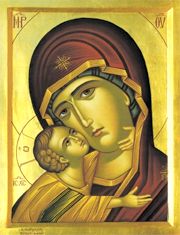
We were also blessed--and surprised!--to receive an icon of Ruth from a fellow parishioner! This beautiful icon was painted by a Father David in Seattle, and is a timely gift, since we were wondering when/how to purchase an icon of Kati's middle-name saint. This lovely icon--painted in a material I can't place--now hangs above her crib.

The service was attended by our parents, none of whom are Orthodox, so it was a bit awkward, but all were, as expected, very respectful. A good opportunity to bear witness to the very last thing most folks would consider "mere Christianity" yet which we would (in our best moments as converts) fit right into...

It's strange--sometimes I catch myself wondering how I wound up here..."What a long, strange trip it's been" and all that. Surely I never would have placed myself here if I had at all been in control of it or gone where I'd have immediately chosen to go...so I wonder, if I--being familiar with the services, the prayer life, the, well, the being Orthodox--have these moments, what must our parents have been thinking, feeling? Were they wondering where they went wrong? What they could have done differently? What the odds were that two similarly "odd" young people would find each other and go off together into this bizarre faith?

A poem I wrote in college during my catechumenate comes back to me now (I'm amazed I still have it). If you'll indulge me and--those who are better poets than I--forgive my probable triteness...

Orthodoxy

You don’t u n d o t w e n t y y e a r s
in one.


This fabric’s a complex, recent weave
with new materials
new fabrics
new patterns
new threads coming in

Some of those already woven in no longer fit,
but stretch
and bulge
and some just break clean off.

They must be disentangled
(careful, now)
by hands that fear the unraveling of it all.

This will not be done in a year, or ten.

No,
I will ever be surprised
(and often frightened)
by the patterns that appear
(and disappear)
throughout the years.

But,
Even when I cease
to weave these earthen tones and,
Weaver willing,
move to patterns everlasting,

I shall still be weaving.

*****

Yes, there're lots of names being called, and it's not only limited to that of our newborn. We call on the name of the Lord, that Name that shines forth from those eternally present icons of the River Jordan. The name of He Who has brought us here, for reasons we most likely can't even fathom yet. We call on Him, having taken names ourselves of ones who now are, by God's presence, what God is by His very nature. Their glory--and our hope!--is Christ in them, causing their souls to shine as sunlight even as they wait for what Rich Mullins has described as "skin as clear as the stained glass panels that make their skin, and [we] will shine like they do now...." should we keep that Name on our lips to the end, should we live up to those names called over us at our baptisms, those names called over us by our Lord and His holy ones as we approach His Cup...

Sunday, July 08, 2007

Holy Noise, Kiddo Blessings, and Liturgical Gripes

Life has been good the past few days. Much illumined. It's interesting that such a momentous occasion, such a significant shift in our life should feel so organic, so natural, as if our family could be no other way. I remember the days before Katherine's birth, of course, but it seems to be a mere cerebral memory, no longer connected to the earthy, organic communion that overwhelms and establishes as normal. The moment our little one began to cry, having been pulled from the womb of my beloved, we moved seamlessly from three to four...

But of course we are four, my whole body tells me; how could we be anything else?

The four of us, then, begin to harmonize, with cries and songs and very peculiar mealtime blessings all converging at once. For example, our two year-old now asks the blessing (in the way only super-sincere two year-olds can do) in the name of the "Fahduur, Shun, an' Hody Britches." She then says, "Tank 'oo, Gaaad, for corn, milk, an' mokey cheez" (that last one was "macaroni and cheese," for those of you without toddlers). New, also, is the Texas twang showing up in her speech; her toddler independence demands that she tells us "No, I'm going to do it"; it comes out, however, (and here you'll have to superimpose your idea of a Texas accent on it) as, "No, m'DOOO 'nit!" Ask her, "Sweetheart, y'done with dinner?" and you'll get a "Yup." Tell her to bring something to you, and you'll hear an "Oh-kiiiie." (rhymes with "pie.")

Imagine all that, punctuated by the beautiful, bleating cries of our newborn, and you'll have an idea of the joyful cacophony that fills our house. Fr. Stephen has a recent post about real communion that is worth the read; the above is our communion w/each other, and I'm so grateful for it.

Now, not to put a damper on all the above gushing--I really don't have a dog in this particular fight, though we did just make the news regarding similar liturgical "atrocities"--but I am quite baffled as to the outrage things like this provoke:
Pope's easing on Latin rites sparks outcry

"Jewish leaders and community groups criticised Pope Benedict XVI strongly yesterday after the head of the Roman Catholic Church formally removed restrictions on celebrating an old form of the Latin Mass which includes prayers calling for the Jews to 'be delivered from their darkness' and converted to Catholicism...the older rite's prayers calling on God to 'lift the veil from the eyes' of the Jews and end 'the blindness of that people so that they may acknowledge the light of your truth, which is Christ' have sparked outrage. 'We are extremely disappointed and deeply offended that nearly 40 years after the Vatican rightly removed insulting anti-Jewish language from the Good Friday Mass, it would now permit Catholics to utter such hurtful and insulting words by praying for Jews to be converted,' said Abraham Foxman, the [Anti-Defamation League]'s national director, in Rome."
How horrible...prayer, of all things, by members of a particular religious group, which correspond to the beliefs of that particular group, for the voluntary conversion of a certain group of people...never mind the spirit in which it was given...Κυριε, ελεησον ημας....

(Read the whole article here.)

Hope y'all had a great Lord's Day.

Tuesday, July 03, 2007

Heeeeere's Kati! (Updated Again)

UPDATE #2: YOU CAN SEE PHOTOS DONE BY THE HOSPITAL HERE, AND YOU CAN SIGN HER GUESTBOOK HERE

UPDATE: PICTURES HAVE BEEN MOVED TO KATHERINE'S PHOTO GALLERY

May I introduce to you our lovely daughter, Katherine Ruth! 23.5 hours after arriving at the hospital, we became a (larger) family with the arrival of this little stinker. Perfect so far. Audra spent most of yesterday trying to dilate enough - they broke her water around 6:30, with an epidural shortly thereafter, which got her to the point where she was ready to deliver.
As Hope had been a C-section, we had wanted to try, if at all possible, to have Kati normally. Audra went to ten and pushed for about five minutes, when it became apparent that it was causing too much distress on the baby (like her big sister, Kati wouldn't fit). So a C-section was called for, and at 4:30 am she drew her first breaths!
She's eight pounds, even, 21.5 inches long, and, as you can see, pretty dang cute! We're thrilled to have the ordeal behind us, and thankful to God for His blessing.

And now, if y'all will excuse me, I'm going to sleep!

Monday, July 02, 2007

Brief Update on Delivery

I'm out running errands while Audra and her mother are at the L and D room; she's labored all day and they've only just now broken her water, so we'll be there all night. She called for an epidural right before I left. Lord willing, either late tonight or early tomorrow morning, Katherine Ruth will be here. Continue praying, please.

Friday, June 29, 2007

Prayers, A Plug, and a Feast Day...

...for my wife, who will (Lord willin' and nothing happens before then), be induced on Monday morning, July 2nd, to give birth to our second daughter, Katherine Ruth.

Thank you.

UPDATE (hence the title change): While wanting to keep the above prayer request at the top of the blog throughout the weekend, I also wanted to direct attention to the (very long) post directly underneath which I've just finished. Forgive any shortcomings in my words.

Thirdly: Happy Feast Day! (Lives) (Hymns)

Monday, June 25, 2007

Αδης / Γεεννα, The Second Coming, and Prayer for the Departed

For those of you who haven't already done so, I recommend that you start browsing the explosion of podcasts that has taken place over at Ancient Faith Radio as of late. I've particularly enjoyed a series of podcasts (recently concluded) by Dr. Clark Carlton on the Orthodox view of the afterlife, the end of all things, and prayer for the departed in light of the Last Judgment. This endorsement of Dr. Carlton may surprise some who read this blog, as they might remember that I've been turned off on past occasions by his at times dismissive approach to intelligent critiques from Evangelicals, but I think he does a good and honest job of putting forth the position of the Church on these subjects. You can hear the four podcasts here, here, here, and here. For those of you who are more the reading type than the listening type, however, I offer what I hope amounts to the main content of those four podcasts here, intertwined with my own comments, thoughts, and experiences.

Why pray for those who've already died? The question is brought up whenever we interact with folks from Protestant traditions and, I must say, was one of the first and most obvious issues I had to confront. I say "obvious" because, in reading the writings of the Church Fathers during the Roman persecutions, I was struck both by the number of references to an intermediate state of the dead as well as the detail given to the nature(s) of said state. My upbringing was one where, when a person died, they either went to live forever with Christ in perfect bliss in Heaven, or to die forever in the flames of Hell in utter agony. This idea of a "holding pattern" or "waiting period" was utterly unknown to me, so when I heard of a distinction between the two Greek words αδης (hereafter "Hades") and γεεννα (hereafter "Gehenna") which was based on a view of things which had at its center the Second Coming and Last Judgment, I was very intrigued, and not a little disturbed. Indeed, Dr. Carlton says, those two terms were made completely interchangeable by the time of the Medieval Period in the West. Hades was (rightly) seen as a place of punishment and torment, as was Gehenna, so both words were translated as "Hell" (this is also the unfortunate case in many of our liturgical translations in Orthodox parishes in the West). Rather, our understanding was that Hades referred to the state of the dead prior to the last Judgment, where those united to Christ began to feel the joy of God's presence, and the damned began to feel the dread and pain of their coming doom, yet neither group of people was understood to be in their "final place" precisely because the Last Judgment had not yet taken place. Said final place for the damned was what was called "Gehenna," or the lake of fire. Put simply, it is for this reason--that the dead are now in Hades, and not yet in Gehenna--that we pray for the dead.

Questions immediately arise at this point: Why would we pray for the dead if those in Hades already feel their inevitable doom? What difference would it make if those in the West (e.g. Tertullian, Cyprian) began early on to apply punishment to Hades if those therein already felt the effects of their sealed fate? Wouldn't the dead in Hades only have the inevitable delayed for a bit instead of thrust upon them, and therefore wouldn't prayer for the dead still be useless and (more importantly) a slap in the face of God's sovereignty in light of their fixed destiny?

Dr. Carlton waits until the fourth podcast to say this, but I think it bears saying outright: this life is the period given to us for repentance; postmortem repentance is not scriptural according to the Fathers. However, we do not rule out the possibility of a change of the state of a soul in Hades because a change could take place there based on events that happened in his/her life on Earth. Father Thomas Hopko has recently commented on predestination on the most recent broadcast of the Illumined Heart, saying that, yes, God foreknows and predestines some to be saved and others damned, but it is a predestination that is done from outside time, whose completion is, in a sense, already done (for God sees the whole span of time), and is a predestination that we, to a degree, influence now with our own prayers and actions, time-bound though they be. The same, he has said elsewhere, applies to our prayers for those in Hades. Our prayers for them are simply for God to do what He will do with them--for He sees what will/has become of them already--and we ask Him to comfort them, in whatever state they're in, knowing that our prayers in this life do reverberate in the eternal. In a nutshell, Dr. Carlton says that the so-called "problem" with prayer for the dead is the exact same "problem" some people have with prayer for the living: If God has already planned out His divine will in this world which He will bring to pass regardless of humanity's actions, what is the purpose of praying for the salvation of individual people or humanity in general? Are we asking God to override a man's free will? Are we asking Him to "change His mind" regarding what He has planned for us? Certainly not, and neither are we asking Him to do any such thing for souls in Hades.

We are, however, following the injunction of the apostles to pray, regardless of the outcome, for all members of the Body of Christ, which we believe are united one to another, even in spite of death. The connection of the people of God across the barrier of death is seen as being passable in the Old Testament (certain endings of Jeremiah show him praying for the people of Israel, and Judas Maccabeus prays "because of the Resurrection of the Dead" for the souls of possibly idolatrous fallen soldiers), after which it is expanded upon in the New Testament (Revelation shows angels and elders carrying the prayers of Christians on earth before the throne of God, and St. Paul, praying for comfort for the household of Onesiphorus, a man he references only in the past tense, asks that God might grant this possibly departed soul "mercy...in that Day" of Judgment (2 Tim 1:18)). While St. Paul's reference is definitely inconclusive--Onesiphorus could very well still have been in this life when St. Paul wrote--we need look no further into the patristic era than the martyrdom of one of the great Apostolic Fathers, Ignatius of Antioch, for confirmation that this belief was accepted and practiced in the early Church, for the account of his martyrdom shows him appearing to his flock, post-martyrdom, "embracing [and] praying for [them], and...dropping with sweat, as if he had just come from his great labor, and standing by the Lord." In spite of the firm belief that this life is the one given to us for repentance, the Church has never felt any contradiction in praying for those who await the second coming from beyond the grave.

Why do we insist on an intermediate state of the Dead if the departed are outside time? Would it not be redundant to speak of a "waiting" period? Are we not contradicting ourselves here? We have, however, a hint in Revelation 6 of the "timeless waiting" spoken of by Father Tom. St. John writes:
"I saw under the altar the souls of those who had been slain because of the word of God and the testimony they had maintained. They called out in a loud voice, 'How long, Sovereign Lord, holy and true, until you judge the inhabitants of the earth and avenge our blood?' Then each of them was given a white robe, and they were told to wait a little longer, until the number of their fellow servants and brothers who were to be killed as they had been was completed."
Even though those martyrs are in the presence of the Lord--among the righteous dead--they are clearly not in a state of final bliss, for they are painfully aware of the fact that judgment has yet to be exacted on the unrighteous. More than that, they petition the Lord to act on behalf of those who still remain on earth. This is, to us, a beautiful example of the communion of the saints that not even the cruelest of deaths--that of a martyr--can sever.

Why not just have an instantaneous meting out of rewards and punishment, of salvation and damnation, right at the moment of death? We would say that, were this to happen, such a system would have no need of a resurrection of the body, nor of a Last Judgment; to said way of thinking, all the judging that would need to be done would have already been done at the moment of the separation of soul and body. This is an immensely troubling problem for the Orthodox, as any attempt to portray the separation of soul and body as "natural," desirable, or anything other than horrible and "the last enemy" of mankind (1 Cor. 15:26) amounts to a denial of the significance of the Logos' incarnation. There must be an intermediate state of the dead prior to the General Resurrection, because that Resurrection and subsequent Judgment is the consummation not only of Christ's Incarnation as the God-Man, but of the creation of the whole Cosmos.

God, it must be said, created the world with the Incarnation in mind. Knowing that man would separate himself from the Source of all Life, thus bringing death upon him as a natural consequence of his freely chosen action (rather than as a punishment from an offended God), the Holy Trinity saw from before man's creation that the only way for man to be truly united to Them would be to send the Son to become one of mankind and, thus, all humanity. We say in the Creed that He was made "anthropos", or human, not just "male" or "a man". This affirmation of the intrinsic goodness of the psychosomatic union that is a living human being is the very thing that is affronted by the appalling mockery that is death, for it seeks to put asunder the very thing that God joined together and, indeed, appears to do so to one not looking through eyes of faith. For us, to say that upon the dissolution of this union of soul and body a person immediately receives his eternal reward (thus making permanent said separation) is tantamount to saying that a human soul can be everything he was created to be without his body. Most religions treat death as this very thing: a "liberation" of sorts from this "fleshy prison" that flies the soul off to incorporeal, Ideal parts unknown and, perhaps unwittingly, consigns this current existence to an unfortunate "halfway house" we must endure before being granted the reward of "real life"--that is, "the life beyond."

In his book, O Death, Where is Thy Sting? Father Alexander Schmemann calls the above heresy on the carpet, saying that "Christianity is not concerned about coming to terms with death, but rather with the victory over it." Furthermore, he continues:
"When Christianity speaks of the resurrection of the body, it does not speak about the vivification of bones and muscles, for bones and muscles and the whole material world, its whole fabric, is nothing more than certain basic elements, in the end--atoms. And in them there is nothing specifically personal, nothing eternally mine.

"Christianity speaks about the restoration of life as communion, it speaks about the spiritual body that over the course of our whole life we have developed through love, through our pursuits, through our relationships, through our coming out of ourselves. It speaks not about the eternity of matter, but about its final spiritualization; about the world that finally becomes truly a body--the life and love of mankind; about the world that has become fully communion with life."
And it is because of the reality of this communion--established beyond time yet still to be consummated at the end of it--which we "remember" in our Sunday Liturgy, having ourselves been brought out of time and "Remembering...all those things that have come to pass for us: the cross, the tomb, the resurrection on the third day, the ascension into heaven, the sitting at the right hand of the Father, and the second and glorious coming," that allows us to add our prayers for the eternal memory of those already-departed souls whose destiny is eternally foreknown yet influenced by prayers from all ages and who are nonetheless joined together with us in the Eternal Now of the Kingdom.

Dr. Carlton recounts a story from the Desert Fathers in which Abba Macarius, upon finding a skull in the desert, inquires of the skull as to its identity. The skull answers that it was a pagan priest who is now in Hades, where all the souls in that very full place are tied back to back, so they cannot see one another. "However," the pagan priest continued, "when you pray for us, we begin to see each other just a little." Our prayer for those waiting for the Resurrection and Judgment asks that God grant them "memory eternal"--that is, that they not be lost to αδης, the land of forgetfulness where the Rich Man in the parable had no name, bur rather that they be sheltered in Abraham's bosom, in the presence of Abraham's Lord, remembered by God and all the righteous as was the beggar Lazarus--whose name was known even by the doomed Rich Man--in anticipation of the coming Day on which the last Enemy will be destroyed through a final, permanent reunion of souls and bodies and on which men will finally feel, in all its "reckless, raging fury," the Judgment of Love that will be the resolution of an existence-long dissonance for those who have loved His appearing, and the fire of γεεννα for all those who are yet determined to resist Him. Such a love, given as it is from an Incarnate Judge, can only be fully received, one way or another, by those in the flesh. Until the time of that universal reunion, however, we all wait--some under the altar, others yet in the arena of this life--still united by a Love stronger than death and (as Fr. Schmemann says) in "loving Christ, [loving] all those who are in Him" and "loving those who are in Him, [loving] Christ...it is truly our love in Christ that keeps [the departed] alive because it keeps them 'in Christ,'" that they might receive "times of refreshing from the presence of the Lord" (Acts 3:19) instead of "
everlasting destruction" from that same presence "and from the glory of His power" (2 Thess. 1:9).

May the souls, then, of all the faithful departed (+) rest in peace, and may light perpetual shine upon them--and upon us--until the Day when Christ Himself will be our Light.

Friday, June 22, 2007

HAHAHAHAHAHA...what???

This is Hope. Hope is silly. Hope likes to laugh REALLY loudly, then stop. We don't know why. But we thought this was really, really funny.

Thursday, June 21, 2007

Wednesday, June 20, 2007

The Jesus Prayer

Fr. Tom Hopko has said that there are people who are interested in the Jesus Prayer who are neither interested in Jesus nor prayer.

May we never trade in ends for means.


Lord Jesus Christ, Son of God, have mercy on me, the sinner.
Señor Jesucristo, Hijo de Dios, ten piedad de mí, el pecador.
Κύριε Ἰησοῦ Χριστέ, Υἱέ τοῦ Θεοῦ, ἐλέησόν με τὸν ἁμαρτωλόν.

Sunday, June 17, 2007

Love w/out Reaction, Condition

Fr. Stephen Freeman has, in his usual, peaceful style, put together a great post entitled, "Why is Love so Difficult?" I encourage you to read the post itself, but I thought I'd duplicate my entry in the combox here:
Love is also difficult because of our fear of the reaction (or lack thereof) of the one loved. Rich Mullins described it better than I ever could, so I'll just defer to him:

"God calls us to 'be strong' and we mistake that for a call to omnipotence. We confuse strength to endure trials with an ability to walk unfrustrated through life. We convince ourselves that if we were strong we would never fail, never tire, never hurt, never need. We begin to measure strength in terms of ease of progress, equate power with success, endurability with invincibility, and inevitably, when our illusion of omnipotence is shattered, we condemn ourselves for being weak.

"God has called us to be lovers and we frequently think that He meant us to be saviors. So we 'love' as long as we see 'results.' We give of ourselves as long as our investments pay off, but if the ones we love do not respond, we tend to despair and blame ourselves and even resent those we pretend to love. Because we love someone, we want them to be free of addictions, of sin, of self--and that is as it should be. But it might be that our love for them and our desire for their well-being will not make them well. And if that is the case, their lack of response no more negates the reality of love than their quickness to respond would confirm it.

"Love is a virtue and not a feeling. It is fed and fired by God--not by the favorable response of the beloved. Even when it doesn't seem to make a dime's worth of difference to the ones on whom it is lavished, it is still the most prized of all virtues because it is at the heart of the very character of God."

Friday, June 15, 2007

In the beginning was grammar . . .

Not sure where this originally comes from, but I really appreciate it, having majored in English Ed and Spanish and having been a Spanish teacher for five years...

In the beginning was grammar . . .

1. In the beginning my English teacher created nouns and verbs.

2. And the verbs were without form and voice; and darkness was upon the face of the deep—my teacher.

3. And she said, “Let there be grammar”, and there was grammar

4. And Teacher saw the verbs and laughed and said that it was good; and she divided the bright students from those who remained in darkness.

5. And Teacher gave the bright students A’s and kept the others after school. And the homework and the bell were the first day.

6. And Teacher said, “Let there be a sentence in the midst of the words, and let it divide the nouns from the verbs.”

7. And Teacher made the sentence and diagrammed it on the board; I looked and saw that it was so.

8. And the Teacher called the sentence declarative. And the capital and the period were the second day.

9. And Teacher said, “Let the noun words in the sentence be gathered together unto one piece, and let the verb words appear; and it was so.

10. And the Teacher called the verb words predicate; and the gathering together of noun words called she the subject; and Teacher was that it was good.

11. And Teacher said, “Let the predicate bring forth modifiers, the transitive verbs yielding objects, and the intransitive verbs yielding complements after their own kind, whose place is in itself, within the predicate.” And it was so.

12. And the predicate brought forth modifiers, and transitive verbs yielding objects after their own kind, and intransitive verbs yielding a complement whose place was in itself, after their own kind. The Teacher saw that it was good and confusing.

13. And the active and the passive were the third day.

14. And Teacher said, “Let there be modifiers in the firmament of the subject to further confuse and divide the students in the classroom; and let them be for proper nouns, concrete nouns, mass nouns, collective nouns, pronouns, and abstract nouns.”

15. “And let them give meaning in the subject and enhance the predicate.” And it was sooo . . . confusing.

16. And Teacher made two great words: the greater word, adjective, to rule the noun, and the lesser word, adverb, to rule the verb; she made the conjunction also.

17. And Teacher set them in the sentence in order to make it difficult to diagram.

18. And to make it easier for her to divide the bright students from those who remained in darkness; and Teacher saw that her system was good.

19. And the phrase and the clause were the fourth day.

20. And Teacher said, “Let the verbs bring forth abundantly the many verb forms, the gerunds, infinitives, and participles; the subjunctives; the auxiliary verbs, the linking verbs, and the phrasal verbs.”

21. And Teacher created moods for every living creature that moveth, and tenses for all time, and voices after their own kind. And Teacher saw that it was indeed good.

22. And Teacher blessed them saying, “Be fruitful and multiply in complexity, and fill young minds with bewilderment, and let the bewilderment multiply into chaos in their minds.”

23. And the lecture and the English test were the fifth day.

24. And Teacher said, “Let the nouns and verbs bring forth living sentences after their own kind, book reports, essay questions, and English themes for the students to write”, and it was very so.

25. And Teacher made all these things for the freshman English student to do, and everything that creepeth into her mind she gave to them to do; and Teacher saw to it that it was good.

26. And Teacher said, “Let us make one project in our image, after our likeness: and let the product have dominion over the other projects, and over every subject of the college student.”

27. So Teacher created the research paper in her own image, in the image of Teacher created she it; boring and difficult created she it.

28. And Teacher blessed it, and Teacher said unto the research paper, “Be fruitful and multiply, and replenish the supply of dropouts, and subdue the remainder of the college students, and have dominion over the other projects, and over the other subjects, and other every single grade that the students receive.”

29. “And to every beast of the earth, and to every fowl of the air, and to every thing that creepeth into the classroom, wherein there is life, I have given every rule and principle for good English”, and it was so.

30. And Teacher saw everything that she had made, and behold it was very good.

Saturday, June 09, 2007

Five Years and a Scotsman Saint

Celebrated five years of marriage with the love of my life last night. The little stinker spent the night at my mom's (BIG fun!) while Mommy and Papi went out for Salvadoran food and a movie. A great, kid-free and (best of all) grown-up time was had by both. Thanks be to God for declaring marriage an honorable estate.

Today is Gary's namesday, so this saint to the right, Columba of Iona, is thus commemorated. God grant Gary many years!
By your God-inspired life
You embodied both the mission and the dispersion of the Church,
Most glorious Father Columba.
Using your repentance and voluntary exile,
Christ our God raised you up as a beacon of the True Faith,
An apostle to the heathen and an indicator of the Way of salvation.
Wherefore O holy one, cease not to intercede for us
That our souls may be saved.
(Troparion, Tone 5)

Thursday, June 07, 2007

Article for Posterity

In case anybody missed the "Faith and Works" post from a little while ago (as well as the huge discussion the followed in the combox), the content of said post is now available as an online article, courtesy of OC.net, and is now listed in the sidebar of this blog as "Harmonious Salvation."

More Grumbling from Texas

Oooookay...rant comin' up....

Things have been up in arms lately here in North Texas regarding some decisions made in some (very) small towns. One decision in Farmers Branch looks to deny illegal immigrants the "right" to rent apartments and is being contested by a federal (no surprises there) Texas judge. Another proposition in Oak Point aims to make English the official language of the city, though it may not have enough council support to make it through.

I enthusiastically support both of these measures, wish their proponents all the luck in the world, and hope that more and more cities here in the South follow suit. Yes, it may sound a little strange coming from me, the Spanish teacher, but I am enthusiastic about closing our borders to illegal activity (as well as streamlining legal immigration processes -- see here, here, and here for past posts on this), as well as making English our defining language as a nation.

You see, I've worked with latino immigrants--legal latino immigrants--helped them find transportation, apartments, jobs. I have absolutely nothing against latinos, Russians, Irish, whatevers coming here legally to contribute to the growth and cultural enrichment, as we are a nation of immigrants. What bothers me--no, what infuriates me--are the ideas that

1. individuals can come in "under the radar" and receive free health care, shelter, government assistance in WIC or foodstamps, free education, and freedom from paying taxes, while those seeking to do things the honest way are punished by not being able to work, sometimes for up to two years, without a green card;

2. said lawbreakers feel no remorse but rather entitlement to all of the above benefits simply by virtue of their being (in the most prominent case) Mexican, and (adding insult to injury) legal Americans of Mexican descent--not to mention many liberal whites working under a false sense of White Man's Guilt and fear of the "r" word--add to said sense of entitlement through their continued support for this illegal activity in the name of "compassion," "tolerance" "open-mindedness" and even "multi-culturalism";

3. our country leaves our borders and our ports wide open so that any José or Abduhl can just waltz right in undocumented, carrying God-knows-what either into our out of this country scot-free (hey, why not put troops on the border? Oh...right...they're all...overseas...making us...safer...yeeah...thanks, George/Dick/Karl et al); and

4. no part of our government--state or federal--is doing anything to punish businesses (as in, fine them so heavily that they're summarily put out of business) who knowingly hire undocumented persons, and so the major incentive to the immigrant flow continues to go unchecked for the simple want of cheap labor and our sad, continued love affair with big business.

I hope I've made it clear that the key distinction here is legal vs. illegal. I make this statement across the board, regardless of whether the person immigrating is Mexican, Irish, Polish, Greek, Russian, Somalian, Filipino or Lebanese. I personally welcome any and all people who simply seek to come and find a better life for themselves, and I'd like to see us able to legally accommodate them more easily. My only stipulation is that said persons do the honorable thing and obey the laws of the nation from which they seek to benefit--i.e., enter legally, register for taxation of wages, obtain a social security card and state driver's license, carry minimum liability insurance (if they are to be driving)--and, yes, learn the English language to at least a minimally proficient degree.

It is my profession to teach the Spanish language to Americans who do not know it, and some may see this, at first glance, as a way to accommodate and enable those coming in from Spanish-speaking countries so that they might not have to acquire the English language very quickly, if at all. Yet this is not the case; legal immigrants who are recently-arrived will have a learning curve, and thus should have some provision in emergency situations (hospital, police, fire, etc) in their native languages. What is more, our nation trails behind the rest of the world to a sad degree in the number of people who speak multiple languages and, thus, are able to compete more aggressively in the global market. Our determination to be a multilingually-proficient society is not as high as it could or should be, and can only do us good.

Yet "multilingually-proficient" does not necessitate "officially multilingual"; in other words, we can have a citizenry that seeks to communicate with the rest of the world and still have one lingua franca (no pun intended) that serves both to identify and unite us as one country. China's official language is still Chinese, in spite of the many students of English there; Germany still has German as its official language, France has French, Britain has English, and Mexico has Spanish. Other languages undoubtedly exist in each of these countries, but their respective official languages serve to unify all nationalities within said country. Refusal to learn and use said language--insisting, rather, that the country one has moved to in order to benefit cater to you and provide you with your language on a regular basis--is the height of cultural arrogance and should be treated as such.

People do not have the "right" to benefit from a country whose laws they don't respect; to the right you'll see the side of the house of Farmers Branch's mayor, lovingly inscribed thus for calling lawbreakers what they are. Way to win some hearts and minds, compa's. I could go into how meddling Feds are once again getting involved where they ought to butt out, but suffice it to say that if Farmers Branch is using federal guidelines to determine the legality of prospective tenants, then the kowtow to Washington, D.C. has been made and no further intrusion is necessary on the part of those boys north of the Potomac. The folks down here have done what needs to be done--made a law with teeth in it--and it stands to reason that only the folks from 'round here would really get what's led up to the passing of a law like this--and now folks from "way far 'way" are trying to dictate how (or even if) this'll go down. Seems we've seen that somewhere before...but y'all know where I'd go with that...

Monday, June 04, 2007

Two Swim the Tiber for Apostolic Faith

Almost a month ago, I was alerted to the fact that Francis J. Beckwith, former President of the Evangelical Theological Society, had converted to Roman Catholicism; I've just been told (hat tip to EYTYXOΣ) that Rob Koons, professor of philosophy at the University of Texas in Austin, has done the same, as well as provided a lengthy and thorough case for the Catholic side of the Catholic/Lutheran justification debate. Good reading for the theologically-inclined with the time to spare. The rest of us have to skim where we can and make up for it later...

Professor Koons' reasons for choosing Rome over the East are, by his own admission, shallow and based on his own cultural inheritance as well as theological exhaustion, but the very comment itself is charitable in its recognition of our shared apostolic heritage -- indeed, the issues that separate the Orthodox from the Catholics are not clear-cut to objective observers, and understanding needs to be given on both sides. The post, though, has me thinking a lot about the fast in which we find ourselves for the next 25 days. Father Stephen stresses that we remember our Apostolic Faith during this time. Of particular recommendation is the quote by Irenaeus, as well as the work from which it comes (books I, II, III, IV, and V -- more reading for theology buffs).

Bit of a segue...re: the faith of the Apostles... Now that I've reconciled myself to this, it's actually comforting to know that God is glorified in His saints. Not just by His saints, through their praises, but in the actions of His saints for the good of the Church and all mankind...not the least of which are, we Orthodox believe, their holy prayers ascending before Christ on our behalf. The power to forgive sins, given to God alone in former times, was passed to these mere men by the Holy Spirit, men who were then led by that same Spirit into all truth in order that we could worship in Spirit and in Truth.

Holy Foremost of the Apostles Peter and Paul, pray to Christ our God for us.

Friday, June 01, 2007

Prayer...

For the military in Lebanon fighting against islamic militants in a refugee camps. The linked article says this is the worst (internal) fighting Lebanon has seen since its Civil War.

Yarob Burham...

Excited...


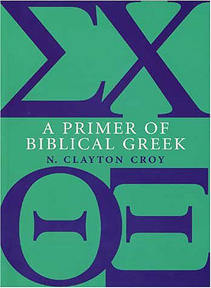
Tomorrow (Lord willing), I'll go up to Denton for the introductory class in an ongoing course in NT Greek that is being offered out of St. Maximus' taught--free of charge!--by our very own EYTYXOΣ. Very much looking forward to this. The books shown above shall be our texts.

Thursday, May 31, 2007

Li'l Sweetie Tastes Immortality

We were blessed to be present at St. Sava's first liturgy on their new property -- outdoors, tent over our heads, hay under our feet -- and much BBQ-ed sausage and Shiner Bock in our bellies afterwards.

But this right here to the right is what it's all about (hint). That li'l one that looks an awful lot like my beautiful wife is such a big girl now, taking communion by herself... Thanks to Mary Bethany for the heads up. You can see the rest of the slideshow here.

Forgotten Sons of the South

This article--written by an African-American professor, as the page states at the bottom--details the ranks of black soldiers--slave and free--who took up arms and fought valiantly against the North.

Forwarded to me also was this article, also on black Confederates, with many documented instances of blacks fighting, not out of obligation or conscription, but out of love for their homeland--and many doing so as already-freed men.

UPDATE: While doing a search on the Five Civilized Tribes of Oklahoma (my native American ancestry comes from one of these, though we're not sure which), this incredibly thorough article jumped out at me from the search results. Deo Vindice.

I Don't Believe in Organized Religion--I'm Orthodox!

(The following is my response to a private email regarding this post at the Triablogue blog. Parts pertaining to the other party's private questions and comments have been removed.)

Evangelicals who interact with Orthodox--particularly converts TO Orthodoxy from Evangelicalism--have to put up with a lot. Specifically, they hear a refrain from us that "sola scriptura leads to doctrinal chaos!" and "Scripture plus tradition leads to wonderful doctrinal unity!" Now, while I personally agree with what we as Orthodox mean by all this, that's just sloppy apologetics on our part...it needs to be unpacked in more than just a sound byte, since Evangelicals reckon themselves to have just as much "unity in essentials" as the Orthodox claim to have.

For me, the difference lies in this: ecclesiology mattered desperately to the early Church, so much so that they put an article in the Creed that the Church was One, Holy, Catholic and Apostolic...that "One" part meaning that only one, visible communion would comprise it. Granted, it was never cut and dry which group it was when controversy came up, but the understanding was there--even among heretical groups of the first 300 years or so!--that groups which held to contradictory teachings on certain issues could not share the same chalice, and therefore could not both comprise the One Church.

So much is made of the fact that the Orthodox, being (as we see it) that One Church established by Christ, is doctrinally consistent. This is why the "Churches in Resistance" like the Athonite monasteries and Russian splinter groups that have broken communion with so-called "World Orthodoxy" ( i.e., the four historical patriarchates of Constantinople, Alexandria, Antioch, and Jerusalem and all those in communion with them) are either now themselves the One Church, or have separated themselves from the One Church. It's hard to tell until 20/20 hindsight clears things up (thanks being given to the Holy Spirit), but this sort of excommunication/reestablishment of communion is what has plagued/blessed the Church for 2,000 years. It's a "plague," for it's never pleasant--often, really, it's downright ugly and folks have lost it, calling folks all kinds of names they shouldn't have--but it's a blessing, overall, because these guys erred on the side of caution: they absolutely refused to believe that the Church could be divided on something that was seen as a major christological dogma and still be seen as "One."

Enter Evangelicalism, specifically (bear with me, those of you who read this blog who adhere to sola scriptura) those declaring sola scriptura to be their bond of unity. Well, all right, Christ is ultimately the bond of unity they claim, but you get me. Here we have groups that believe all kinds of different things re: baptism, the Eucharist, the nature of the Church, the nature of salvation, the means of acquiring said salvation, the operation of the Holy Spirit--even what it means to adhere to sola scriptura. Much could be made of the fact that the Early Church Fathers (hereafter ECFs) were absolutely unified on the nature of these issues--they were even more unified on these than they were regarding the canon of Scripture--but unity or disunity on this or that doctrine will only get an Orthodox and an Evangelical so far in a debate, in my experience.

It has been suggested that we Orthodox compare apples to apples and acknowledge that Southern Baptists (for example) have just as much unity amongst themselves as the Orthodox do amongst themselves (if not more, thanks to detailed systematic theology on the part of the Evangelical). Granted, readily. But this is not my problem with comparing the doctrinal cohesiveness of these two confessions. My problem is the fundamental difference between said confessions' respective beliefs regarding who or what constitutes the One Church of Christ. Whereas the Orthodox see the One Church of Christ as being necessarily doctrinally consistent on all declared matters of faith ("declared" being the key word here), and thus have no problem with Orthodoxy alone comprising the One Church, sola scriptura Evangelicals (it is my opinion--corrections are welcome) are satisfied with saying that groups can be diametrically opposed to each other regarding all the things I listed one paragraph above this one and still, as a group of contradicting confessions, comprise the One Church of Christ. If there's one thing that was made clear through my extensive readings of the ECFs (almost all Ante-Nicene authors), it was that, without exception, no one who did not hold to the Real Presence, Baptismal Regeneration, Infant Baptism, or Apostolic Succession (to name the most prominent four teachings that stand in opposition to most sola scriptura adherents' beliefs) could be said to be in the One Church of Christ, as these were seen to directly oppose the christology of the early Church.

In other words, for the statement that "Baptists have as much unity as Orthodox" to hold any water with an Orthodox Christian whatsoever, the one making said statement would also have to say that "Baptists alone constitute the One Church; they alone are the Body of Christ on Earth." The fact that (some) Lutherans, Church-of-Christers, Presbyterians, and Five-Pointers are included as members of the One Church along with Baptists is what drains the efficacy out of the whole argument. The One Church has more than One Faith in this latter version, it seems.

Still, many an Evangelical remains faithful to sola scriptura because he sees the controversies in Roman Catholicism and/or Orthodoxy as "the proof in the pudding" of their comparable fallibility--in a word, said Evangelical thought he was no worse off in Protestantism than he'd be in the Roman Catholic Church or Eastern Orthodox Church regarding doctrinal confusion, and, hey, at least he could unambiguously point to where his concrete, written-down (and leather-bound), rule of faith was....as opposed to trusting in a sometimes more nebulous "tradition"...

Whence, then, the Orthodox distinction betwen the disunity among the various groups identifying themselves with Orthodoxy and that sola scriptura adherents? In a nutshell, the issues sola scriptura folks disagree on are not only major doctrines in the Early Church, but also major doctrines that enjoyed universal accord among these ECFs. In contrast, the issues of Calendar and Reception of Converts in their current contexts were not directly dealt with by the ECFs, yet are seen by the "Synods in Resistance" in this day and age as major christological affronts, and thus threats to the doctrinal unity of the One Church. In their minds, separation is the only choice if doctrine is different.

God has seen fit to reconcile the Russian Church over the last couple of weeks. May the others who are taking these stands against what they see as false union enter into true (re)union with the rest of the world calling itself Orthodox, and--just as we have experienced for 2,000 years, let God be true; let His truth conquer all men's lies, regardless of what side of the conflict they came down on.

Tuesday, May 29, 2007

Vote for the Cover!

Go here to vote for the cover of the Orthodox Study Bible that you most like. Be sure to tell me which one you chose! (I voted for number one!)


(I'm hoping this means a soon-coming release date...?)

Thursday, May 24, 2007

The Apple iRack

And, on a lighter (yet sardonic) note...

What kind of beloved is your beloved?

The Canticle of Solomon records the maidens of the Shulamite woman asking her this question (Song 5:9), and it is surely a question solely asked to prompt praise for the Beloved. The Greek Septuagint differs only slightly, as the maidens ask, "What is your kinsman more than another kinsman?" This idea of a kinsman redeemer, a kinsman lover, which is brought out so vividly in Boaz's saving of his near relatives Ruth and Naomi, sheds a stronger, more christic light on the Canticle's question -- for we as Christians immediately identify our kinsman redeemer as Christ Himself. For us, then, the question would be thus: how is Christ Jesus--our kinsman who shares in our nature while remaining God, our lover who consummates His relentless love for mankind in a way that proves stronger than Death itself--how is this Christ Jesus more than any other kinsman? How is He more than any other God, more than any other man?

I pose this question for a specific reason, yet mine is slightly different than the ones that are usually seen in print. I have seen many a book, podcast, blog, website--you name it--devoted to an apologetically-based answer for others regarding this question--"How do the Old Testament prophecies establish Him as our kinsman redeemer?" "How is Christ different from and superior to other deities?" "How does the atoning sacrifice of Christ establish His payment as kinsman redeemer?"--yet my question, I think, is somewhat more fundamental, as it seeks not to justify an already established image of our Kinsman Lover within our own lives, our own hearts, but rather asks how we ought to discover our Beloved fully, how we ought to seek to develop said image in the first place.

In other words, how do we know what kind of beloved our Beloved is? And, secondly, how can extremes on either side of, well, my particular religious experience (as an example) rob one of this discovery?

The first extreme I often see reminds me (you'll have to bear with me on these admittedly unusual metaphors, along with all the inherent limitations therein) of an online dating service. To set up the example, imagine the following: A person signs up for a dating service and, after a while, finds a profile that appeals to--we'll say--her. She emails this young man, who emails back quickly with an interest that impresses the young woman. She and her new contact exchange daily emails, and it's quickly obvious that there is an intense, mutual attraction between these two that goes far beyond physical (having never actually seen or met each other in person, physical attraction can't really enter into the situation) -- shared interests, goals in life, his life seeming to complete hers -- all this leads to increased intimacy, increased disclosure, more of the emotional trust flowing back and forth along the modems...yet, for all of the love that is undoubtedly there, these two people never meet, never touch, never fulfill all the longing they most certainly feel with an actual marriage and consummation thereof. I know that this will more than likely offend many who may read this--and, for that, forgive me; I've tried to be as charitable as possible here--but I see non-sacramental approaches to Christianity as a spiritual version of this scenario; so much is learned about Christ through diligent (and admirable!) study of the Scriptures that it is obvious that a vision for who Christ is, gratitude for what He's done, longing to be in His presence--all these things are very often present in the lives of such Christians. Yet, for one to say that this is enough--for one to claim that all that is needed is the re-reading of Scriptures (God's "email correspondence" with us, if you will) and the subsequent, "long distance" relationship that is fostered through that reading, apart from any sacramental contact--is to claim that the woman should be completely satisfied that, in this life, all that she can expect is a constant longing with absolutely no fulfillment, no resolution of tension, no consummation of desire. Such a relationship can hardly be called complete; truly, after a while, it can hardly be considered healthy.

To turn the extreme to the other side, however, is the ancient idea (which nonetheless has most likely been the source of much marital grief in times past, at least by our standards) of arranged marriages, done completely apart from the desire or preference of those (or at least one of those) involved in said arrangement. Here exists a couple who, though united through the sacrament of marriage, have lived their entire lives in close proximity to one another--even to the extent of sharing the same bed and bearing children together--but have not had an experience--or, better yet, a continuous lifetime of experiences--speaking with each other, communing with one another, sharing the marriage bed as a means of union, of blessedness. The bride, in this case, may be able to tell you how the household runs--down to the daily schedule of how the husband likes dinner, how she, the wife, has her nightly talk on the phone with friends--in other words, much familiarity with the household is established, but little is actually known or appreciated about the Spouse Himself. Were the wife and husband so inclined, a conversation could be started which would shed new light on all kinds of things that were done (for reasons heretofore unknown) for years within the household, would usher in new levels of appreciation for Who the Spouse is and why He does what He does within His Household. This, as you may have already guessed, is my take on those who, having grown up in Orthodoxy, are intimately familiar with the rites, the sacraments, the sounds, the hymns, the icons, the prayer cycles, the motions of worship, yet who are almost wholly unaware of the Scriptural significance of all of these gifts. These are they who, though they devoutly show up for the lengthy Canon of St. Andrew of Crete at the beginning of Lent (and for this they are to be commended!), they are unaware of the history of salvation leading up to St. Andrew's preaching: the Covenant with Abraham and his shameful lies concerning his wife Sarah; the passing of the covenant to Isaac instead of Ishmael; the deceitful Jacob and impulsive Esau; the romance of Jacob with Leah and Rachel, the drama of Joseph and the other sons of Jacob, the line of David, Elijah, Elisha, Isaiah, etc...in short, a systematic, intentional study of the Scriptures as a whole, is lacking. And, while I will add quickly that Scripture is not sufficient by itself to provide the ideal, holistic experience of Christ intended for the Church, it is, in and of itself, an indispensable part of having said experience. Father Patrick Henry Reardon has recently said as much, and I believe this to be a truth that bears repeating, ad nauseam (and it may nauseate some unaccustomed to the idea), until it takes hold within the grass-roots life of Orthodox parishes...until, basically, it is no longer a rare, refreshing exception to find regular, well-attended Bible studies thriving within Orthodox parishes. As my friend Alan is fond of mentioning, Scripture is θεοπνευστος -- literally "God breath" -- so, in the words of Rich Mullins, "let's breathe this as deeply as possible."

Matter of fact, let's hear the quote in context (taken from here):
"I don't think you read the Bible to know truth. I think you read the Bible to find God, that we encounter Him there. Paul says that the scriptures are God's breath and I kind of go, wow, so let's breathe this as deeply as possible. And this is what liturgy offers that all the razzmatazz of our modern worship can't touch. You don't go home from church going, "Oh I am just moved to tears." You go home from church going, "Wow, I just took communion and you know what? If Augustine were alive today, he would have had it with me and maybe he is and maybe he did."
While writing this, the only part of the quote that came to me initially was the "deep breathing" part; it was interesting to go back and see that Rich, in saying this, puts the context of "breathing in Scripture" squarely in the context of liturgical, sacramental worship of the καθολικη εκκλησια --the "catholic" (universal, complete) Church. Let us know not only the New Testament through the daily lectionary readings, but let us also revel in the types and shadows of the Old Testament, so rich with foreshadowing of our Bridegroom. Let us pore over the epistles of St. Paul by the light of the apostolic worship, let us hear the apostles James, Peter, and John--let us read the very words of our Lord, over and over, so that when we commune in that most intimate manner--with His Body and Blood fusing and becoming one with ours, so that we may be bearers of Christ in the world and multiply His presence as His Body throughout the nations--we will thus have both the knowledge that comes from intellectual study of a thing and the experiential knowledge that comes from living in the presence of a person--γνοσις in its most complete sense.

Sunday, May 20, 2007

Congrats to Wifey!

My lovely wife is now a proud alumn of Texas Women's U, having just finished her Masters of Library Science. She's pictured here with the little stinker, who was just about as happy to see Momma again (after her long time of sitting down on the ground level with the other graduates) as she was to wear Momma's big, flat, funny hat.

So proud of her. Congrats, baby.

Church School - Fasting

Another great session - in preparation for the upcoming (and, this year, long!) Apostle's Fast, we went over this article in depth (unfortunate spelling errors included).

Lots of good things in there to think about.

Thursday, May 10, 2007

New Article of Mine

...titled "The Unbiblical Doctrine of Sola Scriptura" has been published on OC.net. There's a link in the sidebar, or you can just click here, if you like.

Should be a follow-up to this one sometime soon (summer's comin'!).

Thinker?

So John tags me for this "Thinking Blogger" thing that's been going around (his tag's here). Pot and kettle, sir. Pot. And. Kettle. Thanks all the same, however.

Rules for this:

1. If, and only if, you get tagged, write a post with links to 5 blogs that make you think;
2. Link to this post [already done above -- Me.] so that people can easily find the exact origin of the meme;
3. Optional: Proudly display the 'Thinking Blogger Award' with a link to the post that you wrote (here is an alternative silver version if gold doesn't fit your blog). [Mine's at the bottom of the sidebar.]

My five (I tried to go with folks I haven't seen tagged elsewhere):
  1. Sober Joy
  2. La joie de Dieu est folie
  3. Now and Ever
  4. Pithless Thoughts
  5. Unmitigated Nonsense