
Monday, June 23, 2008
Hebrews 12:1
Fr. Stephen Freeman's most recent post (HERE) got me thinking about the epistle reading from yesterday’s liturgy. One part that stuck out to me was at the beginning of Hebrews 12 where we said to be “surrounded by so great a cloud of witnesses.” Christ is surrounded by the cloud on Mount Tabor, and we read in the Old Testament of when the cloud of God’s glory descended upon the temple. The cloud of witnesses who have gone on — what other cloud could they be said to inhabit but this cloud of glory which is the presence of God? How could we say that we enter the presence of the Living God and not also enter the presence of those who are with Him, and who, therefore, are always with us in this one “storey”?


Thursday, June 19, 2008
Baptism Pics, and St. David of Wales
For pictures of John's baptism mentioned in the last post, click HERE. Unfortunately, our camera battery died halfway through (not the first time that happened-- you'd think we'd have learned by now!), so Amanda's (now the newly-illumined handmaiden of God Deborah's) chrismation photos were taken by our Matushka and will be emailed to us soon, Lord willing. God has granted us two new siblings in the Lord; may He grant them both many, many years!
 The icon to the right is of the David whose name I almost took when I was tonsured a Reader (my being welsh -- among other things -- and whatnot). I was reminded of this by a site run by an iconographer in the UK (found HERE, with a hat tip to Owen). St. David is commemorated on March 1, and his bio as follows is taken from OrthodoxWiki.org.
St. David, pray for us to Christ our God, that we might "be steadfast...and do the little things."
 The icon to the right is of the David whose name I almost took when I was tonsured a Reader (my being welsh -- among other things -- and whatnot). I was reminded of this by a site run by an iconographer in the UK (found HERE, with a hat tip to Owen). St. David is commemorated on March 1, and his bio as follows is taken from OrthodoxWiki.org.
St. David, pray for us to Christ our God, that we might "be steadfast...and do the little things."
Much of our information on the early history of Saint David comes from two sources: the 11th/12th century hagiography Buchedd Dewi (Life of David) of Rhigyfarch and the 12th-century writings of Giraldus Cambrensis (Gerald of Wales). David was a descendant of the royal house of Cunedda. Rhigyfarch wrote that David was the son of Sanctus Rex Ceredigionis, where Sanctus has been interpreted as a proper name and its owner honoured by Welsh Christians as Saint Sant. The Latin phrase itself translates as "a holy king of Ceredigion." The king of Ceredigion in the 510s was Gwyddno Garanhir, according to regional tradition. His title Garanhir ("crane legs"), certainly indicated spiritual accomplishment to the Druids who bestowed it. If the son of King Gwyddno, David was a grandson of King Ceredig, and a nephew of King Maelgwn of Gwynedd, and a brother of Elphin the successor to the Kingdom of Ceredigion and the foster-father and first patron of the bard Taliesin. Little is known of his mother, Non (honoured by Welsh Christians as Saint Non), though she is said to have been the daughter of a local chieftain - some versions of the meeting of Sant (or Gwyddno) and Non state that Sant forced himself upon Non.
David was born on a stormy night at or near Capel Non (Non's chapel) within a short walk of the present day city of Saint David's. The ruins of the medieval chapel are visible near the site, and a nearby well is still a site of pilgrimage. He was baptised by the Irish monk St. Elvis, and educated at the monastery of Hen Fynyw. After ordination, David was taught by the elderly monk Paulinus, whose blindness the young David healed by making the sign of the cross over the monk's eyelids.
He became renowned as a teacher and preacher, founding monasteries in Britain and Brittany (on the west coast of modern France), in a period when neighbouring tribal regions (that were to be united as England three hundred years later) were still mostly pagan. He rose to a bishopric, and presided over two synods, as well as going on pilgrimages to Jerusalem where he was anointed as a bishop by the patriarch.
St. David's Cathedral now stands on the site of the monastery he founded in southwest Pembrokeshire; in early medieval Britain this part of Wales was located near several important Celtic sea routes, and was not nearly as remote as it might seem today. A shrine to Saint David, containing his bones, the bones of his spiritual father Saint Justinian of Ramsey Island, and possibly those of Saint Caradoc, is located within the cathedral.
The Monastic Rule of David prescribed that monks had to pull the plow themselves without draught animals; to drink only water; to eat only bread with salt and herbs; and to spend the evenings in prayer, reading and writing. No personal possessions were allowed: to say "my book" was an offence. He taught his followers to fast, especially refraining from eating meat or imbibing alcohol. His symbol, also the symbol of Wales, is the leek.
The best-known miracle associated with St. David is said to have taken place on an occasion when he was preaching in the middle of a large crowd. When those at the back complained that they could not see or hear him, the ground on which he stood is reputed to have risen up to form a small hill so that everyone had a good view. The village which is said to stand on the spot today is known as Llanddewi Brefi. A more mundane version of this story is that he simply recommended that the synod participants move to the hilltop.
One of Rhigyfarch's aims in the Buchedd Dewi was that his document could establish some independence for the Welsh church, which was risking losing its independence following the Norman invasion of England in 1066. It is significant that David is said to have denounced Pelagianism during the incident before the ground rose beneath him. Giraldus Cambrensis, the nephew of a Bishop of St. David's similarly hoped to demonstrate the ancient independence of the see as the archbishopric of an independent Welsh church; he was himself nominated for the position of Bishop of St. David's on at least three occasions, but was turned down by Henry II initially and the Archbishop of Canterbury subsequently after the accession of John.
William of Malmesbury recorded that David visited Glastonbury intending to dedicate the abbey there, as well as to donate a travelling altar including a great sapphire. He had a vision there of Jesus Christ who said that "the church had been dedicated long ago by Himself in honour of His Mother, and it was not seemly that it should be re-dedicated by human hands." So David instead commissioned an extension to be built to the abbey, east of the Old Church. (The dimensions of this extension given by William were archaeologically verified in 1921.) One manuscript indicates that a sapphire altar was among the items King Henry VIII confiscated from the abbey at its dissolution a thousand years later. There are unverifiable indications that the sapphire may now be among the Crown Jewels of the United Kingdom.
His last words, according to the Buchedd Dewi, were: "Be steadfast, brothers, and do the little things." "
Friday, June 13, 2008
Prayers...
...we will, Lord willing, be baptizing the catechumen John tomorrow before Great Vespers for Pentecost; this will be followed the following morning by both his and his wife Mandy's chrismation before the feastday liturgy. My wife Audra and I have been blessed with the honor of being their sponsors in this beautiful event, so pray for us, as well, if you would.
May God grant His servants many blessed years in His Vineyard.
May God grant His servants many blessed years in His Vineyard.
Thursday, June 05, 2008
Christ is Ascended! He Has Gone Up with a Shout!
 "The body of the Lord is not a spirit, but it is spiritual, that is, it has no part in any coarseness, and is governed by the spirit. For the body which we have now is animate [psychikon], governed by the soul and made alive by natural and animate attributes and faculties. But the body after the resurrection Paul calls spiritual, that is, made alive and governed by the divine spirit, and not by the soul, transformed in an ineffable and spiritual manner into incorruption and preserved incorruptible."
"By eating a piece of broiled fish, He indicates that He has consumed with the fire of his divinity our human nature which had been swimming in the salty sea of this life, and He has scorched away all the damp slime our nature had taken on as it sank into the depths and was battered by the waves. Thus He made our nature food fit for God, fashioning that which before was defiled into sweet food of which God can commune.... Another meaning, namely, active virtue which, aided by the coals of the asceticism of the desert and of the hesychast life, removes everything that is moist and fat. And the honeycomb suggests knowledge and divine vision, for the words of God are sweet. There is also another kind of comb, one full of wasps, which leave no honey. This signifies the wisdom of the pagan Greeks. But the honeycomb suggests the sweetness of divine wisdom[, left by Christ]. For Christ is like the bee, which is small in size (for the Word is concise and weak in worldly power...). Yet is beloved by both kings and commoners, who apply the product of its toils for their health and healing."
"He was carried up into heaven. It was written of Elijah that he was carried up as it were into heaven (IV Kings (II Kings) 2:11). For Elijah only seemed as if he were carried up into heaven. But the Savior ascended into heaven itself as the Forerunner of all men, to appear before the face of God together with His holy Flesh, and to reveal His Flesh co-enthroned with the Father. And now our nature in Christ is worshipped by the whole angelic host."
~ Bd. Theophylact on the feastday gospel reading from Luke 24
Wednesday, May 21, 2008
Be Thou My Vision
It's been interesting to notice which songs have become bedtime traditions with Hope and, in contrast even now, with Kate. They're quite different. While Hope has heard "Arrorro, mi niña" and an original Spanish lullaby of my own making since the day she was born (give or take a day) along with some Orthodox childrens songs we've learned, Kate and I have, on the few times I've been the one to rock her to sleep for the night, fallen into the tradition of singing all the verses of "Be Thou My Vision" which I can recall by memory. A fellow parishioner who, like me, came from a very similar sort of "bapticostal" background -- right down to the same youth missions organization during the teenage years -- knows this song, at least in part, in its "praise band" version, usually with lone, female singer in front swaying, eyes closed and almost trance-like, as she leads the crowd into a Hollywood sountrack-esque crescendo by the last verse (I, however, was fortunate enough to first hear the Michael Card version on his album, Starkindler, which I like very much and recommend).
 Singing it now, though -- especially with the awareness of and need for (if not the active practice of) hesychia and constant remembrance of our Lord -- the verses take on a sober, almost martial tone, without triumphalism, without emotionalism ... yet still deeply moving. If you've clicked on the link already, you'll have heard most of the following verses (and, if you were watching, endured the sappy slideshow the author posted with the song). Nevertheless, here follows what I can remember of this beautiful Irish hymn of the Church:
 Singing it now, though -- especially with the awareness of and need for (if not the active practice of) hesychia and constant remembrance of our Lord -- the verses take on a sober, almost martial tone, without triumphalism, without emotionalism ... yet still deeply moving. If you've clicked on the link already, you'll have heard most of the following verses (and, if you were watching, endured the sappy slideshow the author posted with the song). Nevertheless, here follows what I can remember of this beautiful Irish hymn of the Church:
Be Thou my vision, O Lord of my heart,
Naught be all else to me, save that Thou art.
Thou my best Thought, by day or by night,
Waking or sleeping, Thy presence my Light.
Be Thou my Wisdom and Thou my true Word,
I ever with Thee, and Thou with me, Lord.
Thou my great Father, I Thy true son,
Thou in me dwelling, and I with Thee one.
Be Thou my Battleshield, Sword for the fight,
Be Thou my Dignity, Thou my Delight,
Thou my soul's Shelter, Thou my high Tower;
Raise Thou me heavenward, O Power of my power.
Riches I heed not, nor man's empty praise,
Thou mine Inheritance, now and always.
Thou and Thou Only first in my heart;
High King of Heaven, my Treasure Thou art.
High King of Heaven, my victory won,
May I reach Heav'n's joys, O bright Heaven's Sun.
Heart of mine own heart, whatever befall,
Still be my Vision, O Ruler of all.
Amen. Sleep tight, Kati.
Sunday, May 04, 2008
What Wonderful Daughters
 First up, let me show you what served as a distraction for dang near everybody in liturgy this morning. As if this child did not already look a lot like me; now we've got her in glasses. A couple of weeks ago, we noticed she'd been crossing her eyes (or just one, more often than not) when looking at us. The pediatric opthamologist we took her to told us she is extremely far-sighted and that these lenses (which, thanks be to God, she wears very well and for long stretches of time!) would, in undercorrecting the problem, help her still use her eye muscles to focus on things near her, but would not exhaust them to the point of their giving out and causing one eye to turn in. So this picture is just to brag on my beautiful, four-eyed babygirl who wears her new spectacles so well.
The toddler gets bragged on for whole 'nuther (but in my opinion, better) reason.
Tonight we had finished venerating the icons after evening prayers. Mommy had taken little one into her room to feed her and put her down for the night by the time big sis and I left the master bedroom (where la iglesia pequeña -- the little church, as we call our icon corner -- is located) and as we exited into the hall, I told Hope to keep quiet as we went by the room so Kate could go to sleep. As I entered the dining room from the hall, I noticed Hope stopping by Kate's door and raising her hand...in Papi fashion I waved her on, "no doubt" reminding her of something she'd "obviously" forgotten -- that it was "Kati's" bedtime.
Y'all, this is the kind of kid I've been blessed with: Not only did she immediately come when told, but then, with a hurt and disappointed look on her face, told me with a cracking voice and pouting lip, "But...I just wanted to bendecir su puerta!" ("bless her door," in Spanish) Her hand had not been raised to open the door, but to make the sign of the cross over it in order to help her baby sister sleep.
So I, rightly feeling every inch a moron and a sinner (families really are there to help us with our salvation, aren't they?), hugged my now softly sobbing toddler and told her just how proud I was of her and, after I'd asked her forgiveness (which the little saint gave right away), she and I went back to her door and, one right next to the other, we made the sign of the cross over Kate's door -- "En el nombre del Padre, y del Hijo, y del Espíritu Santo. Amen."
May God protect and further grow this thoughtfulness and generosity that resides in my elder daughter's heart, and may Kate's patience and good temperment follow her.
Sunday, April 27, 2008

.jpg)
Saturday, April 26, 2008
The Psalms of David - Psalm 34
"Judge those who harm Me, O Lord" -- appropriate for this Holy Saturday, the Sabbath of Sabbaths.
From Fr. Patrick:
From Fr. Patrick:
[In the Upper Room] our Lord explicitly appealed to our psalm...to show that this hatred and this persecution by the world are a realization of prophecy: "But this happened that the word might be fulfilled which is written in their law, 'They hated Me without a cause'" (v. 7, also 68:4 and 108:4).
These, then, are psalms in which the praying voice is that of Christ Himself, and, by reason of her sharing in the sufferings of Christ, the Church prays these psalms in His Person.
...
The prayer of Christ here is a battle prayer, for He wages war on the forces of sin, darkness, and destruction: "Let ruin come upon them unawares." ... This is the prayer of Christ doing battle with the forces of sin and death, looking forward to the hour of His victory, when His very body, brought down to the grave, wil rise again in the paschal victory: "And my soul shall be joyful in the Lord; it shall rejoice in His salvation. All my bones shall say, 'Lord, who is like You, delivering the poor from him who is too strong for him.'"
Saturday, April 19, 2008
The Psalms of David - Psalm 33
"I will bless the LORD at all times; His praise shall continually be in my mouth."
"Oh, taste and see that the LORD is good; blessed is the man who hopeth in Him."
"Keep thy tongue from evil, and thy lips from speaking guile."
Movement of the heart is stilled and quieted through repeated meditation on the sacred name of Jesus. The Jesus Prayer -- "Lord Jesus Christ, Son of God, have mercy on me, the sinner" -- is treasured as a blessed, honored way to commune in intimate prayer with the One who fills temples with glory yet inhabits a womb in silence, who blazes fire forth from a tomb in Jerusalem every Pascha, yet who speaks with a still, small voice. When this Messiah is invoked and mercy begged for, not only are our lips sanctified, but our efforts are rewarded with a calming of inner impulses towards all surrounding earthly cares. When we are calmed and sufficiently prepared to hear from God (something today's McMegachurch takes not at all into account), then, in His timing, does He visit those who've tilled the ground of their hearts with the beautiful name of Jesus Christ. We do, indeed, taste and see that our Lord is a good Lover of mankind, for He is not merely content to rid us of the cancerous, diseased existence that is the evil and guile mentioned by David above; He must also fill us with His fear, faith, and love that comes only from an expected visit.
At times expected visits are longer in coming than anticipated...the grave, Hades, the silent silencer, evilly stifled all praise that would have come from it. Its yawning mouth wordlessly destroyed and guilefully consumed all who came to it...until a Word came whose words forced the tomb to reverse its flow, to turn back like Jordan and issue forth a man from it. Soon it would no longer be dictated to but would indeed speak forth a Logos -- though even this would be apart from its own accord. Since then the echo of that Word has left a bitter taste in Hades' mouth -- its evil tongue and guileful lips must always remember both Lazarus' being drawn out and the Word's being spoken from the mouth of the grave. That Word, that Name, is He Whom our lips and heart must ever embrace -- woe to us if our lips honor him apart from our hearts! -- so that our silencing by the grave will not be without a final Word.
"Oh, taste and see that the LORD is good; blessed is the man who hopeth in Him."
"Keep thy tongue from evil, and thy lips from speaking guile."
Movement of the heart is stilled and quieted through repeated meditation on the sacred name of Jesus. The Jesus Prayer -- "Lord Jesus Christ, Son of God, have mercy on me, the sinner" -- is treasured as a blessed, honored way to commune in intimate prayer with the One who fills temples with glory yet inhabits a womb in silence, who blazes fire forth from a tomb in Jerusalem every Pascha, yet who speaks with a still, small voice. When this Messiah is invoked and mercy begged for, not only are our lips sanctified, but our efforts are rewarded with a calming of inner impulses towards all surrounding earthly cares. When we are calmed and sufficiently prepared to hear from God (something today's McMegachurch takes not at all into account), then, in His timing, does He visit those who've tilled the ground of their hearts with the beautiful name of Jesus Christ. We do, indeed, taste and see that our Lord is a good Lover of mankind, for He is not merely content to rid us of the cancerous, diseased existence that is the evil and guile mentioned by David above; He must also fill us with His fear, faith, and love that comes only from an expected visit.
At times expected visits are longer in coming than anticipated...the grave, Hades, the silent silencer, evilly stifled all praise that would have come from it. Its yawning mouth wordlessly destroyed and guilefully consumed all who came to it...until a Word came whose words forced the tomb to reverse its flow, to turn back like Jordan and issue forth a man from it. Soon it would no longer be dictated to but would indeed speak forth a Logos -- though even this would be apart from its own accord. Since then the echo of that Word has left a bitter taste in Hades' mouth -- its evil tongue and guileful lips must always remember both Lazarus' being drawn out and the Word's being spoken from the mouth of the grave. That Word, that Name, is He Whom our lips and heart must ever embrace -- woe to us if our lips honor him apart from our hearts! -- so that our silencing by the grave will not be without a final Word.
Sunday, April 13, 2008
The Psalms of David -- Psalm 32
My sincere apologies for staying away for so long...though perhaps I should qualify that: lenten obligations (the kind that, in streamlining one's life, one finds one should feel more acutely both in periods penitential and festal) have been pressing lately. Just as I am taken aback on this day by the fact that we have but five days remaining in our lenten journey as Orthodox (Lazarus Saturday is the first post-lenten day), so I have been surprised at the fast-approaching end of the school year. Thus, these obligations that have taken priority over this blog are, in fact, ones for which I should not apologize. Nevertheless, it is good to sit and type after so long an absence.
Who is so great a God as our God?
Depends: what would one answering this question see as "greatness"? There are many things that men are proud of in this life, things they attach to themselves as a badge of honor, as a badge of identity. Whether it be political, geographical, racial, philosophical, socioeconomical or other, we humans have a hard time remembering that we have no lasting city, that we wait for our hidden life to be revealed with a shout from Zion.
We see that "by the Word of the Lord"--the Son, doing the Father's will, respectively--"the heavens were established. And all the host of them by the breath [Spirit, or πνευματον, is also "breath"] of His mouth." Our Kingdom, which shall be one where all things are created by that "new song," is not and never has been of this world. We cannot look to kings, mighty men, or horses -- nor to "the multitude of an host" that will save neither said kings nor fledgling parishes -- but "our soul waiteth for the LORD: he is our help and our shield." And that God, that shield that makes fire as cool dew of the evening, that Lord whose Kingdom, He tells us, is not of this world, is a scarlet-robed, thorn-crowned, poured-out, crushed, vulnerable, and rejected God.
Theresa of Calcutta said that we are not called to be successful; we are merely called to be faithful. I can think of no more scandalous -- and no more Christian -- a picture than one who, having descended to the lowest degree of failure in the eyes of those who, like dogs, devour their neighbor, nevertheless refuses to devour and, being thus devoured by those in this world who seek their own good, descends (dead and supposedly conquered) into the earth, only now having become a seed fitting to bear the fruit of the Kingdom of another world: that of the Lord, His Word, and His Breath.
Who is so great a God as our God?
Depends: what would one answering this question see as "greatness"? There are many things that men are proud of in this life, things they attach to themselves as a badge of honor, as a badge of identity. Whether it be political, geographical, racial, philosophical, socioeconomical or other, we humans have a hard time remembering that we have no lasting city, that we wait for our hidden life to be revealed with a shout from Zion.
We see that "by the Word of the Lord"--the Son, doing the Father's will, respectively--"the heavens were established. And all the host of them by the breath [Spirit, or πνευματον, is also "breath"] of His mouth." Our Kingdom, which shall be one where all things are created by that "new song," is not and never has been of this world. We cannot look to kings, mighty men, or horses -- nor to "the multitude of an host" that will save neither said kings nor fledgling parishes -- but "our soul waiteth for the LORD: he is our help and our shield."
 And that God, that shield that makes fire as cool dew of the evening, that Lord whose Kingdom, He tells us, is not of this world, is a scarlet-robed, thorn-crowned, poured-out, crushed, vulnerable, and rejected God.
Theresa of Calcutta said that we are not called to be successful; we are merely called to be faithful. I can think of no more scandalous -- and no more Christian -- a picture than one who, having descended to the lowest degree of failure in the eyes of those who, like dogs, devour their neighbor, nevertheless refuses to devour and, being thus devoured by those in this world who seek their own good, descends (dead and supposedly conquered) into the earth, only now having become a seed fitting to bear the fruit of the Kingdom of another world: that of the Lord, His Word, and His Breath.
Wednesday, March 26, 2008
Theophylact on the Annunciation
"Because the Lord had once said to Eve, In sorrow thou shalt bring forth children, that sorrow is now removed by the joy which the angel offers to the woman, saying to her, Rejoice, thou who art full of grace. Since Eve had been cursed, now Mary hears herself blessed."
"He who appears as a man is called the Son of the Most High; being of one hypostasis, the human son of the Virgin is in truth the Son of the Most High...here the mouth of Nestorius is sealed. For that man said that the Son of God did not take flesh by dwelling in the womb of the Virgin, but that a mere man was born of Mary, and only later was this man "accompanied" by God. let Nestorius hear, therefore, that that Holy Thing Which is being begotten in the womb is the Son of God. That which was carried in the womb and the son of God are not two separate entities, but one and the same, the Son of the Virgin and the Son of God. See how the angel revealed the Holy Trinity by naming the Holy Spirit, the Power which is the Son, and the Most High which is the Father."
"He who appears as a man is called the Son of the Most High; being of one hypostasis, the human son of the Virgin is in truth the Son of the Most High...here the mouth of Nestorius is sealed. For that man said that the Son of God did not take flesh by dwelling in the womb of the Virgin, but that a mere man was born of Mary, and only later was this man "accompanied" by God. let Nestorius hear, therefore, that that Holy Thing Which is being begotten in the womb is the Son of God. That which was carried in the womb and the son of God are not two separate entities, but one and the same, the Son of the Virgin and the Son of God. See how the angel revealed the Holy Trinity by naming the Holy Spirit, the Power which is the Son, and the Most High which is the Father."
The Psalms of David -- Psalms 30-31
Our Lord's cry of the committment of His Spirit into the hands of His Father--along with the rest of Psalm 30--show us the Passion "from the inside," as Fr. Patrick says. The rejection and mockery of those around Him (vv. 12-14); His becoming sin for us (vv. 10-11); and His saving trust in His God and Father (vv. 6, 15).
Yet there was another whose soul was pierced with a sword, some say of doubt, others of grief, still others of silent suffering. Though her side be not pierced with the spear which would cause the life-giving flow our our baptisms and communions, yet her womb would, unpierced, bring forth the thereafter often-pondered Mystery which hung, trusting, on the Cross. As with her Son, so with her, and so it must be with all of us in that mysterious family: "You shall hide [those who fear You] in the secret of Your presence from the disturbance of men; You will shelter them in Your tabernacle from the contradiction of tongues." The one who was His tabernacle, who gave Him His fleshly tabernacle, is now "tabernacled" (as the Greek puts it in Jn 1) by that same, saving, flesh-and-blood Savior.
Her silence is different here. The Prophet David said, "Because I kept silent, my bones grew old From my groaning all the day long; For day and night Your hand was heavy upon me; I became miserable when the thorn pierced me. I made known my sin..." Here, however, was no sin, only the Fruit of grace and faith on Its Tree. This Fruit had been borne in silence (minus the saving "Let it be" which, in echoing the creative logos of the Father, undid Eve's treacherous knot) by the one who was and is most favored, most gracious. Still, the sword does pierce, and the cry of Rejoice! from the angel and from the 31st Psalm must be tempered with Psalm 30's closing words; our Lady must be courageous and let her heart now be strengthened, even she who hopes supremely in the Lord.
Yet there was another whose soul was pierced with a sword, some say of doubt, others of grief, still others of silent suffering. Though her side be not pierced with the spear which would cause the life-giving flow our our baptisms and communions, yet her womb would, unpierced, bring forth the thereafter often-pondered Mystery which hung, trusting, on the Cross. As with her Son, so with her, and so it must be with all of us in that mysterious family: "You shall hide [those who fear You] in the secret of Your presence from the disturbance of men; You will shelter them in Your tabernacle from the contradiction of tongues." The one who was His tabernacle, who gave Him His fleshly tabernacle, is now "tabernacled" (as the Greek puts it in Jn 1) by that same, saving, flesh-and-blood Savior.
Her silence is different here. The Prophet David said, "Because I kept silent, my bones grew old From my groaning all the day long; For day and night Your hand was heavy upon me; I became miserable when the thorn pierced me. I made known my sin..." Here, however, was no sin, only the Fruit of grace and faith on Its Tree. This Fruit had been borne in silence (minus the saving "Let it be" which, in echoing the creative logos of the Father, undid Eve's treacherous knot) by the one who was and is most favored, most gracious. Still, the sword does pierce, and the cry of Rejoice! from the angel and from the 31st Psalm must be tempered with Psalm 30's closing words; our Lady must be courageous and let her heart now be strengthened, even she who hopes supremely in the Lord.
Monday, March 24, 2008
Blessed Feast
 Back home from Amarillo; the services -- or lack thereof, as my granddaddy wanted it -- were good in the sense that his nieces and nephews (dad's cousins) came in from all over, and it was good to meet some of them for the first time. I was honored to deliver a prayer -- loosely based on our prayer for the departed (which, not surprisingly, includes a petition for those still in this life) and stated in "down home" language. Barely got through it, but it was good to commend both his soul and our lives into God's hands.
The hymns for today--the Forefeast of the Annunciation--and tomorrow's feast:
Forefeast of the Annunciation
Troparian - Tone 4
Today is the prelude of joy for the universe!
Let us anticipate the feast and celebrate with exultation:
Gabriel is on his way to announce the glad tidings to the Virgin;
He is ready to cry out in fear and wonder:
Rejoice, O Full of Grace, the Lord is with You!
Kontakion - Tone 8
You are the beginning of salvation for all of us on earth, Virgin Mother of God.
For the great Archangel Gabriel, God's minister, was sent from heaven to stand before you to bring you joy:
Therefore, we all cry to you: Rejoice, O unwedded Bride.
The Annunciation of our Most Holy Lady, the Theotokos and Ever-Virgin Mary
Troparion - Tone 4
Today is the beginning of our salvation,
The revelation of the eternal mystery!
The Son of God becomes the Son of the Virgin
As Gabriel announces the coming of Grace.
Together with him let us cry to the Theotokos:
Rejoice, O Full of Grace, The Lord is with You!
Kontakion - Tone 8
O Victorious Leader of Triumphant Hosts!
We, your servants, delivered from evil, sing our grateful thanks to you, O Theotokos!
As you possess invincible might, set us free from every calamity
So that we may sing: Rejoice, O unwedded Bride!
Thursday, March 20, 2008
Memory Eternal
UPDATE: My grandfather entered the next life tonight around 8:30.
Interestingly enough, Father had heard wrong somehow and put granddaddy's name on the "departed" side of the list prayed over tonight during Presanctified; when he prayed his name, he was either going right then or may even have gone.
Thank you for your prayers. Please continue to pray for his soul, as well as ours.
************************************
Original Post, Tuesday, March 18, 2008:
I received a call from my father today informing me that my grandfather (his father) Leroy, whose health has been deteriorating for a good long while now, is now in hospice care. His lungs are slowly filling with fluid, he is unconscious, but he is still grimacing in pain. They're therefore giving him morphine and just keeping him comfortable until he reposes.
He isn't a professed follower of Christ that I know of; pray, please, that in these last days of his life (barring a miracle) he would be ministered to by his guardian angel, any and all saints that would come to his aid, and by the Lord Himself.
Most holy Theotokos, pray for my granddaddy.
Interestingly enough, Father had heard wrong somehow and put granddaddy's name on the "departed" side of the list prayed over tonight during Presanctified; when he prayed his name, he was either going right then or may even have gone.
Thank you for your prayers. Please continue to pray for his soul, as well as ours.
************************************
Original Post, Tuesday, March 18, 2008:
I received a call from my father today informing me that my grandfather (his father) Leroy, whose health has been deteriorating for a good long while now, is now in hospice care. His lungs are slowly filling with fluid, he is unconscious, but he is still grimacing in pain. They're therefore giving him morphine and just keeping him comfortable until he reposes.
He isn't a professed follower of Christ that I know of; pray, please, that in these last days of his life (barring a miracle) he would be ministered to by his guardian angel, any and all saints that would come to his aid, and by the Lord Himself.
Most holy Theotokos, pray for my granddaddy.
Tuesday, March 18, 2008
55 Maxims from Fr. Thomas Hopko
55 Maxims
(2007)
- Be always with Christ and trust God in everything
- Pray as you can, not as you think you must
- Have a keepable rule of prayer done by discipline
- Say the Lord’s Prayer several times each day
- Repeat a short prayer when your mind is not occupied
- Make some prostrations when you pray
- Eat good foods in moderation and fast on fasting days
- Practice silence, inner and outer
- Sit in silence 20 to 30 minutes each day
- Do acts of mercy in secret
- Go to liturgical services regularly
- Go to confession and holy communion regularly
- Do not engage intrusive thoughts and feelings
- Reveal all your thoughts and feelings to a trusted person regularly
- Read the scriptures regularly
- Read good books, a little at a time
- Cultivate communion with the saints
- Be an ordinary person, one of the human race
- Be polite with everyone, first of all family members
- Maintain cleanliness and order in your home
- Have a healthy, wholesome hobby
- Exercise regularly
- Live a day, even a part of a day, at a time
- Be totally honest, first of all with yourself
- Be faithful in little things
- Do your work, then forget it
- Do the most difficult and painful things first
- Face reality
- Be grateful
- Be cheerful
- Be simple, hidden, quiet and small
- Never bring attention to yourself
- Listen when people talk to you
- Be awake and attentive, fully present where you are
- Think and talk about things no more than necessary
- Speak simply, clearly, firmly, directly
- Flee imagination, fantasy, analysis, figuring things out
- Flee carnal, sexual things at their first appearance
- Don’t complain, grumble, murmur or whine
- Don’t seek or expect pity or praise
- Don’t compare yourself with anyone
- Don’t judge anyone for anything
- Don’t try to convince anyone of anything
- Don’t defend or justify yourself
- Be defined and bound by God, not people
- Accept criticism gracefully and test it carefully
- Give advice only when asked or when it is your duty
- Do nothing for people that they can and should do for themselves
- Have a daily schedule of activities, avoiding whim and caprice
- Be merciful with yourself and others
- Have no expectations except to be fiercely tempted to your last breath
- Focus exclusively on God and light, and never on darkness, temptation and sin
- Endure the trial of yourself and your faults serenely, under God’s mercy
- When you fall, get up immediately and start over
- Get help when you need it, without fear or shame
Father Tom explains this list of maxims in an excellent podcast for Ancient Faith Radio.
Sunday, March 16, 2008
The Psalms of David -- Psalm 29
From the OSB:
Fr. George -- the priest in Tulsa who received both myself and Audra -- always mentioned v. 10: "What profit is there in my blood, When I go down into decay? Will the dust confess You? Or will it declare Your truth?" Christ's groaning in Gethsemane is heard in these words as the fulfillment of David's longing for freedom from his physical enemies. The answer is a resounding yes: there is profit in the blood of the righteous innocents being poured into the ground; there is redemption for those gone down into decay. The dust will confess Him, not just the rocks. In its quiet submission to apparent destruction and death, the death of a holy one does declare God's truth, simply because it is done in union with the death of the Holy One of God. When God's blood soaks into the ground, life sprouts. When the fruit of life falls from the tree of the Cross and is planted as a seed in the ground, Israel is (re)born therefrom. This is a truth that no cruelty, no intimidation, no princes nor sons of men can overcome; our Lord has heard His Holy One, as well as all the holy ones called by His name, and will answer all those who endured and died with Him, for they shall reign and live with Him.
As Fr. Tom mentioned in quoting an (I believe) athonite monk: Our enemies can do anything they want to -- steal our money, burn our churches, smash our icons, rip up our Bibles, etc -- but they cannot rob us of our death. For God is with us.
"Ps 29 speaks of the Resurrection of Christ, who is the End (v. 1), and together with Him, the resurrection of the Church. Man's dilemma is the death and decay of his body in the grave (v. 10) and the dwelling of his soul in Hades (v. 4). As a result, these enemies rejoiced over him (v. 2), and his life was filled with weeping (v. 6), trouble (v. 8), lamentation and sackcloth (v. 12), and sadness (v. 13). But through Christ's resurrection (lifted me up, v. 2), (1) the Church will be healed (v. 3), that is, the body will be raised in beauty and power (v. 8) to immortal life forever (vv. 7, 13) at "the resurrection of the dead and the life of the world to come" (Creed); (2) the souls of the righteous in Hades were brought out from there at His Resurrection (v. 4); and (3) the Church is filled with praises (vv. 5, 13), thanksgiving (vv. 5, 13), great joy (v. 6), dancing and gladness (v. 12)."An interesting observation from Fr. Patrick: he translates v. 11 -- ηκουσεν κυριος και ηλεησεν με κυριος εγενηθη βοηθος μου -- using the imperative "Hear, O Lord, and have mercy on me; Lord, be my helper," while the OSB (perhaps taking their cue from the Douay-Rheims) translates it as "The Lord heard and had mercy on me; the Lord became my helper." Regardless, the Lord did hear His Christ and answered Him (Heb. 5:7).
Fr. George -- the priest in Tulsa who received both myself and Audra -- always mentioned v. 10: "What profit is there in my blood, When I go down into decay? Will the dust confess You? Or will it declare Your truth?" Christ's groaning in Gethsemane is heard in these words as the fulfillment of David's longing for freedom from his physical enemies. The answer is a resounding yes: there is profit in the blood of the righteous innocents being poured into the ground; there is redemption for those gone down into decay. The dust will confess Him, not just the rocks. In its quiet submission to apparent destruction and death, the death of a holy one does declare God's truth, simply because it is done in union with the death of the Holy One of God. When God's blood soaks into the ground, life sprouts. When the fruit of life falls from the tree of the Cross and is planted as a seed in the ground, Israel is (re)born therefrom. This is a truth that no cruelty, no intimidation, no princes nor sons of men can overcome; our Lord has heard His Holy One, as well as all the holy ones called by His name, and will answer all those who endured and died with Him, for they shall reign and live with Him.
As Fr. Tom mentioned in quoting an (I believe) athonite monk: Our enemies can do anything they want to -- steal our money, burn our churches, smash our icons, rip up our Bibles, etc -- but they cannot rob us of our death. For God is with us.
Saturday, March 15, 2008
The Psalms of David -- Psalm 28
"The voice of the LORD..." The word voice in Hebrew, qol, is an onomatopoeic sounding of thunder itself. From the Word creating the worlds to the Word becoming flesh, the voice of the Lord tears through the cedar forest, yet blesses those who are His, those who hear the thundering voice and understand (not all do ~ St. John 12:28-9), with peace from His throne, on which He quietly reigns.
The thunder is, as St. Athanasius also says in On the Incarnation, our Father kneeling down to the level of our toddler eyes and clapping His hands to get our attention. We, distracted and consumed with anything but the still, small voice, are unable to hear Him, often enough, because His still, humble proclamation is drowned out in a sea of our passions. So He, condescending, thunders. Ours is a culture -- a rarity when one considers the scope of religious history -- that not only would have trouble hearing a non-thundering God, but also of hearing a God behind thunder. The qol Adonai, then, has not only to shake us from our distractions to Him, but also to shake us to Him and away from that which originally shakes us, lest we fail to see Creator behind creation.
The thunder is, as St. Athanasius also says in On the Incarnation, our Father kneeling down to the level of our toddler eyes and clapping His hands to get our attention. We, distracted and consumed with anything but the still, small voice, are unable to hear Him, often enough, because His still, humble proclamation is drowned out in a sea of our passions. So He, condescending, thunders. Ours is a culture -- a rarity when one considers the scope of religious history -- that not only would have trouble hearing a non-thundering God, but also of hearing a God behind thunder. The qol Adonai, then, has not only to shake us from our distractions to Him, but also to shake us to Him and away from that which originally shakes us, lest we fail to see Creator behind creation.
Wednesday, March 05, 2008
An Early "Bowout"
 Way back forever ago I started to go over the psalms of my namesake, David, in the Psalter. I dropped it almost just as far back ago.
So I'm going to do two things with this blog for Lent this year, and yes, they're related.
(1) I will, by God's help, be regularly updating the blog with insights from Fr. Patrick Henry Reardon's Christ in the Psalms and/or the Orthodox Study Bible.
(2) I will be shutting off comments, a trick I learned from handmaidleah one Lent, I think it was...previously-made comments will still be there (too many good conversations have been had to get rid of them), they just won't be visible. I spend way too much time reading comments, responding to them, getting sucked into the blogs they link to, etc...hopefully the silence in the absence of conversation will do me good.
Lord, have mercy.
Y'all have a very blessed Lent, and "we'll talk" around the empty tomb of Pascha, Lord willing.
Thursday, February 28, 2008
Pat Buchanan's Thoughts on Kosovo Are Mine as Well
Fr. John Whiteford's posted a Pat Buchanan article I fully agree with HERE.
Lord, have mercy on your servants.
Lord, have mercy on your servants.
Saturday, February 23, 2008
Orthodox Study Bible - Old and New Testament
 Ironic (but not surprising for me) that, after calling for a vote for the cover of the Orthodox Study Bible, Old and New Testaments, I promptly took it off, much preferring the hansome burgundy with gold trim you see to your right (click for a closeup). We're glad this came in time for Great Lent, so we can read the Church's lectionary from a translation of the Church's Old Testament.
Things I've noticed so far:
Audra and I (and, heads up church school class, y'all too) will need to re-memorize the books of the Old Testament! Not only are there more, but the order of the Septuagint books is different. Law, Writings, Minor Prophets, Major Prophets, with the deuterocanonicals scattered all throughout, within their respective genres.
The notes remind me of study Bibles I had when I was younger (yes, of course I was a Study Bible Dork even from the start), so those of you expecting or desiring half a page of patristic quotes on every page will be disappointed. The notes I've read, though, seem to teach Orthodox faith and doctrine very clearly, which is crucial to those who are new to the faith or to "re-treads" who grew up nominally Orthodox and, having rediscovered a zeal for the faith, need to see how the Scriptures proclaim the truth of Christ, as well as how that truth is properly proclaimed by the Church. The notes center on Trinity, Incarnation, and Church, which is refreshing. Some may decry the notes as being too simplistic. I agree that so-called "study" notes that do nothing but restate the verse on which they are supposed to elaborate are quite frustrating, but a verse may need only very little emphasis to bring out a small but needed nuance. Sepa Dios. God knows. Point is, don't look to this to replace any patristic commentaries you may own or currently be eyeing.
One considerable omission on the part of the editors was a concordance. My priest mentioned this to me and, sure enough, there isn't one. This would be a wonderful addition to a second edition. Perhaps they're counting on folks to own the OSBNT already, which comes with (what I understand is) the standard NelsonTM concordance.
Also--no chain references, not in a middle column on the page or otherwise! I miss that...
The articles are good, and there are more of them. They are, from what I've seen so far, quite well-done. Very handsome icon prints on the other side of article pages.
The Psalms (finally!) are numbered according to our reckoning.
Often the topical divisions within the chapters will correspond to the beginning and ending of lectionary readings.
On the whole, we're very grateful to have this. May God bless this tool to His glory.
Any other reviews of this new addition would be much appreciated.
Wednesday, February 13, 2008
Eucharist, Again
On a forum I frequent, a (very eloquent and courteous) Evangelical was making a case for the Eucharist being solely a memorial meal. I responded with some scriptural passages and the Church's belief concerning Christ in the Eucharist but, since the sub-forum is not available to the public (one must register and then request access to said sub-forum), I thought I'd edit a few things and post here what I had written there.
************
Christ says that we must eat His flesh (literally, "to tear it with our teeth," if I'm not mistaken) and drink His blood. If He were speaking metaphorically, according to Jewish idiom, he would be telling those around him to revile Him--something I don't think would lend itself to eternal life and being raised up at the last day.
Nevertheless, it's clear from the text that no one really knew what in the world Jesus was talking about in John 6. Evangelicals often say that the phrase "My words are spirit and they are life" (emph. theirs) are key to interpreting the passage, as if the term "spirit" were synonymous with "incorporeal." In response, we would say that the words "flesh" and "spirit" are not used as synonyms with "corporeal" and "incorporeal," respectively, as such a view would lead to a gnostic hatred of all things material, and such a view could hardly be said to be one friendly to a divine incarnation.
Rather, we would say that the words He spoke to us--those of eating His flesh and drinking His blood--are words (or rather, a divine word or message of our Lord) that can only be understood when one is walking in the Spirit, as St. Paul said, instead of "in the flesh." And -- let me be clear yet again -- even this phrase "in the flesh" need not mean that the material body is somehow to be rejected as unfit for divine habitation, or that the material world is somehow incapable of communicating divine grace to Creation. The flesh of mankind, it has been said, is not so much the enemy as it is the battleground. When the Spirit of our God comes to reside in us, we are then to walk according to that reality, rather than the fallen one which still wars against our God. And where does it war? It just so happens that the war takes place in our fleshly members.
So, in our opinion, when Christ states that "the Spirit gives life; the flesh profiteth nothing," we would say that these are descriptions of the same two realities that St. Paul talks about--walking according to the natural man patterned after the old Adam and without Christ, and walking according to the newness of life offered by the new Adam and shot through with Christ's divine life. In both cases, though--and especially in the latter!--we see a whole mankind reunited--spirit, soul, and body!--through and in the divine power of the resurrected Christ.
So for us to insist that it's His actual body that merges with our flesh as we eat it, that it's His life-giving blood that flows in our veins, is not only an idea that has merit in our minds, but is absolutely crucial to a proper understanding of an incarnational worldview which allows for the redemption of the seen cosmos as well as the unseen.
And yet, some would ask, could it have been intended, after all, to be a purely memorial meal? True, there was talk about believing in Him in John 6, and some Reformed apologists want to take all the "eat My flesh, drink My blood" talk and boil it down to "just believe in your heart and confess with your mouth," but that doesn't explain why Christ brings up His flesh and blood in an edible context again in the upper room at the last supper. He said we have to eat His flesh; He said that what He held in His hands in that room was His flesh and gave it to them to eat. He said we have to drink His blood; He said that what He had in the cup was His blood of the New Covenant.
 So...I would say this, as a starting point: even if an Evangelical is unwilling to concede to some sort of real presence of Christ in the Eucharist, it seems to be fairly obvious that Christ is continuing His discourse in John 6--that of eating His flesh and drinking His blood--specifically in this moment, in the upper room, by giving the Apostles a tangible way to accomplish this command. Apparently this was how He was going to make it possible--somehow--for men to eat His flesh and drink His blood...it was going to be through this Eucharistic meal.
************

Christ says that we must eat His flesh (literally, "to tear it with our teeth," if I'm not mistaken) and drink His blood. If He were speaking metaphorically, according to Jewish idiom, he would be telling those around him to revile Him--something I don't think would lend itself to eternal life and being raised up at the last day.
Nevertheless, it's clear from the text that no one really knew what in the world Jesus was talking about in John 6. Evangelicals often say that the phrase "My words are spirit and they are life" (emph. theirs) are key to interpreting the passage, as if the term "spirit" were synonymous with "incorporeal." In response, we would say that the words "flesh" and "spirit" are not used as synonyms with "corporeal" and "incorporeal," respectively, as such a view would lead to a gnostic hatred of all things material, and such a view could hardly be said to be one friendly to a divine incarnation.
Rather, we would say that the words He spoke to us--those of eating His flesh and drinking His blood--are words (or rather, a divine word or message of our Lord) that can only be understood when one is walking in the Spirit, as St. Paul said, instead of "in the flesh." And -- let me be clear yet again -- even this phrase "in the flesh" need not mean that the material body is somehow to be rejected as unfit for divine habitation, or that the material world is somehow incapable of communicating divine grace to Creation. The flesh of mankind, it has been said, is not so much the enemy as it is the battleground. When the Spirit of our God comes to reside in us, we are then to walk according to that reality, rather than the fallen one which still wars against our God. And where does it war? It just so happens that the war takes place in our fleshly members.
So, in our opinion, when Christ states that "the Spirit gives life; the flesh profiteth nothing," we would say that these are descriptions of the same two realities that St. Paul talks about--walking according to the natural man patterned after the old Adam and without Christ, and walking according to the newness of life offered by the new Adam and shot through with Christ's divine life. In both cases, though--and especially in the latter!--we see a whole mankind reunited--spirit, soul, and body!--through and in the divine power of the resurrected Christ.
So for us to insist that it's His actual body that merges with our flesh as we eat it, that it's His life-giving blood that flows in our veins, is not only an idea that has merit in our minds, but is absolutely crucial to a proper understanding of an incarnational worldview which allows for the redemption of the seen cosmos as well as the unseen.
And yet, some would ask, could it have been intended, after all, to be a purely memorial meal? True, there was talk about believing in Him in John 6, and some Reformed apologists want to take all the "eat My flesh, drink My blood" talk and boil it down to "just believe in your heart and confess with your mouth," but that doesn't explain why Christ brings up His flesh and blood in an edible context again in the upper room at the last supper. He said we have to eat His flesh; He said that what He held in His hands in that room was His flesh and gave it to them to eat. He said we have to drink His blood; He said that what He had in the cup was His blood of the New Covenant.
 So...I would say this, as a starting point: even if an Evangelical is unwilling to concede to some sort of real presence of Christ in the Eucharist, it seems to be fairly obvious that Christ is continuing His discourse in John 6--that of eating His flesh and drinking His blood--specifically in this moment, in the upper room, by giving the Apostles a tangible way to accomplish this command. Apparently this was how He was going to make it possible--somehow--for men to eat His flesh and drink His blood...it was going to be through this Eucharistic meal.
I say "somehow" and want to emphasize that, for we don't actually have a "term" for how what happens, happens when the bread and wine become the Body and Blood. Transubstantiation sits well with some of us (though it's just a theological opinion one can have, not a dogma of the Church), though I prefer to see it simply as mystery: something that's been revealed to us as happening--namely, that the bread and wine are changed by the Holy Spirit into the mystical Body and Blood of Christ--yet the understanding of how it happens when, by all appearances, it still looks/smells/tastes like bread and wine remains (blessedly) hidden.
Some will say that, due to the memorial character of the prototype of the Lord's Supper (the Passover Seder), we should heed Christ's words that this meal was a memorial of what he did, with heavy emphasis and inference being drawn from the term memorial. To separate the Lord's Supper and it's function from the prototype, they say, further compounds the confusion.
This would be true, however, only if one were to work under the assumption that it is, ultimately, to be the Old Testament that informs the New, rather than the other way around. In fact, we must look back over the Old in light of the New; the reality doesn't have much to learn anymore from mere types and shadows. In spite of the merely symbolic character of the Old Testament Seder, St. Paul says that the bread which we break is our communion of the Body of Christ--the term κοινωνια which he uses specifically relates to a sharing or communion of more than one thing. We eat the bread; we have κοινωνια with the Body of Christ. We drink the blessed cup; we have κοινωνια with the Blood of Christ. It would seem that the memorial character of the Seder (which I agree, was heavily and probably exclusively memorialistic) did not transfer over to the Eucharist so thoroughly and exclusively as to preclude any kind of contact with Christ thereby.
This being our teaching--that Christ's sacrifice is somehow present in the Eucharist--it follows that one of the things that Roman Catholics and Orthodox are used to explaining "again and again" (and hopefully "in peace") is that we in no way teach that our experience of Christ in the Eucharist is in any way a re-crucifixion of the Lord. The sacrifice He made, He made once, for all, never to be repeated. It is that same sacrifice which is made present for all the faithful in the Eucharist.
Yet how can this be, if Christ was human, and a human body is limited by space and time? In confessing that one Man's human body can be distributed to thousands upon thousands of assemblies of the faithful (at least!) every Sunday, are we thus confusing the divine and human natures of Christ--something we are so quick to condemn in others? Not at all. We would say, first of all, that Christ's glorified body was much different than the pre-resurrected one the Apostle's witnessed, so much so that He was not immediately recognizable by all after He had risen. We have no problem with His being able to pass through doors and vanish; why is it such a stretch to grant His life-giving, resurrected flesh this miraculous property, as well? Christ is the bread of life, the bread of heaven; just as He multiplied the loaves for the multitudes, yet what was given was all of the original bread (a miracle), so is what is given to the faithful that same Christ, sacrificed in time once, 2,000 years ago, and multiplied and distributed to the faithful in a beautiful, glorious miracle that gives us access to the Fruit of Life that blossomed forth on the Tree of the Cross. We can now eat His flesh and drink His blood as He commanded. Eating it, we die not as did the old Adam, but shall live forever as promised by the New.
We are not, as has been said above, to equate the type and shadow of the Seder with the Eucharistic meal, and neither are we to equate the life-giving blood of our Lord with the mere, terrestrial manna of old in terms of life-giving properties. Our Lord Himself contrasts His own body with that manna of old when He says in John 6 that, "Your fathers did eat manna in the wilderness, and are dead...I am the living bread which came down from heaven: if any man eat of this bread, he shall live for ever: and the bread that I will give is my flesh, which I will give for the life of the world." It would seem that Christ is making a very sharp distinction between the two realities of manna and His life-giving flesh.
It is true that, in both the case of those who ate manna and that of those who eat the body of our Lord, the biological functions cease in the body, and, thus, the spirits of both groups depart from respective bodies. This aspect is acknowledged by the Church; we do not say that those who partake of the Lord's Body and Blood cannot in anywise experience death. We do, however, qualify said admission by saying that the sting of death is avoided, though death be still (temporarily) experienced. We are told by Christ that, even if we die physically, not even that (seeming) death will separate us from His love and that we "will be raised up at the last day"--something never promised to those who ate manna in the wilderness. Indeed, Christ concedes physical cessation of biological life while acknowledging a continuing--and, ultimately, victorious--life that no death can quell: "I am the resurrection, and the life: he that believeth in me, though he were dead, yet shall he live: And whosoever liveth and believeth in me shall never die." St. Paul would agree, that which is sown in corruption will be reaped in incorruption, but no eternal harvest will thus be yielded lest the seed go into the ground and die. As with our Lord, who offered His own body as the Protoseed that would become the Firstfruits of our own resurrection, so with us, His followers, who carry His gracious Body and Blood in ourselves, proclaiming His death to the point of our own departure from this life. Furthermore, having carried the Apocalypse's life-bearing Lamb and Word within ourselves even into the tomb, our still-corruptible bodies will, on the last day, rise to glory as our Lord states.
Yet how can this be, if Christ was human, and a human body is limited by space and time? In confessing that one Man's human body can be distributed to thousands upon thousands of assemblies of the faithful (at least!) every Sunday, are we thus confusing the divine and human natures of Christ--something we are so quick to condemn in others? Not at all. We would say, first of all, that Christ's glorified body was much different than the pre-resurrected one the Apostle's witnessed, so much so that He was not immediately recognizable by all after He had risen. We have no problem with His being able to pass through doors and vanish; why is it such a stretch to grant His life-giving, resurrected flesh this miraculous property, as well? Christ is the bread of life, the bread of heaven; just as He multiplied the loaves for the multitudes, yet what was given was all of the original bread (a miracle), so is what is given to the faithful that same Christ, sacrificed in time once, 2,000 years ago, and multiplied and distributed to the faithful in a beautiful, glorious miracle that gives us access to the Fruit of Life that blossomed forth on the Tree of the Cross. We can now eat His flesh and drink His blood as He commanded. Eating it, we die not as did the old Adam, but shall live forever as promised by the New.
We are not, as has been said above, to equate the type and shadow of the Seder with the Eucharistic meal, and neither are we to equate the life-giving blood of our Lord with the mere, terrestrial manna of old in terms of life-giving properties. Our Lord Himself contrasts His own body with that manna of old when He says in John 6 that, "Your fathers did eat manna in the wilderness, and are dead...I am the living bread which came down from heaven: if any man eat of this bread, he shall live for ever: and the bread that I will give is my flesh, which I will give for the life of the world." It would seem that Christ is making a very sharp distinction between the two realities of manna and His life-giving flesh.
It is true that, in both the case of those who ate manna and that of those who eat the body of our Lord, the biological functions cease in the body, and, thus, the spirits of both groups depart from respective bodies. This aspect is acknowledged by the Church; we do not say that those who partake of the Lord's Body and Blood cannot in anywise experience death. We do, however, qualify said admission by saying that the sting of death is avoided, though death be still (temporarily) experienced. We are told by Christ that, even if we die physically, not even that (seeming) death will separate us from His love and that we "will be raised up at the last day"--something never promised to those who ate manna in the wilderness. Indeed, Christ concedes physical cessation of biological life while acknowledging a continuing--and, ultimately, victorious--life that no death can quell: "I am the resurrection, and the life: he that believeth in me, though he were dead, yet shall he live: And whosoever liveth and believeth in me shall never die." St. Paul would agree, that which is sown in corruption will be reaped in incorruption, but no eternal harvest will thus be yielded lest the seed go into the ground and die. As with our Lord, who offered His own body as the Protoseed that would become the Firstfruits of our own resurrection, so with us, His followers, who carry His gracious Body and Blood in ourselves, proclaiming His death to the point of our own departure from this life. Furthermore, having carried the Apocalypse's life-bearing Lamb and Word within ourselves even into the tomb, our still-corruptible bodies will, on the last day, rise to glory as our Lord states.
Tuesday, February 05, 2008
God Bless N. Dakota...
...Dr. Paul's got 21% of the popular vote. Way to go, "frozen chosen." ;-) Every little bit helps...
Eternal Security Tangent
A lengthy discussion of eternal security has been started in the "Do the Orthodox Know the Gospel?" combox. Comments regarding that have been moved here. Pardon our dust.
Friday, February 01, 2008
Presentation, and Closest Book Meme
Happy Feastday to all!
Lucian tagged me with the following meme:
1. Pick up the nearest book ( of at least 123 pages).
2. Open the book to page 123.
3. Find the fifth sentence.
4. Post the next three sentences.
5. Tag five people.
From the Blessed Theopylact's Explanation of the Gospel of St. Luke, which I was reading for insights for Church School tomorrow after liturgy:
p 123, beginning with the end of the Our Father: "'And forgive us our sins, for we also forgive every one that is indebted to us. And lead us not into temptation; but deliver us from the evil one.' This disciple of Christ is jealous of John's disciples, which is why he wants to be taught how to pray."
Tagging...Zac, John, David, Steve, and Jacob.
Lucian tagged me with the following meme:
1. Pick up the nearest book ( of at least 123 pages).
2. Open the book to page 123.
3. Find the fifth sentence.
4. Post the next three sentences.
5. Tag five people.
From the Blessed Theopylact's Explanation of the Gospel of St. Luke, which I was reading for insights for Church School tomorrow after liturgy:
p 123, beginning with the end of the Our Father: "'And forgive us our sins, for we also forgive every one that is indebted to us. And lead us not into temptation; but deliver us from the evil one.' This disciple of Christ is jealous of John's disciples, which is why he wants to be taught how to pray."
Tagging...Zac, John, David, Steve, and Jacob.
Thursday, January 31, 2008
Do Orthodox "Know the Gospel"?
The following is a comment I left on Jim's blog HERE. It's a fine post he's written, and I'd recommend reading it for context as to what I'm about to place (slightly modified) here.
I confess to being an AFR junkie; it’s almost all I listen to on my iPod. I am particularly fond of Dr. Bradley Nassif. I may not respond with such vehemency as he has to the state of Orthodox clergy, but I do see -- and I'm not alone in this -- a need for increased awareness not only of the content of Scripture among the faithful, but of the central, saving message of the gospel.
I think the awareness of the need for this within the Church is (at least) several decades old; Father Alexander Schmemann wrote of his own awareness of it in the seventies. Father Tom Hopko states repeatedly that “it’s all about God,” and not anything else. So folks in the “upper eschelons” of the Church here in America are aware that, when folks don’t know the basic Bible Story characters in the OT, or don’t know any of the parables of Christ, then something is wrong.
Granted, in my time as a Southern Baptist growing up, I met my fair share of similarly disinterested youth (and adults!) who came on Sunday morning and little else (or, if the youth came more often, it was for social purposes only; they seemed bored to tears during the worship and “sermonette” time). So I don’t want to come across as too one-sided.
Ultimately, though, I think what folks in the West are dealing with is (surprise, surprise!) two different extremes. On the one hand, the Evangelical world that dominates our American (and, in particular, southern) culture is severely truncated in its gospel message. Redemption, according to this particular stripe of Christianity, is seen almost always as a forensic “statement of intention” on God’s part, and nothing more. The Son has changed the Father’s mind about us through a contract written in Blood, so we have an ironclad guarantee that moves the Father’s hand away from the gate to paradise so that we can be allowed — snow-covered dung though we still are — to enter heaven. The Father looks on us with favor instead of vindictive wrath now, and all sin (whether it actually is still present in our hearts post-profession of faith) is forgotten by God, and we are granted passage to heaven. This gospel message is preached, long, loud and strong by Evangelicals, though without my post-convert ramifications added, I’m sure.
On the other hand, we have the Orthodox, whose idea of salvation is a body/soul/spirit infusion of the very life of God into the believer, and is rooted not only in Calvary, but in the Manger, the Mount Tabor, the Empty Tomb, the Mount of Olives (Ascension). The entire advent of Christ thus brings man from ontological death to actual life through a life-long cooperation with divine grace. This idea is intertwined in every hymn, every fast, every Scripture reading, every sacrament, to such a degree that we have at our disposal the most thorough Bible commentary and study resource available to mankind. The simple message at the core of all of our often “over-byzantined” worship, however — that “Christ came into the world to save sinners, of whom I am first” — though it be prayed in every divine liturgy, is quite often missed, the forest of this glorious statement being looked over for love of all the trees (icons, vestment and chant styles, rubrics, ethnic social activities, language issues, and more).
What this leads to, then, is Evangelicals looking at us and saying, “I like the way I do it better than the way you don’t.” Hmm. Harsh, but perhaps something we need to keep in mind. As Father Tom states in his talk on the book of St. John’s Apocalypse, everything in our worship service is meant to point us to the revelation of Jesus Christ. That’s why the Gospel and the Eucharist are the two ways in which Christ is brought out to us in the Divine Liturgy; He is revealed in the Apocalypse as the Word of God (the Gospel) and as the Lamb of God (the Eucharist). St. Ignatius, I believe, stated that our teaching is in agreement with the Eucharist, and the Eucharist confirms our teaching (I may be misquoting this; if so, forgive me and, please, correct the quote in the comments, as I can't seem to google it at the moment). Both the didactic proclamation of the good news given through hearing the written Word of God through reading and worship, as well as the intimate, physical, sacramental acts that unify us — body, soul and spirit — to our Incarnate Lord are needed to bring us into a holistic union with Him. It’s not that the Orthodox Way has been tried and found wanting, but rather that it’s been found difficult and left untried.
This faith is, let me say again, much harder than what Evangelicalism teaches. This may seem overtly hostile to many devout Evangelicals, and I am aware of many Evangelical groups that stress holiness of life and struggle against what we Orthodox call "the passions," but I believe this to be in spite of their soteriology, not because of it. God will not “guarantee” or “make” good works come out of someone. No false comfort is given to someone in the Orthodox Church to make him think that “he’s already believed, so good works will, ultimately, come”; God will never override free will and, as such, we must never be haughty, but fear, as our God, the Consuming Fire, will appear, and those of us who’ve loved His appearing will be purified in glory, while those of us who did not conform ourselves to Christ in spite of the grace given to us — perhaps even through laziness or a false sense of security brought on by all this “I know that I’m saved!” talk — will wish the rocks to fall on us.
This is another facet of the Gospel that the Orthodox Church preaches, yet I thank God that Her saints bear witness that our God loves mankind more than anything else and, though He will not ever trespass our free will in order to monergistically “establish good works,” always wills that we (continually!) repent and (continually!) come to the knowledge of the Truth.
Wednesday, January 30, 2008
Carlton's Open Letter
 For those who haven't read it yet, Dr. Clark Carlton has written an Open Letter to Orthodox Christians on Behalf of Ron Paul's candidacy for President.
I offer my "Amen," and an invitation for you to read it, as well.
Tuesday, January 29, 2008
Eucharist: The Embodiment of Truth
 Father Stephen Freeman has a post that got me thinking about the Eucharist, which is, more than anything else, what drew me out of where I was as an Evangelical and made me hungry for something more -- the reality of God in this physical plane. I constantly tell folks that the main reason I joined the Orthodox Church was that, when I looked at the bishops of the first and second centuries AD, then re-read the Scriptures in light of their consensus, I came away with a drastically different view of what the reality of being "in Christ" actually means.
The Eucharist (no pun intended) embodies that reality. This is not something that can be "reformed," "rediscovered," or "recreated." It's either a reality that exists within a given community as the ultimate gift of God, the ultimate testament to a "one-storey universe" -- or it doesn't. And it doesn't--it can't!--exist just because such-and-such a group says they've "got it." There were (and are) certain qualifications for being a truly eucharistic fellowship and gathering -- all of which qualifications (the apostolic laying on of hands, the physical transmission of the faith from bishop to bishop, from babushka to baby, and others) are themselves also beautifully organic. These seeming limitations, supposedly confining God's saving presence in physical boundaries, nevertheless bring us to the realization that Christ's Church is, that it is to be joined, and that it cannot be manufactured. It is not a matter of parsing apart theological positions to ensure the "validity" of some self-made community's communion service. This reality of the presence of the God Who Is and Who Is with us -- is not something we make, but (to paraphrase Rich Mullins here) is something which is making us, which was given to mankind from the Outside, to be taken into our inside (not merely the stomach but also our heart of hearts), and which cannot be separated from the eternal life of our Creator, the One Who Gives.
I remember my moment of realization, when I realized that my assent to this Church of God made no difference. When I looked at an icon of the Theotokos and Child, the border of which was surrounded by saints that were (at that time) completely unknown to me, I realized that this Church has been what it's been for 2,000 years and has gotten along just fine without my approval -- or even my knowledge of its existence, for that matter. It was I who needed Her, not the other way around. I needed Her to give me the Bridegroom's Flesh and Blood, for it was to Her that such saving antidotes to the death that reigns in my members had been given.
I know the common cliché is that Evangelicals tend to stress "knowledge about God" whereas Orthodox actually "know God" through sacrament and living the Holy Spirit's life in the Church -- and, granted, the cliché can get far too simplistic if we make it the soundbyte I've seen it become in certain places -- but the flesh-to-flesh encounter with our Lord is too intimate to be excluded from our walk with Him. Christ, found in the Eucharist and received in faith by those united with Him in His death, is the seed of immortality that will blossom forth on the Last Day and give us Life (John 6:54) -- it is through this that the mortal puts on immortality (1 Cor. 15:54).
Wednesday, January 23, 2008
Masters of Harmony, Indeed
Those of you who know me will not be at all surprised that I absolutely loved this. "Time After Time" chokes me up every time I play this. Musical theater was a part of my life all growing up; I miss it terribly. To watch these strong-voiced men, from the twentysomethings to the (looks like) septuagenarians, uniting as one voice and one body and having a BLAST doing it...sigh.
Memories...enjoy, y'all.
Monday, January 21, 2008
Lee's and King's Birthdays
 We were on the road for the long weekend, so I missed my usual yearly post for this. HERE is a nice, short memorial (and link) from someone not so otherwise occupied. It contains my favorite quote from this general:
“Duty is the sublimest word in our language. Do your duty in all things. You cannot do more. You should never wish to do less.”And another, circa 1856, four years before siding with the South after being offered command of the Northern armies:
"There are few, I believe, in this enlightened age, who will not acknowledge that slavery as an institution is a moral and political evil."
 Though some might wonder at this, I do believe the good general and the late Dr. Martin Luther King Jr. would have had held much in agreement regarding the nature of healing of race relations, particularly in the South, and particularly in terms of how violent intervention on the part of the government, regardless of its constitutionality, does nothing to win the hearts and minds of those it seeks to influence. In neither man's era was morality successfully legislated, but prayer (and both were men of prayer) has melted many a heart towards those of other colors.
Monday, January 14, 2008
Kerygma of the Wrist
 Church school was last Saturday; seeing as how Theophany was the previous Sunday, I thought a lesson on baptism was apt, so...I came up with what you see to your right. You may have seen something like this before, perhaps slightly different. We not only made these, but "scavenger hunted" around the church grounds for the envelopes with certain colored beads (and the clue to finding the next color of bead) in them. The black and red are where I remember them being in Southern Baptist VBS -- the black being sin and death which, due to the Fall, casts us out of the Kingdom (Jn. 3:5);
 and the red being the bloody death of Christ in which we participate in baptism (Rom. 6:3-4a) -- but instead of the white bead following, the blue (baptism -- Acts 22:16) and yellow (the oil of chrismation -- Acts 2:38) followed, after which the resurrected life of Christ follows (Rom 6:4b). The purple (an Orthodox addition, to be sure) is the color of Great Lent in our parishes, representing a lifetime of repentance and laying hold of that for which Christ laid a hold of us (Phil. 3:12).
The serendipitous side effect of this has been multiple opportunities to interact with Hope, who likes to ask, "What black say? What red say?" and so on. If any readers ever get involved in a church school program, this might be a good, visual, and kinesthetic activity to do that illustrates how we are brought from death to life, from darkness to light--the kerygma, or basic gospel message of our faith.
Friday, January 11, 2008
Beginning with Wonder
Monday, January 07, 2008
Christmas Gifts I Shall Enjoy
 UPDATE: I received in the mail today the four volumes of the Blessed Theophylact's Explanation (seen left). They're softbound, but with care I think they'll hold up. I am quite excited about being able to read such a revered Orthodox commentary alongside the morning Gospel readings. Now if St. Tikhon's would just get those lectionary calendars sent out to our parish so I'd have the readings close at hand (cough, cough)...btw, for an excellent review of these volumes, click HERE for the Ochlophobist's always-eloquent thoughts.
 From my sister-in-law...well, no, she didn't buy me the book to your right, but she got me the Barnes and Noble gift card with which I purchased said prize. I had borrowed this book about a year and a half ago and only now was getting around to reading it. I heartily recommend this book to anyone wanting to seek after the presence of God continually. Father Tom Hopko said that his mother told him the three things he was to do in order to encounter God in his life: Go to church; say your prayers, and never forget God. This "never forgetting God," traditionally, is done through the Jesus Prayer. The book The Art of Prayer goes into how the Jesus Prayer is meant as a tool for achieving a constant awareness of the presence of God who is everywhere and fills all things. What's wonderful about this anthology of quotes is that it is mindful of the "one thing needful"; it places a desire for the conscious awareness of God's presence at the center of one's life, and explicitly warns against those of us who would get caught up in "stylizations" such as types or length of prayer rules (or of prayer ropes, for that matter), the words of the prayer instead of the One invoked by said prayer, imaginations or physiological responses. The only thing a Christian should strive for is a constant understanding that God is present, and calling on the name of Jesus has done this for countless saints through the ages. I thoroughly enjoy this book and look forward to finishing it.
 Every year my wife's family does a "white elephant" style gift exchange due to the sheer size of the family gathering. The men each bring a gift for a man, and the women bring one for a woman. As I spent the majority of my time at the gathering soothing and rocking a five-month old to sleep, I was unable to participate myself, but my wife, always one to look out for me, spied the BBQ utensils to your left and snatched them up for me. My old spatula and tongs were about to split from overuse, so these will be very useful (and will apparently last a good long while!) when I fire up the grill and send the aroma of seared cow flesh into the air in one of the most anticipated of all spring rituals. The budding of the branches in Spring, the warming of the air--all this is accompanied by the rebirth of the fire and the...urm...burnt...offerings? Well, not burnt...medium, medium well tops...
 And what would all this pagan talk be without a libation offering? A colleague of mine and I recently sat down for a lengthy talk which included, among other things, various beverages of the alcoholic persuasion. He knew I have a fondness for Shiner beers and asked if I had ever tasted any of the commemorative brews (Shiner brews one every year and will brew their hundredth one next year!). I was not aware of this, sad to say, so neither did I know that, for the 1997 commemoration, a bohemian black lager was chosen as the brew o' the year. I was graced with a six-pack of these lovely longnecks and, while the flavor is definitely hoppy and dark, the bitterness and strong aftertaste usually associated with said black beers is notably absent. This is a smooth, enjoyable beer that will go well with any and all animals sacrificed to the aforementioned BBQ gods.
Quite grateful for all of these.
Wednesday, January 02, 2008
Icons, Icons, Everyone
A happy new year to all.
Firstly, please pray for the citizens of Kenya who, following a neck-and-neck election, suffered rioting and, most tragically of all, the death of dozens who were seeking sanctuary in a church (Story HERE). We Orthodox have been blessed with much growth in the Church in Africa in general, and Kenya in particular. Lord, have mercy.
Secondly, Fr. Stephen has just posted an excellent article on Iconoclasm and its persistence in history HERE. Worth a read, given what I'm about to post, as Fr. Stephen's posts are always much more eloquent and thorough than my ramblings...
The theme that caught my eye in Fr. Stephen's post is the same one that's been floating around for several weeks now: the theme of man as an icon of God, as the incarnate image of God. I remember when, a year or so ago, I read yesterday's gospel passage and had an epiphany of sorts that, truth be told, was embarrassing, since it took my becoming Orthodox to "get it," while there are many, many other Christians out there (I'm sure) who got it right away. The passage reads thus:
 Christ's rebuke places the emphasis on what it needs to be: man has lost the ability to lift himself, and all others, and all our lives up unto Christ our God, all the while thanking Him for a life in which he can know and be known by those who are outside of him, other than him, yet mystically be one with him. To take it that necessary step further, man no longer acknowledges that this life begins, abides, and finds its supreme end in mystical union with the One who is wholly Other, the One who is ever-apart yet breathtakingly imminent, the One who, in His artistry and craftmanship, bent over clay and breathed His icon into us. To borrow Chekov's phrase , the "blighted image" that we are now is an affront to that divine creativity and ends, of course, with everything from an impaling of the Firstfruit to a Tree to a burning of the brethren in Kenya.
 We are commanded to "give honor to whom honor is due" by St. Paul, yet this in no way diminishes from the honor we are to give from God. "God is glorified in His saints," the Psalmist says--and here I cannot help but note the difference between the Greek text of the Old Testament and the Hebrew used by other communions: the Orthodox read God being glorified "in His holy ones" while other translations based on Hebrew declare God to be glorified "in His holy sanctuary" or "holy places"--certainly not with any other being, much less a created one! Yet it is this same psalmist who, as king, was honored along with God by the people of Israel -- truly, he was given glory for giving glory, and this was seen as good.
 In this case, the "earthy," physical contribution of man through his art, through his music, through his architecture, was seen to be a suitable vehicle for communicating the faith through the world. Not the least of these things was seen to be the holy icons, whose "artistic language," developed over time, expressed the gospel in its fullness in spite of its not being explicitly delineated in Scripture and its being a development in which men played a part.
 Icons are, truly, an incarnational expression of the faith, in which man has played a part in expressing the truth that Christ is, by nature, the glory of God made flesh, and the saints are, by grace, that same enfleshed glory. (Holy St. Seraphim, who in the flesh saw the light of Tabor, pray to God for us).
 My family hails from Texas, my wife's from Kentucky. She, more than I, was blessed with a closer memory of rural Kentucky life (one set of her grandparents still live in a very small town; the other surviving grandmother lives in a mostly blue-collar/old-money-aristocracy southern town. From both sides she's gleaned some of the songs and some of the sayings unique to this part of the States, and she's going to pass those onto our girls. (Side note: for those of you interested who've not yet read it, THIS POST from the Ochlophobist is worth a read to extrapolate on this idea). This uniqueness of expression, from local customs to dishes to crafts to instruments, is what makes us creative; the same creativity that molded Adam and animated his being is what still churns in us, still calls us to creativity, still calls us to pick up slide guitar or mandolin and play the old songs, using them to make new songs, to live in communion with ones who share our flesh and to communicate as an icon of culture the whole of our lives -- including and first and foremost the One Who Is our Life -- to those companions in the flesh.
Firstly, please pray for the citizens of Kenya who, following a neck-and-neck election, suffered rioting and, most tragically of all, the death of dozens who were seeking sanctuary in a church (Story HERE). We Orthodox have been blessed with much growth in the Church in Africa in general, and Kenya in particular. Lord, have mercy.
Secondly, Fr. Stephen has just posted an excellent article on Iconoclasm and its persistence in history HERE. Worth a read, given what I'm about to post, as Fr. Stephen's posts are always much more eloquent and thorough than my ramblings...
The theme that caught my eye in Fr. Stephen's post is the same one that's been floating around for several weeks now: the theme of man as an icon of God, as the incarnate image of God. I remember when, a year or so ago, I read yesterday's gospel passage and had an epiphany of sorts that, truth be told, was embarrassing, since it took my becoming Orthodox to "get it," while there are many, many other Christians out there (I'm sure) who got it right away. The passage reads thus:
Then they sent to Him some of the Pharisees and the Herodians, to catch Him
in His words. When they had come, they said to Him, "Teacher, we know that
You are true, and care about no one; for You do not regard the person of men,
but teach the way of God in truth. Is it lawful to pay taxes to Caesar, or
not? Shall we pay, or shall we not pay?"
But He, knowing their hypocrisy, said to them, "Why do you test Me? Bring
Me a denarius that I may see it." So they brought it. And He said to them,
"Whose image and inscription is this?"
They said to Him, "Caesar's."
And Jesus answered and said to them,
"Render to Caesar the things that are Caesar's, and to God the things that are
God's." And they marveled at Him. (St. Mark 12:13-17).
 Christ's rebuke places the emphasis on what it needs to be: man has lost the ability to lift himself, and all others, and all our lives up unto Christ our God, all the while thanking Him for a life in which he can know and be known by those who are outside of him, other than him, yet mystically be one with him. To take it that necessary step further, man no longer acknowledges that this life begins, abides, and finds its supreme end in mystical union with the One who is wholly Other, the One who is ever-apart yet breathtakingly imminent, the One who, in His artistry and craftmanship, bent over clay and breathed His icon into us. To borrow Chekov's phrase , the "blighted image" that we are now is an affront to that divine creativity and ends, of course, with everything from an impaling of the Firstfruit to a Tree to a burning of the brethren in Kenya.We are commanded to "give honor to whom honor is due" by St. Paul, yet this in no way diminishes from the honor we are to give from God. "God is glorified in His saints," the Psalmist says--and here I cannot help but note the difference between the Greek text of the Old Testament and the Hebrew used by other communions: the Orthodox read God being glorified "in His holy ones" while other translations based on Hebrew declare God to be glorified "in His holy sanctuary" or "holy places"--certainly not with any other being, much less a created one! Yet it is this same psalmist who, as king, was honored along with God by the people of Israel -- truly, he was given glory for giving glory, and this was seen as good.
Fr. Stephen notes that iconoclasm usually is coupled with a stated "protection of God's honor." The gnostic heretics of the first few centuries of Christianity "protected" it from the appalling notion of God's taking onto himself matter, a body, which was considered beneath the Ideal One.
The iconoclastic heretics of the eighth and ninth centuries "protected" it from the idea that the Transcendent One could be physically depicted using physical means; such a "limitation," in their minds, circumscribed the uncircumscribable (though the Scriptures themselves bear witness to the fact that Christ Himself is the eikon tou theou -- the express image of the invisible God.
The puritans, as noted by Fr. Stephen, sought to purge England of statues, images, holy days, etc. This type of iconoclasm, begun by these reformers of reformers and contiunued on today, is a more developed iconoclasm which sought to destroy any sign of a "culture of faith" which carried the gospel. The faith, they said, could be (and must be) deconstructed and separated from any human cultural construct, since any contact with things not specifically mentioned in the pages of Holy Writ must needs be a corruption of the formerly pure expression of the faith (the fact that the faith honored and kept by Christ and passed onto the Apostles had undergone massive cultural influence from Persian and Babylonian sources somehow escaped them).
 In this case, the "earthy," physical contribution of man through his art, through his music, through his architecture, was seen to be a suitable vehicle for communicating the faith through the world. Not the least of these things was seen to be the holy icons, whose "artistic language," developed over time, expressed the gospel in its fullness in spite of its not being explicitly delineated in Scripture and its being a development in which men played a part.
 Icons are, truly, an incarnational expression of the faith, in which man has played a part in expressing the truth that Christ is, by nature, the glory of God made flesh, and the saints are, by grace, that same enfleshed glory. (Holy St. Seraphim, who in the flesh saw the light of Tabor, pray to God for us).
We are, in every aspect of our lives, to reflect this glory. Some things are already on their way -- for example, my friend and I were discussing the idea of the curandera in latin american cultures which has been largely ignored by the Roman Catholic Church. While we need to be careful of things which detract from the communication of the gospel (such as the syncretism that uses Christian forms to worship pagan gods which is prevalent in Latin America), we also need to be aware of things -- like, say, a trinitarian prayer for the healing of a sick person which is already in use by curanderas -- that could be "baptized" and used to communicate the faith to those who already have the cultural form available.  Orthodox, not being so strictly tied to clerical necessity as the Roman Church tends to be (we can, for example, have laymen or lay monastics as spiritual advisors), would at least be more open to including something like this in communicating the gospel through this "lay ministry," affirming a revered figure in the already-existing culture (Granted, this may be an example of it being "easier to ask forgiveness than permission," as a priest or individual bishop may have to allow it at the local level before the Church at large would accept it later, but this, too, has precedent).
 Orthodox, not being so strictly tied to clerical necessity as the Roman Church tends to be (we can, for example, have laymen or lay monastics as spiritual advisors), would at least be more open to including something like this in communicating the gospel through this "lay ministry," affirming a revered figure in the already-existing culture (Granted, this may be an example of it being "easier to ask forgiveness than permission," as a priest or individual bishop may have to allow it at the local level before the Church at large would accept it later, but this, too, has precedent).
Other cultural aspects -- like the "joyful sorrow" in many bluegrass penitential songs -- are quite compatible already with Orthodox sensibilities.
How is all this to be accomplished? I see CD after CD of "Jesus Quotient" music cranked out by a music industry in the image and likeness of our culture's mass music industry; the idea, here, is to take a genre of music as presented by the major labels of this country, imitate it as closely as possible in all its commercial uniformity, and market it to Christian youth as "their" Christianity. All this is, however, is another step towards having no authentic paradosis, or tradition -- literally, the Greek means "that which is handed down from person to person" -- all is given to them by some faceless, pastless corporation with no capacity for embodying anything. To embody something, we must needs have a body. This is not a call to individualism; rather it is a call to radical community, to a radical determination to recover a family memory, to make true, kin-to-kin, ancestor-to-descendant paradosis possible.
 My family hails from Texas, my wife's from Kentucky. She, more than I, was blessed with a closer memory of rural Kentucky life (one set of her grandparents still live in a very small town; the other surviving grandmother lives in a mostly blue-collar/old-money-aristocracy southern town. From both sides she's gleaned some of the songs and some of the sayings unique to this part of the States, and she's going to pass those onto our girls. (Side note: for those of you interested who've not yet read it, THIS POST from the Ochlophobist is worth a read to extrapolate on this idea). This uniqueness of expression, from local customs to dishes to crafts to instruments, is what makes us creative; the same creativity that molded Adam and animated his being is what still churns in us, still calls us to creativity, still calls us to pick up slide guitar or mandolin and play the old songs, using them to make new songs, to live in communion with ones who share our flesh and to communicate as an icon of culture the whole of our lives -- including and first and foremost the One Who Is our Life -- to those companions in the flesh.
Thursday, December 27, 2007
Icons, Icons, Everywhere
From those who deny them (my response to which is here in that combox) to those who celebrate them to those who limit them--gloriously--to their proper use (hat tip to John for the link), icons seem to be a topic of several blogs as of late. Allow me to come and join the mighty chorus.
My daughter -- the elder, of course -- has been making connections left and right as of late between characters in, say the icon of the Nativity of our Lord and the standard icons in our iglesia pequeña ("little church," what we call our icon corner, though the Fathers speak of the household itself time and again as such). We're also blessed with a priest who has taken her up to blow candles out in front of the iconostasis at the end of every service my daughter attends and, in so doing, has given her a catechism of sorts using the icons up there.
I was pleasantly surprised when, after noticing the icon of "bebé Jesús" on the screen (Fr. Stephen Freeman's site was up at the time), she asked to see "Gran Papá Jesús" (which is not "Grandpa Jesus," but rather "Big Daddy Jesus" or "Grown Up Jesus" -- think Three Bears). We scrolled down until we saw the icon there to your right; she pointed to the IC and said, "Dat say ... DJesus ... Keist," referring of course to the IC meaning IECOUC, or Jesus, and the XC on the other side meaning XPICTOC, or Christ. The icon, then, is already doing for her what it's always done: catechizing the illiterate in the gospel--giving them in colorful mosaic the proper portrait of the King that St. Irenaeus said the tradition of the Church would proclaim to the faithful, both through written gospel narrative and through worship and icon.
In a post a few years back, I talked about how icons can be approached coldly and intellectually, as well as worshipfully and spiritually, with radically different effects. The former, if the sole method of inquiry as to the riches of holy images, leads to an academic dead-end of arguing over minutae and intellectual burn-out. The latter, thankfully, can both be coupled with the former (leading to the cultivation of a multi-faceted and rich spiritual life seen in many of our seminaries, parishes, and monasteries) and stand alone (leading to the reason why our faith has been, for hundreds of years, the faith of countless illiterate peasants to whose piety I aspire). I have been progressing further through that train of thought--mostly thanks to the fact that I now have a two year-old to whom I must attempt, falteringly, to explain what Rich Mullins called "what is too good to be real, yet is more real than the air [she breathes]." Rather than begin at the christological, incarnational justifications for icons--though those are important--it's been more important to me that I kiss these icons because they're depictions of people I love. These are members of a community that will save me if I let them. That I can do something, physcially, that will allow me to express this love for them is gratifying. God grant also a heart that would live in a manner so that the love expressed would be without hypocrisy. The Lord is at hand, after all, and no where is this more apparent than in the holy icons.
 Father Thomas Hopko, in his recent release "Praying with Icons," says that icons are a presence of the mighty works of God that are depicted therein. Whether it be the icon of the Nativity, Theophany, St. Nicholas, the Theotokos, or Christ Himself, icons stand as a visible reminder of the invisible reality in which we as believers find ourselves: that of baptized, sealed believers who, though we live in this visible world, are not limited to the seen, as we are by virtue of our baptisms and chrismations citizens of the invisible lasting City, wherein our worship actually takes place. While we don't "need" icons to pray--anyone truly seeking God can be said to be praying--for us as believers who've been initiated into the reality of God's mystical union with His Church, icons are necessary for prayer in its fullness, since all the universe, beginning with the flesh of Christ Himself, has been "shod with the grandeur of God," and it is in these images that we see created things proclaiming what all matter should proclaim and what even the rocks would proclaim if we were silent: that God has visited His people and has done great things for us, and holy is His Name.

All sorts of people are attempting to "get in touch" with nature these days, from the secular environmentalists to neo-pagan tree-worshippers. While both groups seem to think that there's some need to listen to what nature is saying, the former only hears its own voice echoing back to it, as it sees mankind (rightly) as part of the creation, yet sees that creation as the sum total of existence and, therefore, no more or less important than human beings. The second tends to go a little deeper and, while it does acknowledge hidden rooms in this "one-story universe" (to use Fr. Stephen's terminology), the hidden glory behind nature is a false one, for its impersonal, collective spirit (shared also by humanity) bears no witness to an actual Creator, a Source of all being. Icons do what all Creation used to do and one day will do: declare the glory of God in all its fullness, a glory which even now shines not etherially from some intangible source, but from the corporeal face of the Word of the Creator (2 Cor. 4:6).
My daughter -- the elder, of course -- has been making connections left and right as of late between characters in, say the icon of the Nativity of our Lord and the standard icons in our iglesia pequeña ("little church," what we call our icon corner, though the Fathers speak of the household itself time and again as such). We're also blessed with a priest who has taken her up to blow candles out in front of the iconostasis at the end of every service my daughter attends and, in so doing, has given her a catechism of sorts using the icons up there.

I was pleasantly surprised when, after noticing the icon of "bebé Jesús" on the screen (Fr. Stephen Freeman's site was up at the time), she asked to see "Gran Papá Jesús" (which is not "Grandpa Jesus," but rather "Big Daddy Jesus" or "Grown Up Jesus" -- think Three Bears). We scrolled down until we saw the icon there to your right; she pointed to the IC and said, "Dat say ... DJesus ... Keist," referring of course to the IC meaning IECOUC, or Jesus, and the XC on the other side meaning XPICTOC, or Christ. The icon, then, is already doing for her what it's always done: catechizing the illiterate in the gospel--giving them in colorful mosaic the proper portrait of the King that St. Irenaeus said the tradition of the Church would proclaim to the faithful, both through written gospel narrative and through worship and icon.
In a post a few years back, I talked about how icons can be approached coldly and intellectually, as well as worshipfully and spiritually, with radically different effects. The former, if the sole method of inquiry as to the riches of holy images, leads to an academic dead-end of arguing over minutae and intellectual burn-out. The latter, thankfully, can both be coupled with the former (leading to the cultivation of a multi-faceted and rich spiritual life seen in many of our seminaries, parishes, and monasteries) and stand alone (leading to the reason why our faith has been, for hundreds of years, the faith of countless illiterate peasants to whose piety I aspire). I have been progressing further through that train of thought--mostly thanks to the fact that I now have a two year-old to whom I must attempt, falteringly, to explain what Rich Mullins called "what is too good to be real, yet is more real than the air [she breathes]." Rather than begin at the christological, incarnational justifications for icons--though those are important--it's been more important to me that I kiss these icons because they're depictions of people I love. These are members of a community that will save me if I let them. That I can do something, physcially, that will allow me to express this love for them is gratifying. God grant also a heart that would live in a manner so that the love expressed would be without hypocrisy. The Lord is at hand, after all, and no where is this more apparent than in the holy icons.
 Father Thomas Hopko, in his recent release "Praying with Icons," says that icons are a presence of the mighty works of God that are depicted therein. Whether it be the icon of the Nativity, Theophany, St. Nicholas, the Theotokos, or Christ Himself, icons stand as a visible reminder of the invisible reality in which we as believers find ourselves: that of baptized, sealed believers who, though we live in this visible world, are not limited to the seen, as we are by virtue of our baptisms and chrismations citizens of the invisible lasting City, wherein our worship actually takes place. While we don't "need" icons to pray--anyone truly seeking God can be said to be praying--for us as believers who've been initiated into the reality of God's mystical union with His Church, icons are necessary for prayer in its fullness, since all the universe, beginning with the flesh of Christ Himself, has been "shod with the grandeur of God," and it is in these images that we see created things proclaiming what all matter should proclaim and what even the rocks would proclaim if we were silent: that God has visited His people and has done great things for us, and holy is His Name.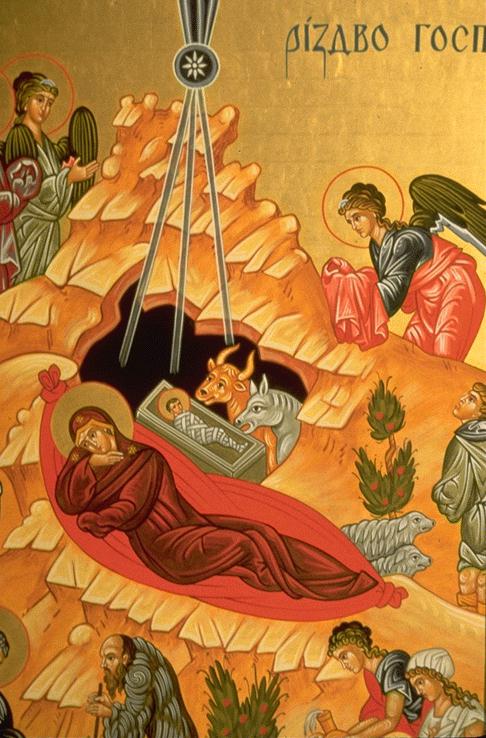
All sorts of people are attempting to "get in touch" with nature these days, from the secular environmentalists to neo-pagan tree-worshippers. While both groups seem to think that there's some need to listen to what nature is saying, the former only hears its own voice echoing back to it, as it sees mankind (rightly) as part of the creation, yet sees that creation as the sum total of existence and, therefore, no more or less important than human beings. The second tends to go a little deeper and, while it does acknowledge hidden rooms in this "one-story universe" (to use Fr. Stephen's terminology), the hidden glory behind nature is a false one, for its impersonal, collective spirit (shared also by humanity) bears no witness to an actual Creator, a Source of all being. Icons do what all Creation used to do and one day will do: declare the glory of God in all its fullness, a glory which even now shines not etherially from some intangible source, but from the corporeal face of the Word of the Creator (2 Cor. 4:6).
Subscribe to:
Posts (Atom)