This is just to say...
...I'll be taking a break from the blog for the next forty days, as today began the Orthodox Nativity Fast (for those of us on the New Calendar, at least). This is usually my custom during both the "Lents" of the year, so expect the same thing in the Spring.
I will, though, be breaking said fast once and only once (Lord helping me) to post pictures of the tonsuring mentioned in the previous post.
I wish you all a blessed Advent/Nativity season. May our Incarnate Lord have mercy on us all.

Wednesday, November 16, 2005


Sunday, November 13, 2005
December 4th
Just an announcement that on Dec. 4th, St. Barbara's Day (our parish's patronal feastday), Lord willing, a few men in my parish (a group which includes me) will be tonsured readers by His Eminence, Archbishop DMITRI. News to all of us; we'd only had one class (though we've all been doing the work of readers for months, some of us years).
Your prayers for Daniel, Demetrios, and Peter would be appreciated.
(And before anyone says it: yes, I am aware that, after that point, upon approaching the Chalice I will be referred to as "The Reader Peter," which sounds like "the Reeder Peeder." Hardy har. Eh...keeps ya' humble...)
Your prayers for Daniel, Demetrios, and Peter would be appreciated.
(And before anyone says it: yes, I am aware that, after that point, upon approaching the Chalice I will be referred to as "The Reader Peter," which sounds like "the Reeder Peeder." Hardy har. Eh...keeps ya' humble...)
Tuesday, November 08, 2005
Suffering Towards Stillness
Been thinking recently about the concept of apatheia--or passionlessness, as it's known in English-speaking Orthodox circles--and how it's ultimately the goal of each Christian striving towards theosis. Also on my mind is the unfortunate contemporary connotation surrounding the Greek word's English cognate: apathy.
Apathy is defined as a "lack of feeling or emotion" or a "lack of interest or concern." Understandable, then, are the raised eyebrows that respond to one who is said to be "striving for apatheia." The Greek word, however, is very different, for it calls us not to turtle-shell, shoe-staring introspection, not to reclusion from the world--though some have felt the call to flee for the sake of their own souls--but rather to a steadfastness, an immovablity within a person. This hearkens back to the likes of St. Ireneaus and his contemporaries, who said that the immutablity of God is one of His greatest, most lauded qualities--for in it lies His utter dependability and changelessness--and it is also one for which Christians should strive most diligently.
Again, I speak not of indifference to others' lives and sorrows, but to our own selves, our so-called "rights," our runaway-train impulses. When insulted, we bear no malice, desire no revenge. When tempted, we feel no pull, no conflict. Apatheia, then, is not a matter of simply "doing the right thing and not doing the wrong thing," but rather a matter of having our very nature tranformed--or, better yet, transfigured--so that we are healed from being vulnerable to these weaknesses. We stand strong and still because God has made us so.
This, however, requires effort, an effort of the heart and mind--for our natural tendency is not to act from within, but simply to react to stimuli from without--and we truly do have little, in and of ourselves, that is capable of moving in the sovereign freedom of God that St. Gregory of Nyssa talked about.
Funny thing, though: the Christian perfection that we are called to--to the point where, as I said earlier, "when tempted, we feel no pull, no conflict"--is not arrived at easily or soon, or, for most, at all in this life. St. Antony, the father of monasticism himself, has said that we are to expect temptation to our last breath. There is no "absolute zero" of the soul, as it were, no total stillness to be found--rather, when one ceases to give oneself "over to every evil desire [and be] a slave to passion" in a certain area (when one has borne his or her cross and successfully died to passion X, in other words)--one can consider himself healed, but healed only to bear more crosses. This suffering towards stillness--and it can only be this way, for in the Cross' humility Christ finds glory and secures our race's salvation--is what St. Paul means when he says that "we all, with unveiled face, beholding as in a mirror the glory of the Lord, are being transformed into the same image from glory to glory, just as by the Spirit of the Lord" (2 Cor. 3:18).
May we all "stand still, and see the salvation of the LORD" (Ex. 14:13).
Apathy is defined as a "lack of feeling or emotion" or a "lack of interest or concern." Understandable, then, are the raised eyebrows that respond to one who is said to be "striving for apatheia." The Greek word, however, is very different, for it calls us not to turtle-shell, shoe-staring introspection, not to reclusion from the world--though some have felt the call to flee for the sake of their own souls--but rather to a steadfastness, an immovablity within a person. This hearkens back to the likes of St. Ireneaus and his contemporaries, who said that the immutablity of God is one of His greatest, most lauded qualities--for in it lies His utter dependability and changelessness--and it is also one for which Christians should strive most diligently.
Again, I speak not of indifference to others' lives and sorrows, but to our own selves, our so-called "rights," our runaway-train impulses. When insulted, we bear no malice, desire no revenge. When tempted, we feel no pull, no conflict. Apatheia, then, is not a matter of simply "doing the right thing and not doing the wrong thing," but rather a matter of having our very nature tranformed--or, better yet, transfigured--so that we are healed from being vulnerable to these weaknesses. We stand strong and still because God has made us so.
This, however, requires effort, an effort of the heart and mind--for our natural tendency is not to act from within, but simply to react to stimuli from without--and we truly do have little, in and of ourselves, that is capable of moving in the sovereign freedom of God that St. Gregory of Nyssa talked about.
Funny thing, though: the Christian perfection that we are called to--to the point where, as I said earlier, "when tempted, we feel no pull, no conflict"--is not arrived at easily or soon, or, for most, at all in this life. St. Antony, the father of monasticism himself, has said that we are to expect temptation to our last breath. There is no "absolute zero" of the soul, as it were, no total stillness to be found--rather, when one ceases to give oneself "over to every evil desire [and be] a slave to passion" in a certain area (when one has borne his or her cross and successfully died to passion X, in other words)--one can consider himself healed, but healed only to bear more crosses. This suffering towards stillness--and it can only be this way, for in the Cross' humility Christ finds glory and secures our race's salvation--is what St. Paul means when he says that "we all, with unveiled face, beholding as in a mirror the glory of the Lord, are being transformed into the same image from glory to glory, just as by the Spirit of the Lord" (2 Cor. 3:18).
May we all "stand still, and see the salvation of the LORD" (Ex. 14:13).
Monday, November 07, 2005
5th Line of 23rd Post
A meme I saw on Mimi's blog prompted me to look this up for myself.
The 5th line of my 23rd post is the following:
The 5th line of my 23rd post is the following:
"The last sentence gave me pause: 'But don't despair: science has proven that "Happy Couplehood" has only a six-month duration (a year, tops), so they'll be immersed in the unpleasantness of everyday existence soon enough, just like the rest of us.'"Read here for the context. Thanks, Mimi. All you other veteran bloggers, let's hear it!
Monday, October 31, 2005
Hope Halloween Photos!
Check the site linked to in my profile (right over to the right under my picture on the words "this little one") for updated photos from this evening--Hope's our little peapod!
Friday, October 28, 2005


Tuesday, October 25, 2005
Thoughts about Languages
Have been thinking the past couple of days about how my students are doing and comparing this to my own achievement in a foreign language class. This then led to a comparison of teaching methods; they say one teaches the way one was taught, but this is definitely not the case with me. Some background...
I began studying Spanish in the seventh grade. Dad (as well as Sesame Street) had given my little sponge brain a nice little primer (numbers, basic greetings, feelings, etc) growing up, and I took to the subject eagerly and naturally OK, I'll be honest: I was and am, academically speaking, a dork in that I LOVE the hallowed halls of academia, so taking to the subject naturally wasn't too much of a surprise, if I can say that without sounding too arrogant...**grimaces**...what DID surprise me was how much I LOVED the subject itself! Math, science, even English--I loved the fact that I could succeed in these courses with little effort, but Spanish...I just LOVED learning it for its own sake. And I learned the traditional way--textbook vocabulary lists, grammar exercises, workbook listening and speaking exercises, etc.--with an almost innate ability to take the grammar rules I'd learned and put them to use in real-life situations.
So I go to college, double major in English Ed and Spanish, and wind up teaching Spanish in a non-magnet school environment (my high school environment was accelerated, AP-type stuff), and, sho nuf, I taught they way I was taught: worksheets, verb conjugation charts, etc. At the end of the year, though, something was odd: my students could conjugate the heck out of a verb or two, meaning that they knew grammar rules, but they didn't know Spanish; if someone came up to them and asked them ¿Qué hora es? they'd be stuck. So I investigated TPR--Total Physical Response--and it claimed to address this very problem. I read a couple of books on it over a summer, and implemented the stuff I gleaned from it the following year.
It was (and is) amazing. My students, in terms of actual communication, can do more after three months of instruction in TPR than my kids in traditional schooling could do after a whole YEAR of instruction. Rather than focus on grammar, we take phrases (already conjugated somehow) and assign an action to them, and every time I say the phrase, they do the action until the sound of the word triggers the meaning. Then, we put the words (along with the words they've already acquired) into a story (which they make up, mostly) and they can oftentimes retell the story with relative ease. They even write their own stories--over 100 words in nine minutes at this point for many of them--and we have quite a bit more fun than I remember having in my own, traditional Spanish class (aside from the dorky, "Wow-this-is-nifty-'cause-I'm-learning!!!" fun, that is).
So why the comparison? Well, like anybody who naturally achieves at something, I find myself feeling as though I'm depriving my kids. TPRS (the S being for Storytelling) doesn't stress formal grammar, correct conjugation, etc) like traditional learning, so it's hard for me not to cringe when I hear my kids say something like, ¡Mi necesitaba fue baño, Señor! (a horrible version of "I need to go to the bathroom, sir!") It's made me realize exactly what it is that I do when I take all those grammar rules and run them through my head real quick-like to communicate in higher-level Spanish: it's like doing calculus in one's head. On the one hand, I know there are bright kids who can handle the grammar, who can use the grammar (as well as the extensive vocab units) and go onto AP stuff. But the majority of these kids...man...this is just getting them to do basic (read: ROUGH) communication in Spanish; the use of the more intricate grammatical functions is and most likely will be lost on them.
So it's a matter, imo, of doing the most I can for as many as I can, and trusting that the ones who will go on and succeed are not going to be killed by going more slowly than I'd like (the premise of TPRS being "Teach less...but teach it more") and that, if they want to continue in this they'll catch the vocab later. It's difficult being someone who got all the vocab words and irregular verbs the first time he heard them; Lord grant that I would act wisely, without embittering or embarrassing those who do not have the gift You've given me.
Lord, have mercy. Lord, have mercy. Lord, have mercy! And blessed be the name of the LORD.
I began studying Spanish in the seventh grade. Dad (as well as Sesame Street) had given my little sponge brain a nice little primer (numbers, basic greetings, feelings, etc) growing up, and I took to the subject eagerly and naturally OK, I'll be honest: I was and am, academically speaking, a dork in that I LOVE the hallowed halls of academia, so taking to the subject naturally wasn't too much of a surprise, if I can say that without sounding too arrogant...**grimaces**...what DID surprise me was how much I LOVED the subject itself! Math, science, even English--I loved the fact that I could succeed in these courses with little effort, but Spanish...I just LOVED learning it for its own sake. And I learned the traditional way--textbook vocabulary lists, grammar exercises, workbook listening and speaking exercises, etc.--with an almost innate ability to take the grammar rules I'd learned and put them to use in real-life situations.
So I go to college, double major in English Ed and Spanish, and wind up teaching Spanish in a non-magnet school environment (my high school environment was accelerated, AP-type stuff), and, sho nuf, I taught they way I was taught: worksheets, verb conjugation charts, etc. At the end of the year, though, something was odd: my students could conjugate the heck out of a verb or two, meaning that they knew grammar rules, but they didn't know Spanish; if someone came up to them and asked them ¿Qué hora es? they'd be stuck. So I investigated TPR--Total Physical Response--and it claimed to address this very problem. I read a couple of books on it over a summer, and implemented the stuff I gleaned from it the following year.
It was (and is) amazing. My students, in terms of actual communication, can do more after three months of instruction in TPR than my kids in traditional schooling could do after a whole YEAR of instruction. Rather than focus on grammar, we take phrases (already conjugated somehow) and assign an action to them, and every time I say the phrase, they do the action until the sound of the word triggers the meaning. Then, we put the words (along with the words they've already acquired) into a story (which they make up, mostly) and they can oftentimes retell the story with relative ease. They even write their own stories--over 100 words in nine minutes at this point for many of them--and we have quite a bit more fun than I remember having in my own, traditional Spanish class (aside from the dorky, "Wow-this-is-nifty-'cause-I'm-learning!!!" fun, that is).
So why the comparison? Well, like anybody who naturally achieves at something, I find myself feeling as though I'm depriving my kids. TPRS (the S being for Storytelling) doesn't stress formal grammar, correct conjugation, etc) like traditional learning, so it's hard for me not to cringe when I hear my kids say something like, ¡Mi necesitaba fue baño, Señor! (a horrible version of "I need to go to the bathroom, sir!") It's made me realize exactly what it is that I do when I take all those grammar rules and run them through my head real quick-like to communicate in higher-level Spanish: it's like doing calculus in one's head. On the one hand, I know there are bright kids who can handle the grammar, who can use the grammar (as well as the extensive vocab units) and go onto AP stuff. But the majority of these kids...man...this is just getting them to do basic (read: ROUGH) communication in Spanish; the use of the more intricate grammatical functions is and most likely will be lost on them.
So it's a matter, imo, of doing the most I can for as many as I can, and trusting that the ones who will go on and succeed are not going to be killed by going more slowly than I'd like (the premise of TPRS being "Teach less...but teach it more") and that, if they want to continue in this they'll catch the vocab later. It's difficult being someone who got all the vocab words and irregular verbs the first time he heard them; Lord grant that I would act wisely, without embittering or embarrassing those who do not have the gift You've given me.
Lord, have mercy. Lord, have mercy. Lord, have mercy! And blessed be the name of the LORD.
Sunday, October 23, 2005
Just in Case You Haven't Read it Yet...
...'cause it's attained mildly legendary status among the "Net-odox"...
The Church is Visible and One by Patrick Barnes of orthodoxinfo.com reknown, regarding THE issue that (ultimately) converted me.
Fabulous. Rather long, but fabulous.
The Church is Visible and One by Patrick Barnes of orthodoxinfo.com reknown, regarding THE issue that (ultimately) converted me.
Fabulous. Rather long, but fabulous.
Child on Loan from God
So I'm standing in line for communion today behind my wife, and our daughter, cradled in the arms of her godmother Mary, is going up before us.
I suddenly had a "head smack" moment of why we do this godparent thing. Yes, yes, the historical roots of such a practice date back to the days of the Roman persecutions when parents stood a good chance--due to the likelyhood of martyrdom--of never seeing their kids grow up in the Faith, so godparents were assigned to do just that. There is that. But watching the two of them approach the Chalice, approach our God's flesh and blood while we just stood there impressed two things upon me:
1) This child is not really mine. Biologically, yeah. Don't get any ideas. But she's "on loan," as it were. And that meeting at the Chalice is why she's really here. That's Who she really belongs to, so the fact that another should take her there, who's specifically there to be an example in the faith, seems fitting to me.
2) The child went on up ahead of me, which left me free to...pray. For myself. She was fine. She was partaking of the all-holy Body and precious Blood of the Lord, unhindered by any personal sin. I was not, and this needed my attention. For if my own life is unfocused, how can I help her focus hers?
I suddenly had a "head smack" moment of why we do this godparent thing. Yes, yes, the historical roots of such a practice date back to the days of the Roman persecutions when parents stood a good chance--due to the likelyhood of martyrdom--of never seeing their kids grow up in the Faith, so godparents were assigned to do just that. There is that. But watching the two of them approach the Chalice, approach our God's flesh and blood while we just stood there impressed two things upon me:
1) This child is not really mine. Biologically, yeah. Don't get any ideas. But she's "on loan," as it were. And that meeting at the Chalice is why she's really here. That's Who she really belongs to, so the fact that another should take her there, who's specifically there to be an example in the faith, seems fitting to me.
2) The child went on up ahead of me, which left me free to...pray. For myself. She was fine. She was partaking of the all-holy Body and precious Blood of the Lord, unhindered by any personal sin. I was not, and this needed my attention. For if my own life is unfocused, how can I help her focus hers?
Friday, October 21, 2005
Trinity Explained to Muslims
An article concerning discussing the nature of the Trinity with Muslims. Fascinating.
Part of the text:
Thomas: How do you approach the souls that come to you? If they are Moslem how do you work with them and how do you explain the difference between Christianity and Islam. How do you draw them in?
Fr. Daniel: I think that in any missionary work, you must first of all understand the culture of the people and you have to be able to speak within the bounds of that cultural language, because otherwise your word cannot be heard or understood. So, when you talk with a Moslem, you must understand the Moslem mind. Don’t just try to throw in words and phrases that are familiar to Christians, to Orthodox, because they will not be understood by a Moslem. First of all, when you talk to a Moslem, you have to emphasize that God is One.
Thomas: Because they already believe this?
Fr. Daniel: Not only because they already believe this, but because they accuse us [the Christians] of having three gods. That is the problem. So, you have to clear up the misunderstanding that we worship three gods. Don’t try to use our traditional language, like Father, Son and Holy Spirit – because for them, that is three gods! In their minds, the Father is different, the Son is different, the Holy Spirit is different. For myself, I emphasize that God is One, that this One God is also the Living God, and as the Living God He has Mind. Because if God didn’t have a mind, I’m sorry to say, He would be like an idiot. God has to have a mind. Within the Mind of God there is the Word. Thus, the Word of God is contained within God Himself. So, God in His Word is not two, but one. God is full with His own Word; He is pregnant with Word.
And that Word of God is then revealed to man. The thing that is contained within – like being impregnated within oneself – when it is revealed, it is called being born out of that person. That is why the Word of God is called the Son: He is the Child Who is born from within God, but outside time. So, that is why this One God is called the Father, because He has His own Word Who is born out of Him, and is called the Son. So, Father and Son are not two gods. The Father is One God, the Son is that Word of God. The Moslem believes that God created the world through the Word. So what the Moslem believes in as Word, is what the Christians call the Son! In that way, we can explain to them that God does not have a son separate from Himself.
Thomas: So the Moslems see our idea of the Son of God in terms of physical sonship.
Fr. Daniel: Yes, of course. And God does not have a son in that way, that’s true. He is not begetting in the sense of a human being giving birth. He is called the Father because He produces from Himself, His own Word, and that Word is the Son. So because God is the living God, He must have the principle of life within Himself. In man, this principle of life is man’s spirit. God is the same. The principle of life within God is the Spirit of God. It is called the Holy Spirit. But the Holy Spirit is not the name of the Angel Gabriel, as the Moslems understand it. The Holy Spirit is the living principle, the principle of life and power within God Himself. This One God is called the Father because He produced from Himself His own Word, which is called the Son, and the Word of God is called the Son because He is born out of the Father eternally, without beginning, without end. This One Living God also has Spirit within Himself. So, Father, Son and Holy Spirit is one God. This is the way we explain to Moslems about the Trinity, and we should not try to use our language of “Father and Son, co-equal, co-...” something like that. Even though it is our Christian terminology, they will not understand this. The purpose is not to theologize to them but to explain the reality of the Gospel in a way that is understandable to them. This is point number one: you have to be clear about the Trinity. The second point is this: the basic difference between Islam and Christianity concerns revelation. In Islam, God does not reveal Himself. God only sends down His word. “Revelation” in Islam means “the sending down of the word of God” through the prophets. And that word is then written down and becomes scripture. So in Islam, revelation means the “inscripturization” of the word of God while in Christianity, it is not the same. The Word was sent down to the womb of the Virgin Mary, took flesh and became man. Namely, Jesus Christ.
So, the two religions believe that God communicated Himself to man by means of the Word, but the difference is how that Word manifested in the world. In Christianity it is manifested in the person of Jesus Christ and in Islam it is manifested in the form of a book, the Koran. So, the place of Mohammed in Islam is parallel to the place of the Virgin Mary in Orthodox Christianity. That is why in Islam the Moslems respect Mohammed, not as a god, but as the bearer of revelations. Just as the Orthodox Church respects the Virgin Mary not as a goddess but as the bearer of the Word of God, who gave birth to the Word of God. Incidentally, the two religions both give salutations, to Mohammed for the Moslems and to the Virgin Mary for Christians. The Moslems also have a kind of akathist, like a paraclesis but to Mohammed! It is called the depa abarjanji – in Orthodox terms it would be a “canon” to Mohammed, because he is the bearer of the revelation.
Part of the text:
Thomas: How do you approach the souls that come to you? If they are Moslem how do you work with them and how do you explain the difference between Christianity and Islam. How do you draw them in?
Fr. Daniel: I think that in any missionary work, you must first of all understand the culture of the people and you have to be able to speak within the bounds of that cultural language, because otherwise your word cannot be heard or understood. So, when you talk with a Moslem, you must understand the Moslem mind. Don’t just try to throw in words and phrases that are familiar to Christians, to Orthodox, because they will not be understood by a Moslem. First of all, when you talk to a Moslem, you have to emphasize that God is One.
Thomas: Because they already believe this?
Fr. Daniel: Not only because they already believe this, but because they accuse us [the Christians] of having three gods. That is the problem. So, you have to clear up the misunderstanding that we worship three gods. Don’t try to use our traditional language, like Father, Son and Holy Spirit – because for them, that is three gods! In their minds, the Father is different, the Son is different, the Holy Spirit is different. For myself, I emphasize that God is One, that this One God is also the Living God, and as the Living God He has Mind. Because if God didn’t have a mind, I’m sorry to say, He would be like an idiot. God has to have a mind. Within the Mind of God there is the Word. Thus, the Word of God is contained within God Himself. So, God in His Word is not two, but one. God is full with His own Word; He is pregnant with Word.
And that Word of God is then revealed to man. The thing that is contained within – like being impregnated within oneself – when it is revealed, it is called being born out of that person. That is why the Word of God is called the Son: He is the Child Who is born from within God, but outside time. So, that is why this One God is called the Father, because He has His own Word Who is born out of Him, and is called the Son. So, Father and Son are not two gods. The Father is One God, the Son is that Word of God. The Moslem believes that God created the world through the Word. So what the Moslem believes in as Word, is what the Christians call the Son! In that way, we can explain to them that God does not have a son separate from Himself.
Thomas: So the Moslems see our idea of the Son of God in terms of physical sonship.
Fr. Daniel: Yes, of course. And God does not have a son in that way, that’s true. He is not begetting in the sense of a human being giving birth. He is called the Father because He produces from Himself, His own Word, and that Word is the Son. So because God is the living God, He must have the principle of life within Himself. In man, this principle of life is man’s spirit. God is the same. The principle of life within God is the Spirit of God. It is called the Holy Spirit. But the Holy Spirit is not the name of the Angel Gabriel, as the Moslems understand it. The Holy Spirit is the living principle, the principle of life and power within God Himself. This One God is called the Father because He produced from Himself His own Word, which is called the Son, and the Word of God is called the Son because He is born out of the Father eternally, without beginning, without end. This One Living God also has Spirit within Himself. So, Father, Son and Holy Spirit is one God. This is the way we explain to Moslems about the Trinity, and we should not try to use our language of “Father and Son, co-equal, co-...” something like that. Even though it is our Christian terminology, they will not understand this. The purpose is not to theologize to them but to explain the reality of the Gospel in a way that is understandable to them. This is point number one: you have to be clear about the Trinity. The second point is this: the basic difference between Islam and Christianity concerns revelation. In Islam, God does not reveal Himself. God only sends down His word. “Revelation” in Islam means “the sending down of the word of God” through the prophets. And that word is then written down and becomes scripture. So in Islam, revelation means the “inscripturization” of the word of God while in Christianity, it is not the same. The Word was sent down to the womb of the Virgin Mary, took flesh and became man. Namely, Jesus Christ.
So, the two religions believe that God communicated Himself to man by means of the Word, but the difference is how that Word manifested in the world. In Christianity it is manifested in the person of Jesus Christ and in Islam it is manifested in the form of a book, the Koran. So, the place of Mohammed in Islam is parallel to the place of the Virgin Mary in Orthodox Christianity. That is why in Islam the Moslems respect Mohammed, not as a god, but as the bearer of revelations. Just as the Orthodox Church respects the Virgin Mary not as a goddess but as the bearer of the Word of God, who gave birth to the Word of God. Incidentally, the two religions both give salutations, to Mohammed for the Moslems and to the Virgin Mary for Christians. The Moslems also have a kind of akathist, like a paraclesis but to Mohammed! It is called the depa abarjanji – in Orthodox terms it would be a “canon” to Mohammed, because he is the bearer of the revelation.
The Psalms of David -- Psalm 16
This is a psalm we pray during the hours before a divine liturgy; especially helpful to me personally is the following verse, which often serves as a meditation for times of temptation (good for praying on the knots of a prayer rope):
Fr. Patrick talks a lot about how St. Peter heard the psalms explained to him by Christ after the resurrection and used them when he preached. St. Peter was an ignorant fisherman when Christ found him, but preached the Messiah from the prayerbook of the Church. Comforting to me, another Peter, who desires to meet the Word through the psalms. Arise, O LORD...
Arise, O LORD, confront him, cast him down, deliver my life from the wicked with Your sword.Also telling are the last two verses, with all their talk of the unrighteous' belly being filled with its portion in this life, as opposed to the righteous' being satisfied only when he "beholds the form" or "awakes in the likeness" of God. This truly is the struggle I know I face: determining day by day--often minute by minute!--where my satisfaction will come from. Will I find my portion in what is passing away in this world with all its passions, or will I be satisfied only by beholding and becoming like the One who is above it all, who changes and heals it all (myself included, if I let Him)?
Fr. Patrick talks a lot about how St. Peter heard the psalms explained to him by Christ after the resurrection and used them when he preached. St. Peter was an ignorant fisherman when Christ found him, but preached the Messiah from the prayerbook of the Church. Comforting to me, another Peter, who desires to meet the Word through the psalms. Arise, O LORD...
A Hard Week and a Half
Been a while since I've posted. There's been a lot that's happened...tonight's the first night I've been able to sit down in a while and get online. Our AC unit, which had been giving us hints a while back that it was on its last leg, finally gave up the ghost last Thursday. As this is TX, that's not a good thing. So--thank God for family--we stayed at my aunt and uncle's house through Tuesday morning, which was the earliest they could come and install a new unit (the old one was installed in '86. Yeah. That's old.). No internet at their house, and no ability to post at school. Ah, well.
Add to this lovely complication--isn't it amazing how living out of someone else's house and having to shuttle stuff back and forth puts a cramp in your life?--the fact that I am one of the lead sponsors of our school's sophomore class and that this past week was homecoming, and you have one tired dude. Had to decorate our hall, which meant a week and a half of staying after school, facilitating student work days, storing and moving materials, and putting it all up (with the help of a VERY dedicated core group of students) last night. Now, this would have been difficult regardless. HOWEVER! We--Trimble Technical High School--share a building with a night school who (of course!) had chosen this week to administer the state's standardized tests and (again, of course!) would be using my room to administer said test after school. So--once again feeling the pain of shuttling materials from one place to another because of an unforseen event (we had not been notified by our administrators that the other school would do this, though they'd known for weeks prior)--we moved all the decorations we'd done down to the other head sponsor (who, of course, is on the first floor while I am on the fourth. Joy).
I am happy to say that, small and inconsequential a victory though it may be, we did, in fact, win the competition for best class hall decorations. Now my life can resume its more-or-less normal pattern.
Just in time for another surprise. Hoo boy.
Add to this lovely complication--isn't it amazing how living out of someone else's house and having to shuttle stuff back and forth puts a cramp in your life?--the fact that I am one of the lead sponsors of our school's sophomore class and that this past week was homecoming, and you have one tired dude. Had to decorate our hall, which meant a week and a half of staying after school, facilitating student work days, storing and moving materials, and putting it all up (with the help of a VERY dedicated core group of students) last night. Now, this would have been difficult regardless. HOWEVER! We--Trimble Technical High School--share a building with a night school who (of course!) had chosen this week to administer the state's standardized tests and (again, of course!) would be using my room to administer said test after school. So--once again feeling the pain of shuttling materials from one place to another because of an unforseen event (we had not been notified by our administrators that the other school would do this, though they'd known for weeks prior)--we moved all the decorations we'd done down to the other head sponsor (who, of course, is on the first floor while I am on the fourth. Joy).
I am happy to say that, small and inconsequential a victory though it may be, we did, in fact, win the competition for best class hall decorations. Now my life can resume its more-or-less normal pattern.
Just in time for another surprise. Hoo boy.
Friday, October 14, 2005
The Psalms of David -- Psalms 14-15
Psalm 14 asks the LORD who may abide in His tabernacle. Fr Patrick says this means four things:
It is “an ethical inquiry by which man seeks to identify the nature of the dark, haunting, and native imperative that stalks his soul.”
Its implied eschatology is that “at the base of his soul [man] senses that it would be life’s greatest tragedy if he should, at the end, fail to abide in God’s tabernacle and to rest on His holy mountain.”
It is “invariably answered with some kind of command: ‘Believe,’ ‘repent,’ ‘love justice and hate iniquity,’ ‘be baptized,’ ‘sell all you have and give to the poor,’ ‘take up your cross.’ In other words, since God puts the…question into the human heart, it is a justified question that is always answered.”
“The same haunting sense that prompts the inquiry also informs the man that he is supposed to scale to the pinnacle, and…we would rightly be suspicious of any response suggesting acquiescence in the aboriginal gravity of our fallen state. ‘Doing what comes naturally’ is scarcely the path to ascent. To ‘go with the flow’ is invariably to go lower.”
Psalm 15, then, ties all the commands given to the man who would ascend -- which, by the way, all paint a picture of a man the Fathers say has achieved peace, stillness and immoveable inner silence -- into one particular description (v. 8):
May we set Him before the eyes of our hearts through constant meditation and contemplation of His Name. May we be so still at His side that we resist any of our own, sinful, inner reactions to the cares of the world listed in Psalm 14, and rather that we be moved into action from our stillness only by the holy prodding of the Holy Spirit.
Psalm 15, then, ties all the commands given to the man who would ascend -- which, by the way, all paint a picture of a man the Fathers say has achieved peace, stillness and immoveable inner silence -- into one particular description (v. 8):
“I have set the LORD always before me: because He is at my right hand I shall not be moved.”
May we set Him before the eyes of our hearts through constant meditation and contemplation of His Name. May we be so still at His side that we resist any of our own, sinful, inner reactions to the cares of the world listed in Psalm 14, and rather that we be moved into action from our stillness only by the holy prodding of the Holy Spirit.
The Psalms of David -- Psalm 13 / 52
“The Fool Says in his Heart…”
An interesting note: the almost identical duplication of this psalm within the psalter shows the result of some overlapping from two different collections that eventually made it into the book and were not “synchronized” to prevent the repetition.
Fr. Patrick seems to think that “there is no God” refers only to the atheist, who is, in Fr.’s opinion, is the ultimate in foolishness, engaging in the ultimate and voluntary denial of the self-evident God. He “cuts some slack” to the idolaters mentioned in Wisdom 13 and Romans 1, as though they were not cut from the same cloth.
I think, though, that we today deal with idolaters of a different stripe: the idol is now secularism, and it is much more damaging, I think, than pure atheism. The latter vehemently set itself up as the overt enemy of God (and thereby tacitly acknowledged Him), causing the adherents of the Faith to resist it (atheism) more passionately. Secularism, however, says “there is no God” in a much more devious way, I think. Secularism desires to destroy the transcendent One, to say that nothing can surpass the physical world, that nothing is greater than what our senses can show us, and that (and here’s the horrid part), while God may be found, He is not to be seen as above or beyond -- and certainly not as ruling over! -- the physical world. Therefore, by saying that God is not over something, the secularist, while leaving room for the existence of a deity, is, in his idolatry of the material, denying that this deity is a transcendent One -- and yet we know that if God is not God over all, He ceases to be God at all. A more devious thing, therefore, is not merely to say “There is no God,” but rather “there is no God as He Himself proclaims Himself to be, for the latter, though it allows for the presence in our mind of a deity of sorts, makes it a powerless one, one who will not interfere, one who will not break into our tiny, material worlds and shatter our created souls with His fiery Grace.
May we see You as You are; burn away our foolish hearts, O LORD…
An interesting note: the almost identical duplication of this psalm within the psalter shows the result of some overlapping from two different collections that eventually made it into the book and were not “synchronized” to prevent the repetition.
Fr. Patrick seems to think that “there is no God” refers only to the atheist, who is, in Fr.’s opinion, is the ultimate in foolishness, engaging in the ultimate and voluntary denial of the self-evident God. He “cuts some slack” to the idolaters mentioned in Wisdom 13 and Romans 1, as though they were not cut from the same cloth.
I think, though, that we today deal with idolaters of a different stripe: the idol is now secularism, and it is much more damaging, I think, than pure atheism. The latter vehemently set itself up as the overt enemy of God (and thereby tacitly acknowledged Him), causing the adherents of the Faith to resist it (atheism) more passionately. Secularism, however, says “there is no God” in a much more devious way, I think. Secularism desires to destroy the transcendent One, to say that nothing can surpass the physical world, that nothing is greater than what our senses can show us, and that (and here’s the horrid part), while God may be found, He is not to be seen as above or beyond -- and certainly not as ruling over! -- the physical world. Therefore, by saying that God is not over something, the secularist, while leaving room for the existence of a deity, is, in his idolatry of the material, denying that this deity is a transcendent One -- and yet we know that if God is not God over all, He ceases to be God at all. A more devious thing, therefore, is not merely to say “There is no God,” but rather “there is no God as He Himself proclaims Himself to be, for the latter, though it allows for the presence in our mind of a deity of sorts, makes it a powerless one, one who will not interfere, one who will not break into our tiny, material worlds and shatter our created souls with His fiery Grace.
May we see You as You are; burn away our foolish hearts, O LORD…
The Psalms of David -- Psalm 12
The Psalms of David -- Psalm 12
“How Long, O LORD?”
Some beautifully crafted thoughts on this from Fr. Patrick:
“How Long, O LORD?”
Some beautifully crafted thoughts on this from Fr. Patrick:
“Psalm 12 yields yet a more ample understanding if we hear it on the lips of the Lord Jesus during the night of His agony and betrayal…As it was in the garden that we first fell beneath the power of darkness, entirely proper it was that the redeeming blood of our true Adam
should fall first on the earth of the orchard, in the shadows of the garden trees, those dear and lovely trees, of whose fruit, He told us, we might freely eat. His blood puddle on the very ground where we contemned His gracious trees, and where the earth had been cursed, and where the ancient serpent was condemned to crawl across it on his belly…Every night has something about it of Gethsemane and the dark salvific drama that unfolded amidst the witnessing trees.
“That nocturnal engagement of Jesus in the garden is repeated, too, in the souls of those He has reconciled to God, for they also are summoned to the bearing of His cross, warring against the devil, sin, and death.”
The Psalms of David -- Psalm 11
A bit of a “shop talk” reflection from this language teacher:
Fr. Patrick makes the claim in his commentary on this psalm that it is an example of the way Scripture goes against the idea prevalent in today’s society that “[h]uman society, no matter how sinful and deceived, is named the final authority over speech, which is responsible only to those who use it…” He makes the claim based on the idea that man can arbitrarily decide what words mean without regard for the objective truth of God, which was the original purpose of man’s use of speech (cf. Adam’s naming of the animals).
A good idea, I think, but a bit too general…the nature of the defining of individual words is in fact societal and arbitrary; the framing of our thoughts depends on a common societal agreement regarding the meaning of the individual words strung together to express said thoughts. But individual words’ definitions determine neither the capacity nor the tendency of a society to reflect God’s truth either accurately or poorly. Any rendering of individual words is capable of either reflecting or refuting God’s truth; it is the realization of this capability -- transcending as it does the mere use of individual words’ definitions – that determines either the godly or corrupt heart of a people.
Vv. 3-4: “May the LORD cut off all flattering lips, and the tongue that speaks proud things, Who have said, ‘With our tongue we will prevail; our lips are our own; who is lord over us?’”
Fr. Patrick makes the claim in his commentary on this psalm that it is an example of the way Scripture goes against the idea prevalent in today’s society that “[h]uman society, no matter how sinful and deceived, is named the final authority over speech, which is responsible only to those who use it…” He makes the claim based on the idea that man can arbitrarily decide what words mean without regard for the objective truth of God, which was the original purpose of man’s use of speech (cf. Adam’s naming of the animals).
A good idea, I think, but a bit too general…the nature of the defining of individual words is in fact societal and arbitrary; the framing of our thoughts depends on a common societal agreement regarding the meaning of the individual words strung together to express said thoughts. But individual words’ definitions determine neither the capacity nor the tendency of a society to reflect God’s truth either accurately or poorly. Any rendering of individual words is capable of either reflecting or refuting God’s truth; it is the realization of this capability -- transcending as it does the mere use of individual words’ definitions – that determines either the godly or corrupt heart of a people.
Sunday, October 09, 2005
The Psalms of David -- Psalm 10
The LORD is in His holy temple /
The LORD’s throne is in heaven.
"God's throne is the source of our stability and the foundation of our hope," says Fr. Patrick of this psalm. "If there is any firmness for our lives, any steadfastness for our souls, the cause of such constancy is the immoveable throne of Christ our God. Consequently, in the history of Christian prayer this line has often served as the interpretive antiphon for Psalm 10, especially on the Feast of Our Lord's Ascension."
Saturday, October 08, 2005
The Psalms of David -- Psalm 9
Here begin the different renderings of the Psalms in the Septuagint (the Greek translation of the OT) and the Masoretic Text (the Hebrew text received by the rabbis). I'll henceforth be using the LXX ("Seventy," from whence the Septuagint gets its name) rendering, as it's the official Bible of the Orthodox Church. In the Masoretic Text, this is Psalm 9 and 10 combined:
The triumph of the risen Christ, as expressed to His Father!
The triumph of the risen Christ, as expressed to His Father!
Remembering our place as "dust in the wind," or mere dust that the breath of life has animated:3 When my enemies turn back,
They shall fall and perish at Your presence.
4 For You have maintained my right and my cause;
You sat on the throne judging in righteousness.
5 You have rebuked the nations,
You have destroyed the wicked;
You have blotted out their name forever and ever.
6 O enemy, destructions are finished forever!
And you have destroyed cities;
Even their memory has perished.
7 But the LORD shall endure forever;
He has prepared His throne for judgment.
8 He shall judge the world in righteousness,
And He shall administer judgment for the peoples in uprightness.
9 The LORD also will be a refuge for the oppressed,
A refuge in times of trouble.
10 And those who know Your name will put their trust in You;
For You, LORD, have not forsaken those who seek You.
11 Sing praises to the LORD, who dwells in Zion!
Declare His deeds among the people.
12 When He avenges blood, He remembers them;
He does not forget the cry of the humble.
13 Have mercy on me, O LORD!
Consider my trouble from those who hate me,
You who lift me up from the gates of death,
14 That I may tell of all Your praise
In the gates of the daughter of Zion.
I will rejoice in Your salvation.
20 Put them in fear, O LORD,Contrasting the godly, Christ-like, humble, satisfied man with the man of this world who seeks only his own gain and not that of God or his neighbor:
That the nations may know themselves to be but
men.
23 For the wicked boasts of his heart’s desire;The reason for the wickedness in my own life; the product of deception:
He blesses the greedy and renounces the LORD.
24 The wicked in his proud countenance does not seek God;
God is in none of his thoughts....
29 He lies in wait secretly, as a lion in his den;
He lies in wait to catch the poor;
He catches the poor when he draws him into his net....
31 He has said in his heart, "God has forgotten; He hides His
face; He will never see."
33 Why do the wicked renounce God?The ultimate goal of our Lord (deals with destinies of those who are proud and those who are humble of heart):
He has said in his heart,
“You will not require an account.”
38 To do justice to the fatherless and the oppressed,
That the man of the earth may oppress no more.
Wednesday, October 05, 2005
The Psalms of David -- Psalms 7 and 8
"Psalms of the Incarnation"--Fr. Patrick gives this theme to these two psalms, which portray very different moods. The psalter as a whole, he says, is seen as a very "human" book, but not in the sense that it centers around humans as the end-all; it ultimately centers on Christ as man. "The Psalter is not human merely because it speaks for man in general, but because it speaks for Christ. The underlying voice of the Psalms is not simply "man," but the Man."
Seven is said to be a parallel of our Lord's passion--from the initial plot to betray the LORD'S Anointed One to the scourging, crucifixion, and death. This highly emotionally expressive psalm "is not [there] to give expression to our own personal feelings, but to discover something of His. It is to taste, in some measure, the bitterness and the gall."
Eight is a meditation on the parallel between the fourth verse--"What is man"--that is, the total of our race--"that You are mindful of him, / And the son of man that You visit him?"--and the Creed, where we see the uniquely translated line, "and was incarnate of the Virgin Mary and was made man"--that is, made into the total of all mankind, the restatement of the whole human race in Himself, the "reboot" of humanity in that one Man. The man little lower than the angels and crowned with glory and honor (Heb. 2:9); the subjugation of all things under the first Adam was a precursor to all things being put under Christ's rule later.
Good, I think, that those two psalms are back to back; the passion and the pain of the Cross before the glory and honor of the Resurrection. O Lord, bring us further into union with Thy Passion and Thy Resurrection, that we might truly walk with Thee; through the prayers of the holy Prophet David, have mercy on us.
Seven is said to be a parallel of our Lord's passion--from the initial plot to betray the LORD'S Anointed One to the scourging, crucifixion, and death. This highly emotionally expressive psalm "is not [there] to give expression to our own personal feelings, but to discover something of His. It is to taste, in some measure, the bitterness and the gall."
Eight is a meditation on the parallel between the fourth verse--"What is man"--that is, the total of our race--"that You are mindful of him, / And the son of man that You visit him?"--and the Creed, where we see the uniquely translated line, "and was incarnate of the Virgin Mary and was made man"--that is, made into the total of all mankind, the restatement of the whole human race in Himself, the "reboot" of humanity in that one Man. The man little lower than the angels and crowned with glory and honor (Heb. 2:9); the subjugation of all things under the first Adam was a precursor to all things being put under Christ's rule later.
Good, I think, that those two psalms are back to back; the passion and the pain of the Cross before the glory and honor of the Resurrection. O Lord, bring us further into union with Thy Passion and Thy Resurrection, that we might truly walk with Thee; through the prayers of the holy Prophet David, have mercy on us.
Monday, October 03, 2005
The Psalms of David -- Psalm 6
1 O LORD, do not rebuke me in Your anger,We serve a God Who will destroy all iniquity, Who will purge away--and violently so--all evil, corruption, dishonesty, vanity, selfishness, and disobedience from this earth. He abhors it, and the hatred towards it is felt by those who would unite themselves to it. We must, therefore, take care to avoid union with these cancers, as they will be purged; let us not be consumed as well, O our Creator.
Nor chasten me in Your hot displeasure.
At the risk of sounding flippant, another--obviously lighter--comparison to the wrath of God and its consumption of wickedness and those who practice it: siblings who are told to refrain from hitting their siblings often work around this prohibition by saying that "they were just swinging their fist and his/her face got in the way!" A lame excuse in that case, but relatively like what God will one day do. He does not delight in the death of a sinner, nor does He establish their death as some sort of payback or vengeance (at least, not in the hurt, spiteful way that we easily-offended humans know it). He destroys wickedness with a swing of His Fist that cannot be stopped; any man who would unite himself to wicked deeds is "in the way," as it were, and will feel the same pain as the wicked demons who are consumed along with him.
2 Have mercy on me, O LORD, for I am weak;There's a song whose lyrics include the following:
O LORD, heal me, for my bones are troubled.
3 My soul also is greatly troubled;
But You, O LORD—how long?
4 Return, O LORD, deliver me!
Oh, save me for Your mercies’ sake!
5 For in death there is no remembrance of You;
In the grave who will give You thanks?
And the smell of our sacrificesThe psalmist senses the need for a purification, a cleansing not only of a record of wrongs done, but of a death that cascades down to our very bones. This death will be the universal end of us all, David knows, unless the LORD intervenes. No one gives the LORD thanks from the grave; our own courting of death cuts us off from life as Eucharist even now, thus making us less than human. Were we to turn, however, from our thankless deeds and walk towards Him apart from His Way of the Cross and Resurrection, even then it would not be enough, for it is our very nature, now finite and mortal, that would still be drawn to the dust from whence it came. Obedience is not enough; there must be a salvation from the fruit of sin, still present and eating away at this world. We must succumb for a while to our race's chosen fate in order to bear that other, glorious fruit of immortality.
still fills up my head
There’s just a few left at the altar, Lord
all the rest of them fled
And we’ve cried and we’ve tried
We’ve sweat and we’ve bled
But we don’t just need atonement
We need to be raised from the dead
6 I am weary with my groaning;Would that I saw my sin as being this serious.
All night I make my bed swim;
I drench my couch with my tears.
7 My eye wastes away because of grief;
It grows old because of all my enemies.
8 Depart from me, all you workers of iniquity;And the saint knows he grieves not as one without hope. The battle that he wages, though long and without an end in sight, is one of victory if fought through.
For the LORD has heard the voice of my weeping.
9 The LORD has heard my supplication;
The LORD will receive my prayer.
10 Let all my enemies be ashamed and greatly troubled;
Let them turn back and be ashamed suddenly.
Glory to the Father, and to the Son, and to the Holy Spirit; now and ever, and unto ages of ages. Amen.
Saturday, October 01, 2005
The Psalms of David -- Psalm 5
A good coincidence that today's psalm comes at the same time it's scheduled to be prayed in Morning Prayers.
What strikes me here--other than the repeated battle of good vs. evil that is again so clearly drawn by David--is the confidence David has in placing himself on the "good side." This man knew he was righteous. Not perfect--we all have our Bathshebas--but righteous. He was not a bloodthirsty man, not boastful or a worker of iniquity, not deceitful or a flatterer, not faithless or a wicked liar. When he did stumble into sin, he knew how to repent and accept the forgiveness and correction of God and His servants.
I have no such confidence, nor such skill in repentance. I have to say, however, that these meditations on just how much spiritual warfare Joe Christian is expected to fight--and I speak only of that within his own heart!--are strengthening me in areas where before I had simply "rolled over" and stood in the path of the sinner...which, of course, means that the enemy turns up the heat on his side.
Noteable notes from Fr. Patrick on this psalm:
What strikes me here--other than the repeated battle of good vs. evil that is again so clearly drawn by David--is the confidence David has in placing himself on the "good side." This man knew he was righteous. Not perfect--we all have our Bathshebas--but righteous. He was not a bloodthirsty man, not boastful or a worker of iniquity, not deceitful or a flatterer, not faithless or a wicked liar. When he did stumble into sin, he knew how to repent and accept the forgiveness and correction of God and His servants.
I have no such confidence, nor such skill in repentance. I have to say, however, that these meditations on just how much spiritual warfare Joe Christian is expected to fight--and I speak only of that within his own heart!--are strengthening me in areas where before I had simply "rolled over" and stood in the path of the sinner...which, of course, means that the enemy turns up the heat on his side.
Noteable notes from Fr. Patrick on this psalm:
"The Greek (parastesomai) [in verse 3, "direct it to You" in the NKJV]...preserve[s] the original sense [in the Hebrew] of simply standing in proper order in the presence of God. To this is added a certain note of vigilance, 'keep watch.' These two verbs...set the tone for how to begin the day of prayer."
"...the proper praying of the psalms is rleated to a certain regular and disciplined style of life. The Christian, by preference, rises early and stands in vigilance in the presence of God. When the sun rises, it shines on the believer already at prayer."
"The context for this worship...is still the life of strugle with evil. When the Christian rises, it is always on the battlefield."
"'They have rebelled against You,' the psalm says. Sin is abhorrent to God. He not only loves justice; He also hates iniquity. 'Fools shall not stand in Your presence,' our psalm goes on, 'You hate all workers of iniquity.' When the psalmist prays for the destruction of the wicked, this is not his personal sentiment...of private vindictiveness but of foundational justice. It is a plea that God vindicate His own moral order. When Jesus refused to 'pray for the world' (John 17:9), He was recognizing the existence of those who, willfully unrepentant and deliberately hard of heart, have placed themselves beyond hope...Jesus on the Cross had not one word to say to the blasphemous, unrepentant thief."
"Some modern Christians are tempted to see in such sentiments [as those mentioned above] only a lamentable vestige of Old Testament negativity and judgementalism, now appropriately surpassed by a New Testament emphasis on God's mercy and compassion...Such an idea would have surprised the Apostles...Indeed, the descriptions of sin in Romans 1 and 3 make a good commentary on many verses of Psalm 5. Similarly, when the Book of Wisdom says that 'equally hateful to God are the ungodly man and his ungodliness' (14:9), its thesis is hard to distinguish from certain verses in the New Testament, such as 'I never knew you; depart from me, you who pravctice lawlessness' (Matt. 7:23 cf. 25:41) and 'You hate the deeds of the Nicolaitans, which I also hate' (Rev. 2:6; cf. 21:8; 22:15). The loving mercy of God must never be thought of or described in ways suggesting that Christianity is less morally serious than Judaism. The moral sentiments of the psalms are, in this respect, Christian sentiments, and they are highly appropriate in Christian prayer."
Friday, September 30, 2005
The Psalms of David -- Psalm 4
I guess if I had a phrase to describe this psalm's impression on my heart upon this last reading, it'd be this: God is a loner's sufficiency.
What I mean is--and Fr. Patrick's commentary says as much, too--that to follow God in this world means to separate yourself from the fallen activities of those who are wicked. As much as we may look with disdain upon those sects who pride themselves on "no dancing, no alcohol, no movies, no whatever," as much as we may talk about God redeeming and baptizing the world and making all things into passages into the Kingdom of God, there're just certain things that cannot be baptized and must needs be avoided, for they will eventually be destroyed by a holy God; any attachment to these unredeemable things on our part, then, equals our own destruction.
This is lonely! Or, it can be. This psalm, in all truthfulness, reminds me of the feelings I often had during my high school years. My high school, as academically challenging and beneficial as it may have been, was also overrun by those who were often violently opposed to any appeal to the divine and violently committed to any vice that would fly in the divine's Face. David cries:
Yet, though we are yet in battle against spiritual passions and demonic influences (and not, as I reminded myself all through high school, against my fellow men), though we go even to our beds still fighting this war, we are commanded not to allow that most long-lasting passion of anger to plague us. The Orthodox Christian is to strive for the passionlessness, the immutability that is an attribute of God Himself. We can feel the anger, but we must not allow ourselves to be carried away by it, always remaining serenely and submissively within the Hands of our Lord, hands that--maddeningly!--may not rush off to vindicate us as quickly as we'd like...or at all, as far as we know...
Or, as David said:
What I mean is--and Fr. Patrick's commentary says as much, too--that to follow God in this world means to separate yourself from the fallen activities of those who are wicked. As much as we may look with disdain upon those sects who pride themselves on "no dancing, no alcohol, no movies, no whatever," as much as we may talk about God redeeming and baptizing the world and making all things into passages into the Kingdom of God, there're just certain things that cannot be baptized and must needs be avoided, for they will eventually be destroyed by a holy God; any attachment to these unredeemable things on our part, then, equals our own destruction.
This is lonely! Or, it can be. This psalm, in all truthfulness, reminds me of the feelings I often had during my high school years. My high school, as academically challenging and beneficial as it may have been, was also overrun by those who were often violently opposed to any appeal to the divine and violently committed to any vice that would fly in the divine's Face. David cries:
"How long, O you sons of men, will you turn my glory to shame? How long will you love worthlessness and seek falsehood? But know that the LORD has set apart for Himself him who is godly; the LORD will hear when I call to Him."Notice that God has set apart those godly ones for Himself; they are now His sons, as opposed to the "sons of men," those whose lives consist solely of those things which are rooted in this world, which are seen as ends in themselves and not sacraments of passage into the One, True Life.
Yet, though we are yet in battle against spiritual passions and demonic influences (and not, as I reminded myself all through high school, against my fellow men), though we go even to our beds still fighting this war, we are commanded not to allow that most long-lasting passion of anger to plague us. The Orthodox Christian is to strive for the passionlessness, the immutability that is an attribute of God Himself. We can feel the anger, but we must not allow ourselves to be carried away by it, always remaining serenely and submissively within the Hands of our Lord, hands that--maddeningly!--may not rush off to vindicate us as quickly as we'd like...or at all, as far as we know...
Or, as David said:
"Be angry, and do not sin. Meditate within your heart on your bed, and be still."
Thursday, September 29, 2005
The Psalms of David -- Psalm 3
Am feeling drawn to the psalms of the Prophet David as of late; will be posting anything from the psalms attributed to him that catches my attention. Am also reading as a companion to David's psalms the book Christ in the Psalms by Fr. Patrick Henry Reardon.
Fr. Patrick says the following concerning Ps. 3:
Fr. Patrick says the following concerning Ps. 3:
"So we begin the day. Psalm 1 has already contrasted the lots of the just and the unjust, and Psalm 2 indicated the battle between the two sides. Now, in this third psalm, there cries out the just man engaged in that battle: 'Lord, how increased are they that trouble me; many are they that rise up against me. Many there be that say of my soul: "There is no help for him in God".'
"Conflict we have here, and the distress that conflict brings, for fighting battles is one of the major motifs of the Book of Psalms. This is not a prayer book for the noncombatant, and unless a person is actually engaged in hostilities it is difficult to see how he can pray Psalm 3: 'Arise, O Lord, save me, O my God; for You have smitten all my enemies on the jaw; You have broken the teeth of the ungodly.'"
Friday, September 23, 2005
Reminders...
An older post of James' reminded me of the Evangelical bumper sticker I used to like:
Now I'd like one like this:"In case of rapture, this car will be unmanned."
"In case of rapture, can I have your car?"
Thursday, September 22, 2005
Bad Math?
Newsweek's got it on their cover, and I think they ask it best:
Katrina
+ Iraq
- Taxes
--------
= How Much?
This was the same problem in the election last November--neither Kerry nor Bush was willing to tell the public the truth: that we all need to dig deep and make a sacrifice, because, whether we initially supported it or not, we're in this conflict in Iraq now for better or for worse, and are now faced with the awful consequences of a horrible hurricane season. What's maddening is not ONLY that Bush continues to trim taxes, not ONLY that he doesn't seem to see the horrific budget practice that this is, but that, even if he does, he doesn't seem to be able to find the spine to face the public and tell us like a man that we'll all need to step up and take a hit--yes, in our blessed pocketbooks--for our country.
This from a schoolteacher who's the sole financial provider for his family. Trust me; I KNOW about budgeting, and this ain't it.
Or, for a slightly more (ahem) spirited commentary on the subject, see here (wait for it to finish loading; it'll scroll down to the relevant post).
+ Iraq
- Taxes
--------
= How Much?
This was the same problem in the election last November--neither Kerry nor Bush was willing to tell the public the truth: that we all need to dig deep and make a sacrifice, because, whether we initially supported it or not, we're in this conflict in Iraq now for better or for worse, and are now faced with the awful consequences of a horrible hurricane season. What's maddening is not ONLY that Bush continues to trim taxes, not ONLY that he doesn't seem to see the horrific budget practice that this is, but that, even if he does, he doesn't seem to be able to find the spine to face the public and tell us like a man that we'll all need to step up and take a hit--yes, in our blessed pocketbooks--for our country.
This from a schoolteacher who's the sole financial provider for his family. Trust me; I KNOW about budgeting, and this ain't it.
Or, for a slightly more (ahem) spirited commentary on the subject, see here (wait for it to finish loading; it'll scroll down to the relevant post).
Saturday, September 17, 2005
Plumbing Escapades
This is a bit late in coming, but we lost water pressure to the house the week before Labor Day due to a pipe breaking (it was made of shoddy material that is now illegal, but what can you do...?). A friend of the family is a plumber, who itemized and priced every step of the repair. He let us know we could cut the price of the repair in half if I did the trenching myself for him to lay a new pipe. The old pipe--and I use the term "pipe" loosely--if repaired only in the place it broke, would probably just break elsewhere sooner or later. The following chronicles what happened:
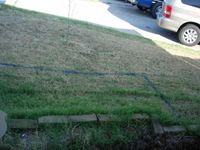
The line the plumber sprayed on our lawn going from the house towards our driveway.

The line from the left side of the driveway.
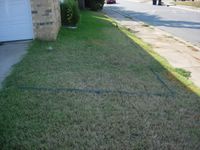
The line from the right side of the driveway down alongside the sidewalk to the meter.

In the meantime, what we did for water was, we put a hydrant spigot (at least, I think that's what it's called) near the meter, and attached an above ground hose to it...

...ran the hose along the side strip beside the sidewalk...
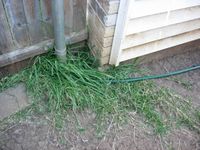
...put it under the fence...

...and ran it to this spigot in the back (it's a miracle our dog Brigid, pictured here, didn't chew this thing to bits!).
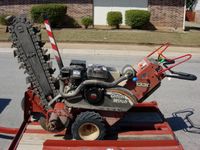
So the night before Labor Day, I went to Home Depot and rented this Ditch Witch trencher for a day. It was $132, which is considerably better than the $800 we would have spent on labor!
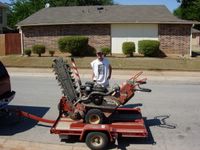
To give you an idea of the size of this thing, I'm just under 6' and am standing on the same level as the tire of the trencher.
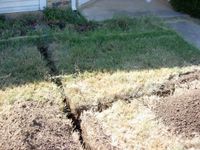
The ditch I dug from the tank away from the house.
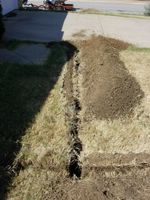
The ditch from out from the house to the left side of the driveway; we had to get the plumber to go underneath the driveway with a high-powered hose in order to lay the pipe under it without breaking up the concrete.
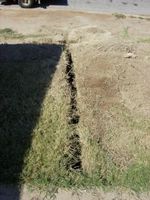
The ditch from the right side of the driveway to the sidewalk.
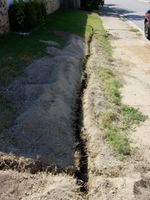
The ditch alongside the sidewalk to the meter.
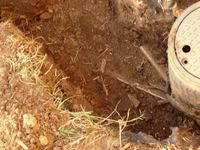
The new entrance of the pipe to a tank by our house, using PVC pipe.
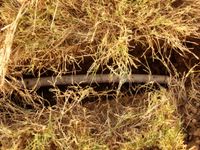
The new pipeline; the PVC will last almost as long as copper (several decades) and is one-third the price. Sweeeeeet.

The line the plumber sprayed on our lawn going from the house towards our driveway.
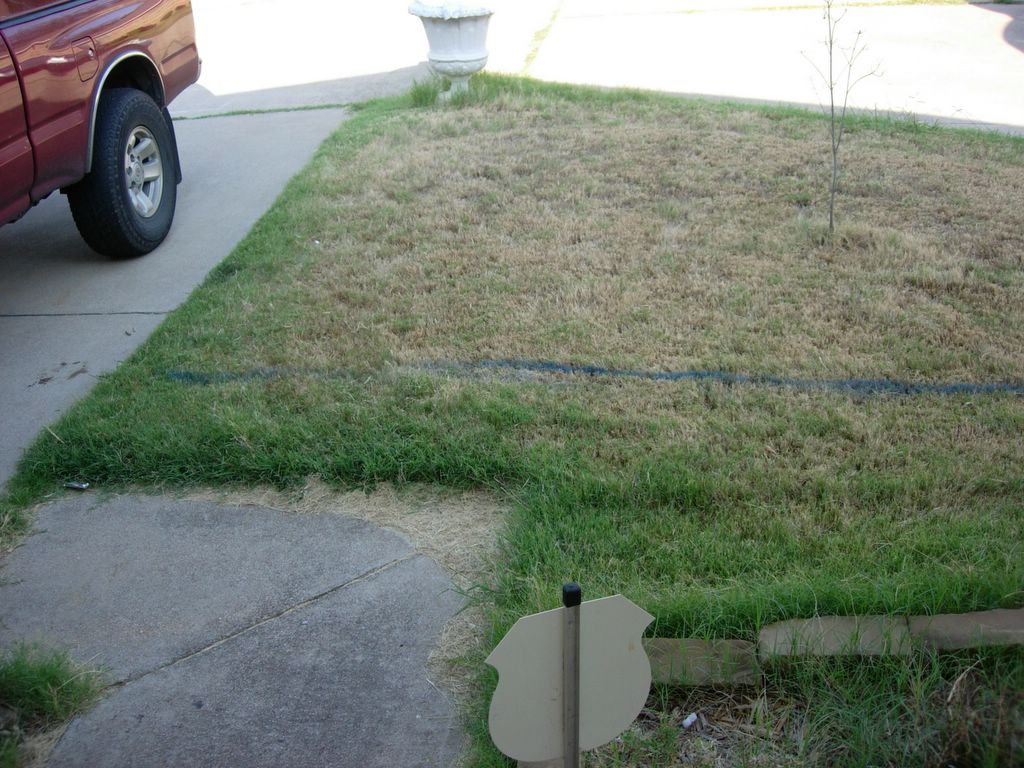
The line from the left side of the driveway.

The line from the right side of the driveway down alongside the sidewalk to the meter.

In the meantime, what we did for water was, we put a hydrant spigot (at least, I think that's what it's called) near the meter, and attached an above ground hose to it...

...ran the hose along the side strip beside the sidewalk...

...put it under the fence...

...and ran it to this spigot in the back (it's a miracle our dog Brigid, pictured here, didn't chew this thing to bits!).

So the night before Labor Day, I went to Home Depot and rented this Ditch Witch trencher for a day. It was $132, which is considerably better than the $800 we would have spent on labor!

To give you an idea of the size of this thing, I'm just under 6' and am standing on the same level as the tire of the trencher.
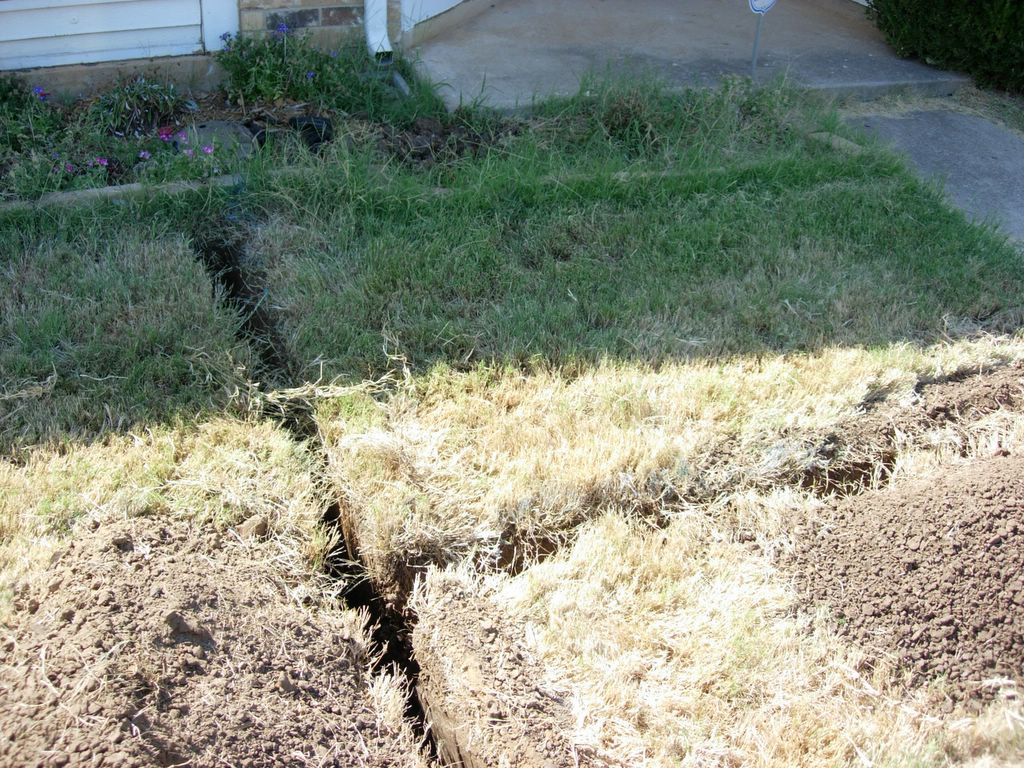
The ditch I dug from the tank away from the house.

The ditch from out from the house to the left side of the driveway; we had to get the plumber to go underneath the driveway with a high-powered hose in order to lay the pipe under it without breaking up the concrete.

The ditch from the right side of the driveway to the sidewalk.

The ditch alongside the sidewalk to the meter.

The new entrance of the pipe to a tank by our house, using PVC pipe.

The new pipeline; the PVC will last almost as long as copper (several decades) and is one-third the price. Sweeeeeet.
Friday, September 16, 2005
Saturday, September 10, 2005

Windows and stone are done; Fr. says that, now that the exterior of the building is pretty much done (except for the dome, which will be last), all the rest of the jobs on the new building are two- to three-day jobs on the interior (sheet rock, drywall, floor, etc.). He's giving us a move-in date of sometime in either Oct. or Nov.!

The completed stone exterior from a bit further back

The stone wall from even further back

The worker installing the ducts.

Ducts on the floor.

Ducts on inside of new church building.
Links to the previous phases of the building program:
Phase 1
Phase 2
Phase 3
Phase 4
Phase 5
Phase 6
Thursday, September 08, 2005
Thoughts on Katrina Victims
There's a lot of speculation coming out of the situation in New Orleans; it's led me to do some thinking of my own.
Two very different views from Orthodox Christians can be found here and here regarding the state of the thousands of victims that were stranded in New Orleans.
As usual, I find myself somewhere in the middle in terms of what I stress in these situations.
I, for one, find it inconceivable that, in the face of such a potentially fatal catastrophe, a man would not, even if desperately poor, sell all he yet had if only to buy bus fare out of town for himself and his family. I suppose this comes from the example given to me by my dear mother, who worked two jobs all through my K-12 years in order to afford the small apartments I grew up in. We were not rich by any stretch of the imagination. On the contrary; we were, relatively speaking, rather poor. Yet I saw in that woman an absolute resistance to adverse situations that, though she perhaps did not always act in the most prudent or practical manner to resolve said situations, absolutely drove her to do what was necessary to make ends meet. It is from this upbringing that this incredulity springs; I simply cannot fathom why so many would stay, citing insufficient funds as a reason. The mere thought of my family being destroyed by anything would drive me to do whatever was needed to avoid it.
Yet there is, undoubtedly, an unlevel playing field when it comes to certain groups of people and generationally-engrained approaches to life. Tragically, this often is marked by race, especially in the South, where the infamous and evil blight of slavery--which forbade that blacks learn to read, write or "cipher"--began a habitual neglect of rigorous academic pursuit among many African Americans. Of course, we know the great achievements of Frederick Douglass, W.E.B. DuBois, Booker T. Washington, Langston Hughes, Zora Neale Hurston, Ralph Ellison and many others; there is no denying that African Americans from poor upbringings can achieve and have achieved academic heights that rival and often surpass those of privileged whites. Yet it seems--and I say this as a schoolteacher whose students are almost all black--that many of the poorer black students are addicted to the idea that all things must come easily (for they are poor and lack the means to gain the finer things in life) and that, if it does not, it is not worth struggling for (for such a struggle would inevitably end in failure). These students are perfectly content to slide by, barely passing (if that), and many times refuse to believe in themselves enough to give themselves a fighting chance.
I do wonder if this had anything to do with why many poorer citizens of New Orleans did not undertake the admittedly daunting task of preparing what little they had and fleeing by any means possible. Perhaps there was doubt as to whether they could actually raise enough money. Perhaps the doubt lay in whether they could arrange for a suitable place to stay outside the city. I do not know, but I believe this reluctance to actively and aggressively engage adverse situations is a cross. For any impoverished African American, young or otherwise, who comes from a home life which discourages academic success and higher levels of thinking, it will not be an easy road. Perhaps assistance from outside sources--church, government, etc.--will be needed, as is often the case (even Christ had a Simon of Cyrene at His side). Yet perhaps by bearing this cross redemption can come.
My apologies if I have offended anyone by this message. Your thoughts would be appreciated...
Two very different views from Orthodox Christians can be found here and here regarding the state of the thousands of victims that were stranded in New Orleans.
As usual, I find myself somewhere in the middle in terms of what I stress in these situations.
I, for one, find it inconceivable that, in the face of such a potentially fatal catastrophe, a man would not, even if desperately poor, sell all he yet had if only to buy bus fare out of town for himself and his family. I suppose this comes from the example given to me by my dear mother, who worked two jobs all through my K-12 years in order to afford the small apartments I grew up in. We were not rich by any stretch of the imagination. On the contrary; we were, relatively speaking, rather poor. Yet I saw in that woman an absolute resistance to adverse situations that, though she perhaps did not always act in the most prudent or practical manner to resolve said situations, absolutely drove her to do what was necessary to make ends meet. It is from this upbringing that this incredulity springs; I simply cannot fathom why so many would stay, citing insufficient funds as a reason. The mere thought of my family being destroyed by anything would drive me to do whatever was needed to avoid it.
Yet there is, undoubtedly, an unlevel playing field when it comes to certain groups of people and generationally-engrained approaches to life. Tragically, this often is marked by race, especially in the South, where the infamous and evil blight of slavery--which forbade that blacks learn to read, write or "cipher"--began a habitual neglect of rigorous academic pursuit among many African Americans. Of course, we know the great achievements of Frederick Douglass, W.E.B. DuBois, Booker T. Washington, Langston Hughes, Zora Neale Hurston, Ralph Ellison and many others; there is no denying that African Americans from poor upbringings can achieve and have achieved academic heights that rival and often surpass those of privileged whites. Yet it seems--and I say this as a schoolteacher whose students are almost all black--that many of the poorer black students are addicted to the idea that all things must come easily (for they are poor and lack the means to gain the finer things in life) and that, if it does not, it is not worth struggling for (for such a struggle would inevitably end in failure). These students are perfectly content to slide by, barely passing (if that), and many times refuse to believe in themselves enough to give themselves a fighting chance.
I do wonder if this had anything to do with why many poorer citizens of New Orleans did not undertake the admittedly daunting task of preparing what little they had and fleeing by any means possible. Perhaps there was doubt as to whether they could actually raise enough money. Perhaps the doubt lay in whether they could arrange for a suitable place to stay outside the city. I do not know, but I believe this reluctance to actively and aggressively engage adverse situations is a cross. For any impoverished African American, young or otherwise, who comes from a home life which discourages academic success and higher levels of thinking, it will not be an easy road. Perhaps assistance from outside sources--church, government, etc.--will be needed, as is often the case (even Christ had a Simon of Cyrene at His side). Yet perhaps by bearing this cross redemption can come.
My apologies if I have offended anyone by this message. Your thoughts would be appreciated...
Tuesday, September 06, 2005
Why the South Seceded
One of the best speeches I have ever read on why the southern states seceded from the Union in 1861. It was delivered by the Hon. John H. Reagan, the last surviving member of the Confederate States Cabinet. Even better, it was delivered right here in Ft. Worth, TX!
Monday, September 05, 2005
Daddy Duty
Woke up yesterday to a wife with a pretty upset stomach, so it was just me and the li'l stinker in Liturgy yesterday. It was really different being in the main congregation (I'm usually in the choir), but it was refreshing.
A few things I was reminded of:
- The word liturgy means "common work," or "work of the people." Were this to be "stressed from the pulpit" (or "small, moveable podium," in our case) it would at least put the ball in the court of those in the nave to sing, to pray, to pay attention...to put forth their efforts into this sacrifice, efforts of praise which St. Paul (or whomever) says are themselves a sacrifice, "the fruit of lips that confess his name" (Heb. 13:15). It was good to be a part of this work in this common way which, to be quite honest, really helps me forget myself. Sometimes reading the epistle or singing in the choir, being one of those who helps lead everyone else into prayer, can bring about the temptation to notice oneself, to acknowledge one's own visiblity. Rich Mullins said once that, after playing piano in church and thinking he'd done a very good job, his teacher (also a member of the church) reprimanded him, for he should desire to disappear so that the people could focus on Christ in prayer, not him. His awareness of common work is seen in a statement where he says the following:
"When I go to church...I involve myself in something that identifies me with Augustine, that identifies me with Christ, that identifies me with nearly 2000 years of people who have come together once a week and said, 'Let’s go to the Lord’s table and enjoy the feast that He has prepared for us.' In that week I may have been subjected to a million billboards that try to make me identify with the thinking of contemporary society. But once a week I go back to church, and acknowledge that though the shape of the world is really different now than it used to be, this remains the same: I still come to the Lord’s table and say, 'Oh God, if it weren’t for your grace, if it weren’t for the sacrifice of Christ, my life would have no meaning, no life would have real substance.' And I do that voluntarily."
- To piggyback on Rich's thoughts: I am dust. Mere dirt that has been blown on to be praise unto my Creator. To that dust, one day, I shall return, "whither we mortals all shall go," as our prayer for the departed says. The fact that I consumed the One Flesh that unites and unties us (an initial typo proved to merit keeping around just there), the One Blood that washes and frees us, the One Hope that will take the dusty, feeble parts of me that have succumbed to decay and age--this One Gift will be the seed of immortality my body (should I endure to the end in struggling with my crosses) shall put on: His glorious immortality made tangible in the Eucharist.
- My role that day, as feeder, holder, and comforter of a two-month old child there in the midst of Heaven-meeting-earth, was to take the child given me (also dust, but a much cuter configuration thereof) and present her before this life-giving Fountain, to make it, as much as I can, the center, not only of my life, but of hers (the former, I am well aware, is a necessary part of the latter's coming to pass). That we might, individually and together, be a part of that One Body who will rise up and raise us up on that final Day.
Happy Name's Day to Hope!

The barren wilderness thou didst make fertile with the streams of thy tears; and by thy deep sighing thou hast given fruit through thy struggles a hundredfold. Accordingly, thou hast become a star for the universe, sparkling with miracles. Therefore, O righteous Mother Elizabeth, intercede with Christ God to save our souls.
Friday, September 02, 2005
"It's a third world country down there..."
The scenes of dirt, refugees, disease, riots, looting, men fighting like dogs in the street, homes (and in the case of Waveland, Miss., whole cities) flattened to nothing...it's brought the Katrina victims to the level of many people in the third world.
Lord, have mercy. Lord, have mercy. Lord, have mercy.

(Click on the ribbon to find out how to donate to the relief effort.)
Lord, have mercy. Lord, have mercy. Lord, have mercy.

(Click on the ribbon to find out how to donate to the relief effort.)
Saturday, August 27, 2005
Active Saints
From this site, an electronic version of a Conciliar Press tract, Prayer and the Departed Saints:
Why, then, the hesitating tone of this post? It is not to refute this particular passage, but perhaps to complement it. It is easier for a former Protestant to get his or her mind around the saints in heaven merely praying for us in some sort of "eternal prayer meeting"; it is quite another thing to imaging the saints themselves doing battle, delivering messages, appearing to those on earth...being actively involved in matters of men's salvation, in other words. When we pray, "Most Holy Theotokos, save us," we all know that it is not a cry for her to ascend the Cross in the flesh--only her divine Son could do and indeed did do that--but is it more than just a cry for her to "pray for us sinners"?
Indeed, the post-communion prayer to the "All-Holy Theotokos" in my prayer book says the following:
We all know--it is evident enough in our hymns--that only one is God: the Father, the Son, and the Holy Spirit, the Trinity, one in essence and undivided. The Theotokos is not included in this object of worship, nor is any other saint. We need not go further into this. It seems to me, however, that the prayer quoted above seems to lend itself rather nicely to the idea St. Peter put forth--that we shall be partakers of the divine nature--and that St. Paul expressed--that we shall see Him as He is and shall be like Him. Christ said we shall do the things He did; why is it so hard to see the Mother of our Lord, close to Him as she now undoubtedly is, doing things in His name and for His glory in our lives?
The Theotokos has been seen over naval ships in battle, has intervened in the lives of such prominent saints as St. Nicholas of Myra and St. Mary of Egypt, and has been depicted in countless icons which miraculously weep tears and/or produce healing myrrh. Are we to infer from this that she is to be sought out instead of Christ, that she is just as good a refuge as Christ for our souls, or that she is a safer advocate when compared to the strict, austere Judge of the Nations? I do not think so, yet this is an accusation raised by many Evangelicals, most noticeably those who have spent any time in predominantly Roman Catholic countries where the Blessed Virgin or the Saints are held up in almost god-like reverence, with (so it would seem) scarcely a reference to the Lord of these saints.
To (finally) answer the objection raised by the well-meaning Evangelical, I would say that, in asking the Theotokos and the Saints to save us, to protect us, to make us worthy of everlasting life, to shelter and protect us, to guide us to the eternal kingdom etc., we should not look at them as replacements for Christ who are somehow in opposition to Him, but rather as ambassadors for Him who always seek to do His will. If a captain in the Army sends his general to do something in his stead, the general will (if he is a good general) act in complete obedience, acting in his general’s stead due to his captain’s absence. Will the general be praised for his works? Of course; he will, when the history books are written, be seen as a good and faithful general, who had a very real role in the overthrow of the forces of the enemy. So, too, are the saints honored and revered, for they not only pray and intercede with their most holy prayers, but also have been known to personally appear and minister to the faithful on earth and/or fight against the forces of darkness here on earth, all in the name of their (and our) Lord.
But, some might say, is our Captain not Himself able to accomplish these goals? Does not the idea of “generals” doing things “in His absence” relegate Him to a secondary role? Is it not blasphemous to share this Captain’s glory with His generals? Granted, the analogy of the Captain and his generals is an imperfect one. I would submit, however, that the action of the Lord’s using His holy ones to accomplish His purposes does not in any way take away from His glory in all things; rather, it increases it, for He is ultimately seen as the driving force behind it all. The commanding officer in battle is revered not only for his own exploits, but for his ingenious maneuvering of those under him. So, too, is our Lord blessed, not only for the salvation He has “wrought…in the midst of the earth,” but for the mighty acts He continues to enact amongst those still in this life through His faithful, departed servants. Is it possible that some will revere the servant in his or her obedience more than the Master? Yes, just as it was possible to say that one was “of Paul” or “of Cephas” or “of Apollos” in the first century AD. St. Paul, however, did not stop glorifying God through his actions simply because some could not see past him to Christ. Neither, then, should we deny the very real actions—worthy of very real praise!—done by the saints and the most holy Theotokos here on earth; Christ Himself has sent them—what an honor that must be!—to do something in His name…something which they, no doubt, will execute perfectly. In their obedience, He is glorified, yet they, too, are praised for their obedience to their Lord, and thanked for their very real and God-ordained part in our salvation.
These tracts, coming as they do from Ben Lomond, CA, have a decidedly formerly-Protestant bent and are written to address objections many Protestants would have concerning Orthodox doctrine and/or practice. I suppose I should start out by saying that the above can be taken as absolutely true. No saint's prayers or actions should ever be taken as being done apart from the will of God Himself. If things "get done" in the spiritual realm, it is ultimately because the Lord willed it, and it was ultimately done. It is most definitely NOT an issue of someone saying, "Well, the Lord must not like me very much, worthless sinner that I am; I'll just pray to the Theotokos or St. So-and-so, in the hopes that they'll 'talk God into' granting my request." This use of the saints and the Holy Mother--wherein they are pitted against the Lord of all as a sort of "buffer against an angry God"--is both an insult to these faithful servants of the Most High God, and an affront to the ever-loving, always-forgiving nature of our Lord. In this, the tract does well in saying that the prayers of the saints are always in line with the Lord's will, and that, in terms of what is ultimately accomplished, one saint may plant through his prayers, the Holy Theotokos may water through her intercessions or actions, but it is ultimately God who gives the increase.Can the saints answer our prayers directly? Is it within their power to grant our requests? The prayers of our brothers and sisters in Christ here on earth are only effective insofar as God answers them. It is the same with the intercessions of the saints in heaven for us. They can never answer prayers of their own accord or in their own power; they can only beseech Christ on our behalf. To imagine that prayer to the saints means that they can grant our requests apart from Christ is a totally unacceptable idea according to Orthodox theology and practice. So when we pray to the saints, the understanding is always clear that we are asking them to help us by praying to God, and not by their own power or actions apart from Him.
Why, then, the hesitating tone of this post? It is not to refute this particular passage, but perhaps to complement it. It is easier for a former Protestant to get his or her mind around the saints in heaven merely praying for us in some sort of "eternal prayer meeting"; it is quite another thing to imaging the saints themselves doing battle, delivering messages, appearing to those on earth...being actively involved in matters of men's salvation, in other words. When we pray, "Most Holy Theotokos, save us," we all know that it is not a cry for her to ascend the Cross in the flesh--only her divine Son could do and indeed did do that--but is it more than just a cry for her to "pray for us sinners"?
Indeed, the post-communion prayer to the "All-Holy Theotokos" in my prayer book says the following:
O All-holy Lady Theotokos, light of my darkened soul, my hope, my shelter, my refuge, my consolation and my joy: I thank thee that thou hast accounted me worthy, although unworthy, to be a partaker of the immaculate Body and precious Blood of thy Son. But do thou, who gavest birth to the true Light, enlighten the mental eyes of my heart; O thou who didst bear the fountain of immortality, quicken thou me who lie dead in sin. O compassion-loving Mother of the merciful God, have mercy upon me, and grant me humility and contrition of heart, and meekness in my thoughts, and deliverance from the bondage of my vain imaginings. And account me worthy, even unto my last breath, to receive without condemnation the sanctification of the immaculate Mysteries, unto the healing of both soul and body. And grant unto me tears of repentance and confession, that I may hymn thee and glorify thee all the days of my life: for blessed and glorified art thou unto all ages. Amen.This is the sort of prayer that seems to depart from the merely static status of intercessors many former Evangelicals give to the saints; indeed, many Evangelicals would be horrified at this prayer, as it seems to attribute characteristics and deeds to the Theotokos that are (or should be) reserved for Christ our God alone. What, then, do we as Orthodox say to this?
We all know--it is evident enough in our hymns--that only one is God: the Father, the Son, and the Holy Spirit, the Trinity, one in essence and undivided. The Theotokos is not included in this object of worship, nor is any other saint. We need not go further into this. It seems to me, however, that the prayer quoted above seems to lend itself rather nicely to the idea St. Peter put forth--that we shall be partakers of the divine nature--and that St. Paul expressed--that we shall see Him as He is and shall be like Him. Christ said we shall do the things He did; why is it so hard to see the Mother of our Lord, close to Him as she now undoubtedly is, doing things in His name and for His glory in our lives?
The Theotokos has been seen over naval ships in battle, has intervened in the lives of such prominent saints as St. Nicholas of Myra and St. Mary of Egypt, and has been depicted in countless icons which miraculously weep tears and/or produce healing myrrh. Are we to infer from this that she is to be sought out instead of Christ, that she is just as good a refuge as Christ for our souls, or that she is a safer advocate when compared to the strict, austere Judge of the Nations? I do not think so, yet this is an accusation raised by many Evangelicals, most noticeably those who have spent any time in predominantly Roman Catholic countries where the Blessed Virgin or the Saints are held up in almost god-like reverence, with (so it would seem) scarcely a reference to the Lord of these saints.
To (finally) answer the objection raised by the well-meaning Evangelical, I would say that, in asking the Theotokos and the Saints to save us, to protect us, to make us worthy of everlasting life, to shelter and protect us, to guide us to the eternal kingdom etc., we should not look at them as replacements for Christ who are somehow in opposition to Him, but rather as ambassadors for Him who always seek to do His will. If a captain in the Army sends his general to do something in his stead, the general will (if he is a good general) act in complete obedience, acting in his general’s stead due to his captain’s absence. Will the general be praised for his works? Of course; he will, when the history books are written, be seen as a good and faithful general, who had a very real role in the overthrow of the forces of the enemy. So, too, are the saints honored and revered, for they not only pray and intercede with their most holy prayers, but also have been known to personally appear and minister to the faithful on earth and/or fight against the forces of darkness here on earth, all in the name of their (and our) Lord.
But, some might say, is our Captain not Himself able to accomplish these goals? Does not the idea of “generals” doing things “in His absence” relegate Him to a secondary role? Is it not blasphemous to share this Captain’s glory with His generals? Granted, the analogy of the Captain and his generals is an imperfect one. I would submit, however, that the action of the Lord’s using His holy ones to accomplish His purposes does not in any way take away from His glory in all things; rather, it increases it, for He is ultimately seen as the driving force behind it all. The commanding officer in battle is revered not only for his own exploits, but for his ingenious maneuvering of those under him. So, too, is our Lord blessed, not only for the salvation He has “wrought…in the midst of the earth,” but for the mighty acts He continues to enact amongst those still in this life through His faithful, departed servants. Is it possible that some will revere the servant in his or her obedience more than the Master? Yes, just as it was possible to say that one was “of Paul” or “of Cephas” or “of Apollos” in the first century AD. St. Paul, however, did not stop glorifying God through his actions simply because some could not see past him to Christ. Neither, then, should we deny the very real actions—worthy of very real praise!—done by the saints and the most holy Theotokos here on earth; Christ Himself has sent them—what an honor that must be!—to do something in His name…something which they, no doubt, will execute perfectly. In their obedience, He is glorified, yet they, too, are praised for their obedience to their Lord, and thanked for their very real and God-ordained part in our salvation.
The Hardest Things
Someone on OC.net asked what the hardest part about Orthodoxy was for converts. I responded with the following:
The hardest part...hmm...
...two things, I guess.
I guess the first'd have to be dealing with the (natural?) tendency of people to see the chant, the icons, the incense, the vestments, the protocol, the rubrics, and all the other "trappings" of organized religion as ends in themselves. There was a phrase I used all the time as an Evangelical Protestant: "It's just all about Jesus." Meaning, of course, that anything that got in the way of an encounter with God was to be pushed aside so that we could focus on meeting Christ. It's easy to slip into "going through the motions" (another fav saying of mine when I was Protestant) and forget that all these things are passageways to that higher reality in which my Savior waits for me.
This, of course, was a Christ who is very different from--and much less demanding than--the Christ I see now in the Orthodox Church. The Christ from my Protestant days, yes, demanded that we change, but was still going to "get us off the hook" if we weren't totally sanctified at the end, 'cause after all, nobody's perfect. This, to me, is much more attractive than the God who is a consuming fire and will save some "only as through fire"--hardly a pleasant experience to think about, and not really something that goes over well in drive-thru America. So, this is the second thing: Christ the healer, made present through the holy icons, is focused intently on our sin and won't let stuff slide; He desires our full healing now, so that we can pass through the fire purified and clean. Gone is the benign Jesus who blesses us with His "warm fuzzies" and guaranteed heavenly bliss; now we are faced with our Brother and our Judge, and it is easy to become discouraged or even resentful against this much more businesslike, sometimes colder-seeming Christ of the Orthodox. The fact that I need to see amazing love in that face is one of the hardest things for me as an Orthodox Christian, but I do know it's absolutely there...more than that, it's there more than it is in the smiling Jesus of Evangelicalism.
This, I know, is my problem; still that old dichotomy I had drilled into me for twenty years. But it's a cross I'm learning, more and more, to carry, as it's only through the cross that we'll see the resurrection...
Saturday, August 20, 2005
I Guess I Shouldn't Be Surprised...
...if and when the divorce rate, like gas prices, reaches an all-time, ludicrous high...perhaps in part due to these cards...
Yes, ladies and gentlemen, for just a few bucks, you too can tell that special secret someone on the side that you're soooo grateful they're the one w/whom you're breaking a sacred covenant with God and your spouse. That's right, it's the "Secret Lover" line of greeting cards.
My initial reaction: "You've got to be kidding." Perhaps I'm just that naive and think that there might be some shred of dignity (or, on a lower common denominator, shame) left in American society that would keep this sort of thing out of reach of the common people. Apparently not...the report did mention that the current divorce rate is above 50% right now; anyone want to go for 75?
Lord. Have. Mercy!
Yes, ladies and gentlemen, for just a few bucks, you too can tell that special secret someone on the side that you're soooo grateful they're the one w/whom you're breaking a sacred covenant with God and your spouse. That's right, it's the "Secret Lover" line of greeting cards.
My initial reaction: "You've got to be kidding." Perhaps I'm just that naive and think that there might be some shred of dignity (or, on a lower common denominator, shame) left in American society that would keep this sort of thing out of reach of the common people. Apparently not...the report did mention that the current divorce rate is above 50% right now; anyone want to go for 75?
Lord. Have. Mercy!
Friday, August 19, 2005
More Pics of Hope

Playin' in the floor, and wondrin' what that flashy thing is Mama's got...

Fascinated in the floor...

Pretty red dress...she just LOVES playin' in the floor...!

BIG ol' grin!

Smilin' in the swing...

Happy li'l swinger!

Mama and kiddo windin' down for a nappy

Time for a bath!

Mama and baby after tonight's bath
Wednesday, August 17, 2005
Orthodox Parochial School
Plug for St. Peter's Orthodox Classical School. If you're interested in how to start one where you live, contact 'em.
Also...interested in trying my hand at writing visitors' pamphlets--geared towards both the churched and the unchurched--about why the Church's services are the way they are, what it "symbolizes," etc. Will publish here if, when and as these come about.
Also...interested in trying my hand at writing visitors' pamphlets--geared towards both the churched and the unchurched--about why the Church's services are the way they are, what it "symbolizes," etc. Will publish here if, when and as these come about.
Saturday, August 13, 2005
Two Beautiful Women, Next to No Computers
You know what's a great feeling? Getting up early (I know, I know, stay with me here), getting a job done around the house that'd been looming over your head for a long time, then coming back in the house and, with a glance down the hall at your room, knowing that there are two beautiful ladies asleep in your bed (wife and newborn daughter -- y'all behave, now!). Awesome feeling of peace.
Must needs go back up to school, for yesterday we were struck by the computer demons: with T-2 days until school starts, no more than five teachers (out of upwards towards 100) could sign in to and thus gain any access to their computers. Thus, how many syllabi got written, approved and printed off? Right! Not a whole heapin' heckofalot. Thus, I go, after having revamped said syllabus from home and printed it off, both to get it approved by the principal as suitable for copying and mass distributing to hoards of delinqu--I mean, classes of learners, excuse me--and to finish decorating my (new and much larger!) room in time for Monday.
Am excited, however, because I get to try out TPRS for the second time this coming year; looking forward to making improvements and seeing even more of an increase in learning happening than what I saw last year!
Must needs go back up to school, for yesterday we were struck by the computer demons: with T-2 days until school starts, no more than five teachers (out of upwards towards 100) could sign in to and thus gain any access to their computers. Thus, how many syllabi got written, approved and printed off? Right! Not a whole heapin' heckofalot. Thus, I go, after having revamped said syllabus from home and printed it off, both to get it approved by the principal as suitable for copying and mass distributing to hoards of delinqu--I mean, classes of learners, excuse me--and to finish decorating my (new and much larger!) room in time for Monday.
Am excited, however, because I get to try out TPRS for the second time this coming year; looking forward to making improvements and seeing even more of an increase in learning happening than what I saw last year!
Saturday, August 06, 2005
Transfiguration
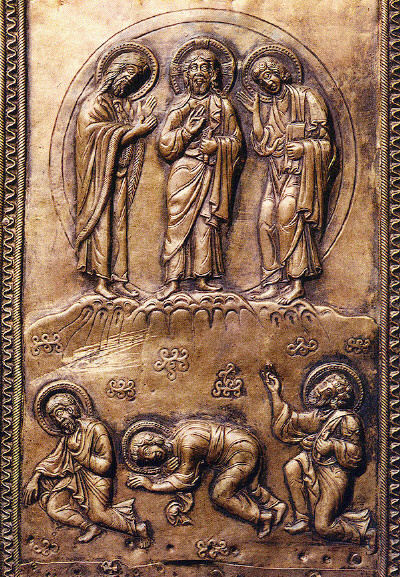
Georgian carved icon of the Transfiguration
Troparion - Tone 7
You were Transfigured on the Mount, O Christ God,
Revealing Your glory to Your disciples as far as they could bear it.
Let Your everlasting Light shine upon us sinners!
Through the prayers of the Theotokos, O Giver of Light, glory to You!
Kontakion - Tone 7
On the Mountain You were Transfigured, O Christ God,
And Your disciples beheld Your glory as far as they could see it;
So that when they would behold You crucified,
They would understand that Your suffering was voluntary,
And would proclaim to the world,
That You are truly the Radiance of the Father!
Luke 9:28-36 (Matins Gospel)(Comment: This Gospel reading was one of the main Scripture passages that led me to pick St. Peter as my patron saint; as someone who talks a lot (many times without considering whether or not the time is appropriate), I can relate to St. Peter's blurting out the thing about the tabernacles. What's funny to me is, not only does God the Father interrupt St. Peter in mid-sentence, but He also tells him to hear Jesus--in other words: "Shaddup...and listen.")
28 Now it came to pass, about eight days after these sayings, that He took Peter, John, and James and went up on the mountain to pray.
29 As He prayed, the appearance of His face was altered, and His robe became white and glistening.
30 And behold, two men talked with Him, who were Moses and Elijah,
31 who appeared in glory and spoke of His decease which He was about to accomplish at Jerusalem.
32 But Peter and those with him were heavy with sleep; and when they were fully awake, they saw His glory and the two men who stood with Him.
33 Then it happened, as they were parting from Him, that Peter said to Jesus, "Master, it is good for us to be here; and let us make three tabernacles: one for You, one for Moses, and one for Elijah"-not knowing what he said.
34 While he was saying this, a cloud came and overshadowed them; and they were fearful as they entered the cloud.
35 And a voice came out of the cloud, saying, "This is My beloved Son. Hear Him!"
36 When the voice had ceased, Jesus was found alone. But they kept quiet, and told no one in those days any of the things they had seen.
Thursday, August 04, 2005
Solitude
An excellent post from the Yahoo! group orthodoxdynamis on solitude:
*Solitude:* */St. Matthew 14:1-13, especially vs. 13:/* /"When Jesus heard it, He departed from there by boat to a deserted place by Himself."/ These Gospel verses tell again the grisly story of the macabre execution of St. John the Forerunner, the devotion of St. John's disciples who buried him, and of how, afterwards, they reported to the Lord Jesus all that had happened. One part of our Lord's response to the tragic news was to go apart to a lonely place.
Throughout the four Gospels, the Evangelists record that the Lord Jesus often left the crowds that followed Him to be by Himself. In solitude He sought to be with His Father. Note: if the Lord as both Man and God, needed to withdraw from the world to have times of intimacy with the Father, how much more do we, as mere human beings, need to follow His example!
St. Antony, the founder of monasticism, exemplifies one who discovered the blessings of solitude. When he was about 18 years of age, he heard these words from the Gospel: "If you would be perfect, go, sell what you possess and give to the poor, and you will have treasure in heaven; and come, follow Me" (Mt. 19:21). St. Antony understood these words to apply to him. Immediately, he began living as a poor laborer at the edge of his village. In time, he withdrew deep into the desert to live in complete solitude for twenty years. Note what happened to him.
During these years, the great desert hermit underwent painful spiritual and physical trials. His superficial self cracked, and God revealed to him the abyss of his sinfulness - all because St. Antony surrendered unconditionally to the Lord Jesus Christ. After surrender and the years of solitude, he emerged into contact with other people who immediately recognized in him a man whole in mind, body and soul; and they flocked to him for healing and direction.
Christ calls to every one: "Follow Me!" St. Anthony's experience reveals the meaning of "following": to take our sinful-self apart for times of solitude. Each one must deliberately cast himself into the furnace alone with God to be melted down in the Lord Jesus' transforming presence, to be recast according to His will and likeness, as He burns away our impurities.
Ah, but how can we practice solitude within the mad rush of this secular, godless society that offers no spiritual room for pursuing the disciplines of Holy Solitude? But, wait! A modern contemplative, Thomas Merton, reminds us that the Christians in St. Antony's day faced a similar situation: "Society...was regarded...as a shipwreck from which each single individual man had to swim for his life....These were men
who believed that to let oneself drift along, passively accepting the tenets and values of what they knew as society, was purely and simply a disaster!"
Not all are called to monasticism. The majority of us are engaged with family and society. While more are turning to the monastic way in order to struggle for union with Christ, yet, whatever lifestyle is chosen, each one remains responsible for his salvation; and, the primary place for regaining the desire for a full, rich life in Christ remains to be found in solitude.
Hence, those in the world must develop "little deserts" for withdrawing each day into the firm, renewing, and healing presence of God. Without such times and places, the Christian will lose his soul. Two steps are obvious: 1) Our first duty is to find a Spiritual Father. We must search for one before whom we may bare our inmost thoughts. St. John of the Ladder says, " A shepherd is pre-eminently he that is able to seek out and set aright his lost, rational sheep by means of guilelessness, zeal,
and prayer." 2) We must deliberately set apart a time and a place each and every day to be with God and with Him alone. Without solitude, no renewal, no life!
/O Thou, Who in the desert gavest water to Thy People, guide us into solitude with Thee where we may come and drink so that streams of living water may flow from our inmost being./
*Solitude:* */St. Matthew 14:1-13, especially vs. 13:/* /"When Jesus heard it, He departed from there by boat to a deserted place by Himself."/ These Gospel verses tell again the grisly story of the macabre execution of St. John the Forerunner, the devotion of St. John's disciples who buried him, and of how, afterwards, they reported to the Lord Jesus all that had happened. One part of our Lord's response to the tragic news was to go apart to a lonely place.
Throughout the four Gospels, the Evangelists record that the Lord Jesus often left the crowds that followed Him to be by Himself. In solitude He sought to be with His Father. Note: if the Lord as both Man and God, needed to withdraw from the world to have times of intimacy with the Father, how much more do we, as mere human beings, need to follow His example!
St. Antony, the founder of monasticism, exemplifies one who discovered the blessings of solitude. When he was about 18 years of age, he heard these words from the Gospel: "If you would be perfect, go, sell what you possess and give to the poor, and you will have treasure in heaven; and come, follow Me" (Mt. 19:21). St. Antony understood these words to apply to him. Immediately, he began living as a poor laborer at the edge of his village. In time, he withdrew deep into the desert to live in complete solitude for twenty years. Note what happened to him.
During these years, the great desert hermit underwent painful spiritual and physical trials. His superficial self cracked, and God revealed to him the abyss of his sinfulness - all because St. Antony surrendered unconditionally to the Lord Jesus Christ. After surrender and the years of solitude, he emerged into contact with other people who immediately recognized in him a man whole in mind, body and soul; and they flocked to him for healing and direction.
Christ calls to every one: "Follow Me!" St. Anthony's experience reveals the meaning of "following": to take our sinful-self apart for times of solitude. Each one must deliberately cast himself into the furnace alone with God to be melted down in the Lord Jesus' transforming presence, to be recast according to His will and likeness, as He burns away our impurities.
Ah, but how can we practice solitude within the mad rush of this secular, godless society that offers no spiritual room for pursuing the disciplines of Holy Solitude? But, wait! A modern contemplative, Thomas Merton, reminds us that the Christians in St. Antony's day faced a similar situation: "Society...was regarded...as a shipwreck from which each single individual man had to swim for his life....These were men
who believed that to let oneself drift along, passively accepting the tenets and values of what they knew as society, was purely and simply a disaster!"
Not all are called to monasticism. The majority of us are engaged with family and society. While more are turning to the monastic way in order to struggle for union with Christ, yet, whatever lifestyle is chosen, each one remains responsible for his salvation; and, the primary place for regaining the desire for a full, rich life in Christ remains to be found in solitude.
Hence, those in the world must develop "little deserts" for withdrawing each day into the firm, renewing, and healing presence of God. Without such times and places, the Christian will lose his soul. Two steps are obvious: 1) Our first duty is to find a Spiritual Father. We must search for one before whom we may bare our inmost thoughts. St. John of the Ladder says, " A shepherd is pre-eminently he that is able to seek out and set aright his lost, rational sheep by means of guilelessness, zeal,
and prayer." 2) We must deliberately set apart a time and a place each and every day to be with God and with Him alone. Without solitude, no renewal, no life!
/O Thou, Who in the desert gavest water to Thy People, guide us into solitude with Thee where we may come and drink so that streams of living water may flow from our inmost being./
Tuesday, August 02, 2005
On Baptism
The newly illumined child of God Elizabeth is currently sleeping in her crib (much to her mother's and my relief). Pictures are directly below this, but I've been ruminating the past two days over the significance of what has just occurred, and how it hits this convert where he lives a whole lot more when it's his kid.
First of all, I realized something about myself. The tendency among artsy, theatrical, somewhat-charismatic Protestants like I was was to imagine some sort of otherworldly parallel to a service in which the participants were (always dramatically) enfused with power from on high. Images in our head--fueled oftentimes by Christian authors' descriptions of swirling mist, glowing hearts and various scenes of Jesus' direct bestowing of the Holy Spirit upon us (Frank Peretti comes to mind)--led us to truly believe that life-changing moments in the spiritual realms were always accompanying our meetings. What I noticed about my daughter's baptism was that, first, there were no images in my mind of "what was going on" in that other, unseen plane of existence. This is why, I think, we have sacraments: we couldn't handle the full disclosure of the spiritual reality were we shown it; it would, I don't doubt, consume us. Any mental depiction we attempt of it as it is, then, is a gross injustice thereto.
Our services, however, are a depiction of and a union with that reality which we can handle. Hope truly did put on Christ's death and resurrection in those waters; she truly did acquire the third Person of the Trinity Himself when the chrism was applied; she truly was united to our Lord in all His fullness when her little body was merged with His true Food and her rapidly-circulating blood was mingled with His true Drink. We focus on these rites, these human actions and these physical elements of water, oil, bread and wine, not only as signs pointing to what is truly happening at that moment, but also as the concrete means by which those things truly are accomplished in our lives...they are beautiful not only because of the asthetically pleasing aspects of the prayers and hymns, but because of the realities towards which they point and in which they share.
Secondly, in light of all of this connection to that higher, saving reality...what an amazing act of grace on God's part! That our very nature as humans, fallen and corrupt as it is, could receive the seeds of immortality merely by being immersed in water, anointed with oil and fed with bread and wine--all of which have had a contact with and transformation into the Element of our life Himself--such events which make it possible to even begin our journey into life eternal are so beyond us, yet so simple to partake of. It's like a man stumbling on water as if it were dry land; he didn't get there by himself...
Thirdly, there is the issue, as a friend of mine just commented in a post below, of having a "cradle" Orthodox Christian in my house! She will have experiences I never had and will see them through a lens I've only recently acquired; from reading the Scriptures to worshipping with her Church family and praying on her own, as well as looking at the world and all its various ideologies, she'll have it all from the git-go from an Orthodox point of view. This both excites and troubles me, as I know "cradles" who take their faith quite seriously, and also those who take it quite for granted, so there's a very real responsibility on our part to be models of holiness, so that she has as much as possible, both in church and out, after which to model her own life of faith, which begins now, at her baptism into Christ. Talk about a role to play; fear and trembling definitely going on here.
I'm reminded of a phrase I've heard many times, though I have no idea who first said it. To paraphrase: "There's no such distinction between 'cradle' Orthodox and 'convert' Orthodox, or at least there shouldn't be. All Orthodox Christians, at some point in their lives, need to be 'converts,' need to make this personal, need to own this."
May Christ our God, through the intercessions of the most holy Theotokos, His mother, and of His foster father Joseph, have mercy on us as we all embark together on this quest for union with Him, together with His Father and the All-Holy Spirit.
And, the following:
First of all, I realized something about myself. The tendency among artsy, theatrical, somewhat-charismatic Protestants like I was was to imagine some sort of otherworldly parallel to a service in which the participants were (always dramatically) enfused with power from on high. Images in our head--fueled oftentimes by Christian authors' descriptions of swirling mist, glowing hearts and various scenes of Jesus' direct bestowing of the Holy Spirit upon us (Frank Peretti comes to mind)--led us to truly believe that life-changing moments in the spiritual realms were always accompanying our meetings. What I noticed about my daughter's baptism was that, first, there were no images in my mind of "what was going on" in that other, unseen plane of existence. This is why, I think, we have sacraments: we couldn't handle the full disclosure of the spiritual reality were we shown it; it would, I don't doubt, consume us. Any mental depiction we attempt of it as it is, then, is a gross injustice thereto.
Our services, however, are a depiction of and a union with that reality which we can handle. Hope truly did put on Christ's death and resurrection in those waters; she truly did acquire the third Person of the Trinity Himself when the chrism was applied; she truly was united to our Lord in all His fullness when her little body was merged with His true Food and her rapidly-circulating blood was mingled with His true Drink. We focus on these rites, these human actions and these physical elements of water, oil, bread and wine, not only as signs pointing to what is truly happening at that moment, but also as the concrete means by which those things truly are accomplished in our lives...they are beautiful not only because of the asthetically pleasing aspects of the prayers and hymns, but because of the realities towards which they point and in which they share.
Secondly, in light of all of this connection to that higher, saving reality...what an amazing act of grace on God's part! That our very nature as humans, fallen and corrupt as it is, could receive the seeds of immortality merely by being immersed in water, anointed with oil and fed with bread and wine--all of which have had a contact with and transformation into the Element of our life Himself--such events which make it possible to even begin our journey into life eternal are so beyond us, yet so simple to partake of. It's like a man stumbling on water as if it were dry land; he didn't get there by himself...
Thirdly, there is the issue, as a friend of mine just commented in a post below, of having a "cradle" Orthodox Christian in my house! She will have experiences I never had and will see them through a lens I've only recently acquired; from reading the Scriptures to worshipping with her Church family and praying on her own, as well as looking at the world and all its various ideologies, she'll have it all from the git-go from an Orthodox point of view. This both excites and troubles me, as I know "cradles" who take their faith quite seriously, and also those who take it quite for granted, so there's a very real responsibility on our part to be models of holiness, so that she has as much as possible, both in church and out, after which to model her own life of faith, which begins now, at her baptism into Christ. Talk about a role to play; fear and trembling definitely going on here.
I'm reminded of a phrase I've heard many times, though I have no idea who first said it. To paraphrase: "There's no such distinction between 'cradle' Orthodox and 'convert' Orthodox, or at least there shouldn't be. All Orthodox Christians, at some point in their lives, need to be 'converts,' need to make this personal, need to own this."
May Christ our God, through the intercessions of the most holy Theotokos, His mother, and of His foster father Joseph, have mercy on us as we all embark together on this quest for union with Him, together with His Father and the All-Holy Spirit.
And, the following:
A PRAYER OF PARENTS FOR THEIR CHILDREN:
O God, our heavenly Father, who love mankind, and are most merciful and compassionate, have mercy upon Your handmaiden Hope Elizabeth, for whom I humbly pray and commend to Your gracious care and protection. Be, O God, her guide and guardian in all her endeavors, lead her in the path of Your truth, and draw her nearer to You, that she may lead a godly and righteous life in Your love and fear; doing Your will in all things. Give her grace that she may be temperate, industrious, diligent, devout and charitable. Defend her against the assaults of the enemy, and grant her wisdom and strength to resist all temptation and corruption of this life; and direct her in the way of salvation, through the merits of Your Son, our Savior Jesus Christ, and the intercessions of His Holy Mother and Your blessed saints. Amen.
Thou Art Baptized; Thou Art Chrismated; Thou Art Illumined...

Fr. Basil with godparents Zac (Daniel) and Lindsey (Mary) during the exorcism prayers

Anointing with the oil of gladness prior to baptism
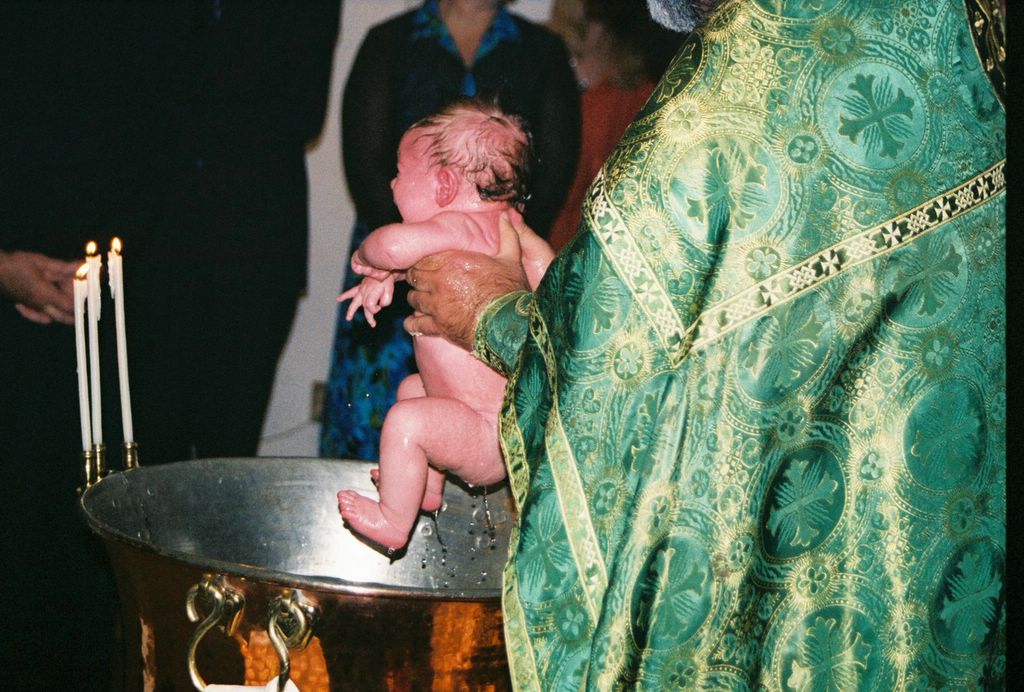
The child of God Elizabeth is baptized, in the name of the Father...and of the Son...and of the Holy Spirit

As many as have been baptized into Christ have put on Christ. Allelulia!
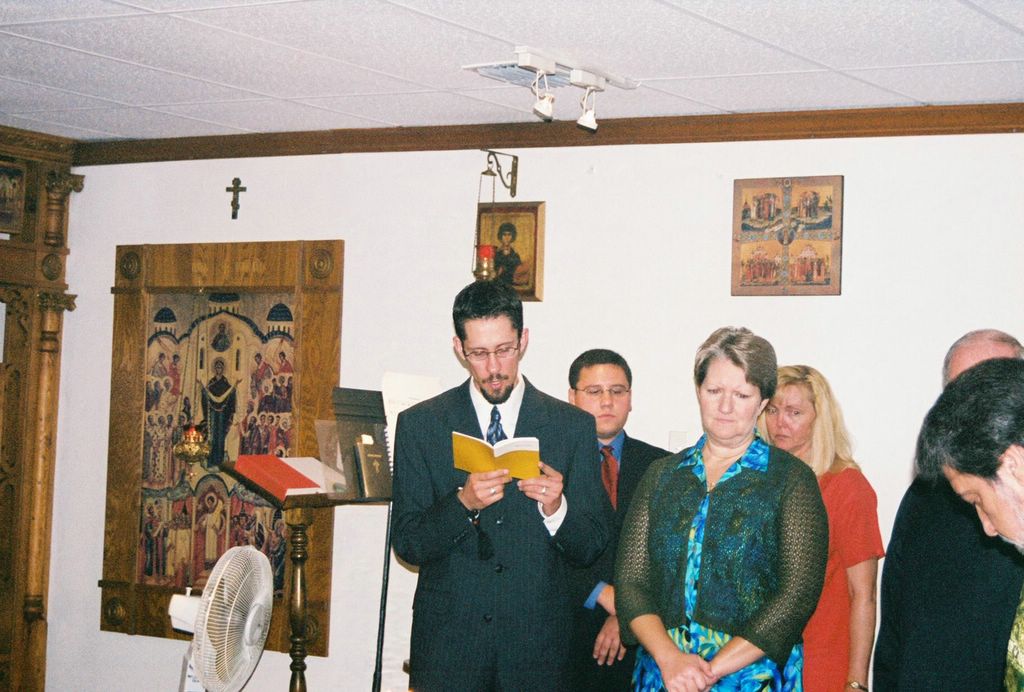
Papi reads from the epistle of the holy Apostle Paul to the Romans (6:3-11)

Fr. Basil reads from the Holy Gospel according to St. Matthew (28:16-20)
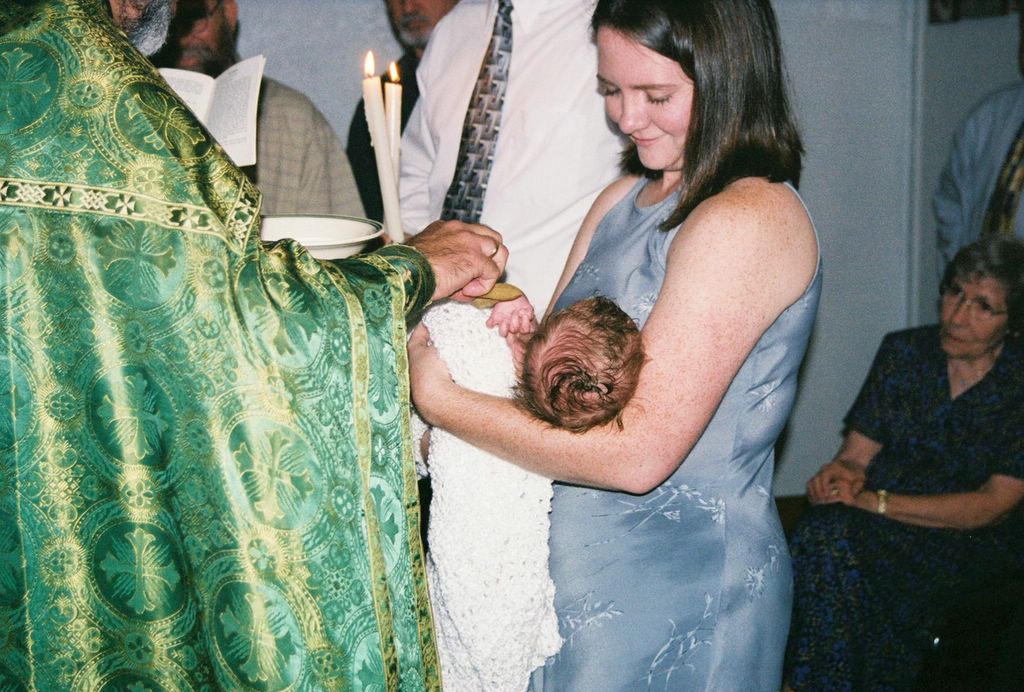
Wiping off the chrism
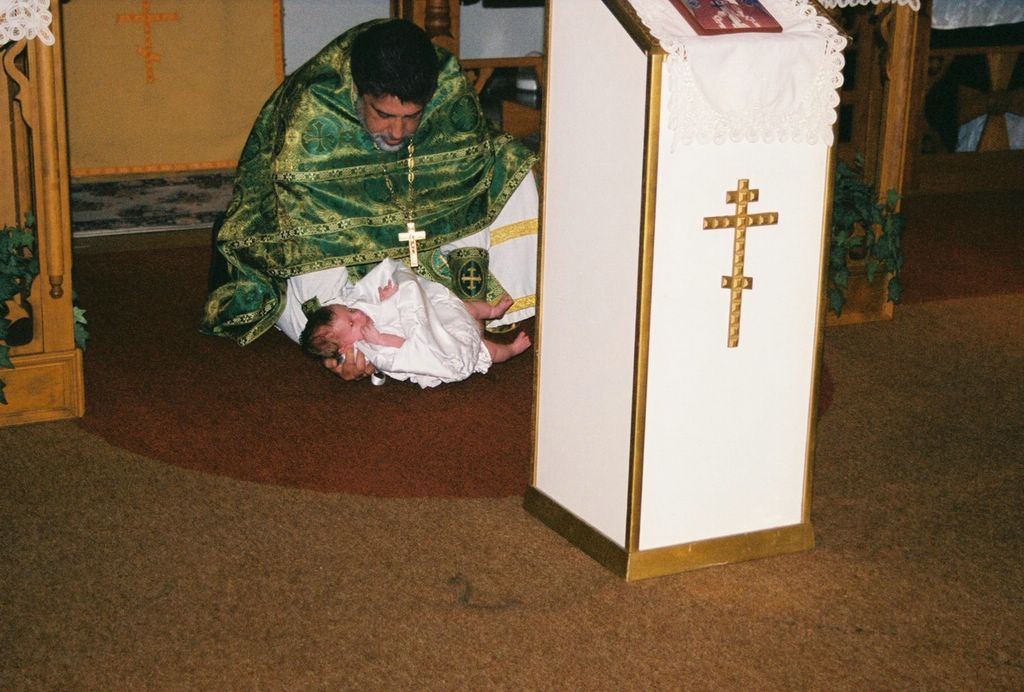
The churching, where the child is received into church life after being illumined

A bit of a shadow due to the flash, but..."receive the Body of Christ; taste the Fountain of Immortality"
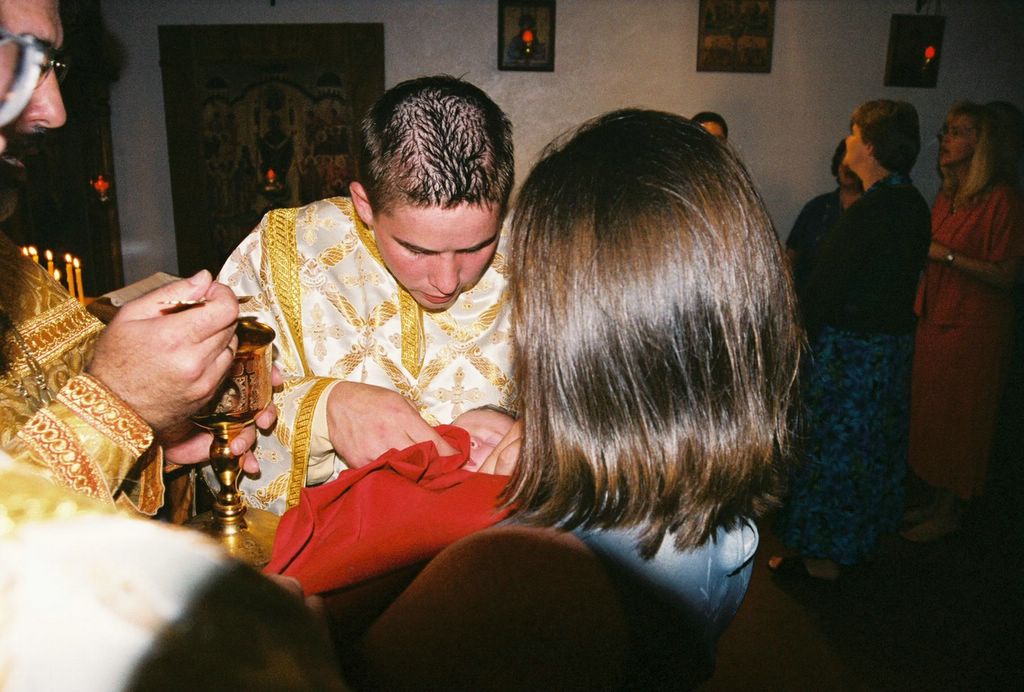
Wiping the Blood from her lips...

The newly illumined child of God Elizabeth, up close
Subscribe to:
Posts (Atom)