The Shokey Pokey
O proud left foot, that ventures quick within
Then soon upon a backward journey lithe.
Anon, once more the gesture, then begin:
Command sinistral pedestal to writhe.
Commence thou then the fervid Hokey-Poke,
A mad gyration, hips in wanton swirl.
To spin! A wilde release from Heavens yoke.
Blessed dervish! Surely canst go, girl.
The Hoke, the poke -- banish now thy doubt
Verily, I say, 'tis what it's all about.
-- by William Shakespeare (Jeff Brechlin, Potomac Falls)

Sunday, February 26, 2006
Of Chews and Chips and Ceiling Whacks, of Cabbie Jazz and Kinks...
...Audra and I came up with that parody of a line in this poem last night...thought it an appropriate (or, rather, sufficiently-random) lead-in to this, a Shakespearean version of everybody's favorite roller-rink activity...found among various and sundry Shakespearean parodies here...
House Blessing
Posted quite a bit after the fact--this happened on the 18th--Fr., Matushka and their son Nick were over for the blessing of our home. Some photos:
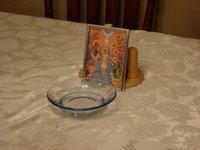 The icon (propped up on salt and pepper shakers, of course!) of the Theophany--the revelation of God as Trinity, seen in Baptism of Christ--in front of the bowl which would hold the holy water, laid out on a white tablecloth, as per Orthodox custom.
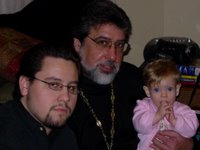 Fr. Basil and Nick with Hope--Nick's "mean-muggin'" here...
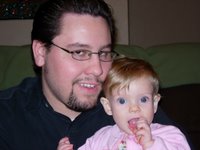 A nicer Nick w/Hope...awww...
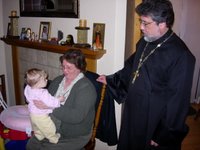 Matushka bouncing Hope on her lap while Hope had a serious conversation with her and Father, mostly along the lines of, "AwahwahWAH!!"
 Close-up of Matushka and Hope.
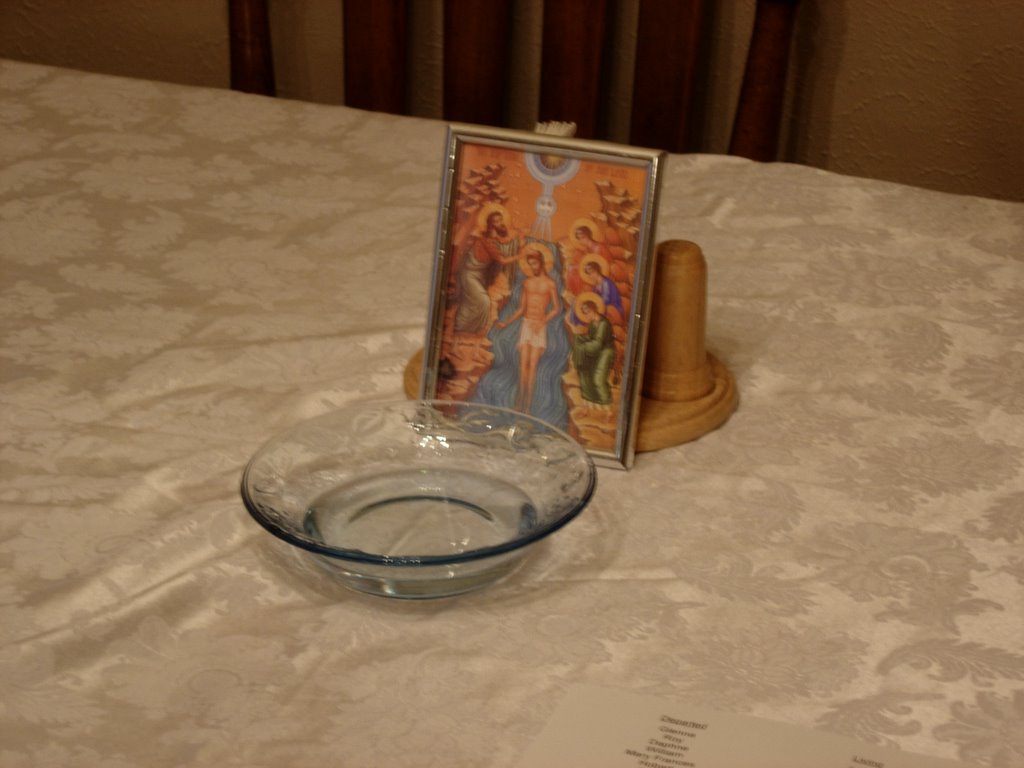 The icon (propped up on salt and pepper shakers, of course!) of the Theophany--the revelation of God as Trinity, seen in Baptism of Christ--in front of the bowl which would hold the holy water, laid out on a white tablecloth, as per Orthodox custom.
 Fr. Basil and Nick with Hope--Nick's "mean-muggin'" here...
 A nicer Nick w/Hope...awww...
 Matushka bouncing Hope on her lap while Hope had a serious conversation with her and Father, mostly along the lines of, "AwahwahWAH!!"
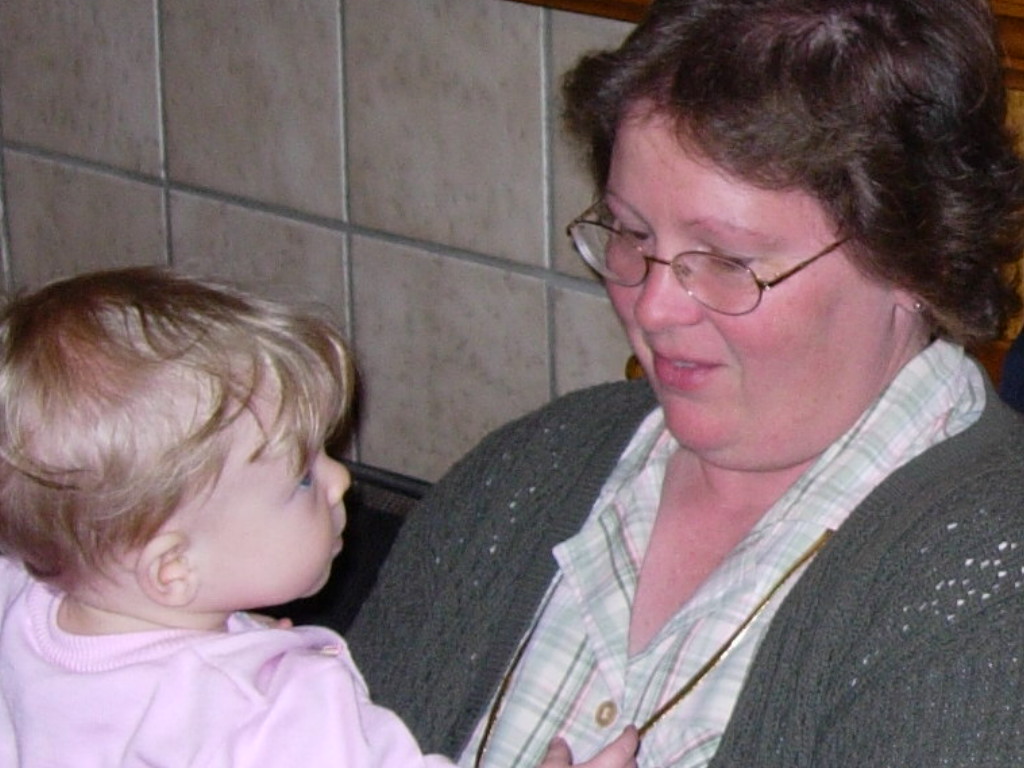 Close-up of Matushka and Hope.
Sunday, February 19, 2006
The Psalms of David -- Psalm 25 (and thoughts on today's DL)
VINDICATE ME, O GOD...
We are all fallen creatures. Twice in this psalm there's the idea of innocence--washing your hands in innocence, and thus returning to the innocence of Eden.
Innocence involves a purification of our relationships with those with whom we worship in the beauty of the house of God (v. 8). It also involves our relationship with God Himself. This relationship, when restored to its original, innocent position of total dependence on God for everything from our next breath to our mortgage payment, involves not only a real change on our part ("my integrity," v. 11), but an acknowledgement that, even when we do our part, we still require His help ("redeem me, O LORD," the rest of v. 11).
Or, as Fr. Patrick says, "It is from the altar of repentance that we are rendered innocent, purged by a coal so ardent that not even the firery seraph dares to take it except with tongs."
Thought of this today, btw, during Liturgy...the Holy Eucharist is likened to Isaiah's coal, yes, but an even more direct comparison is the blood over the doors of the Israelites when they left Egypt. We, when we place the Blood of the Lamb on our mouths--one of the "doors" of the body, our senses--we prepare ourselves for death, knowing that death will pass over us when it sees the Blood of the Lamb.
We are all fallen creatures. Twice in this psalm there's the idea of innocence--washing your hands in innocence, and thus returning to the innocence of Eden.
Innocence involves a purification of our relationships with those with whom we worship in the beauty of the house of God (v. 8). It also involves our relationship with God Himself. This relationship, when restored to its original, innocent position of total dependence on God for everything from our next breath to our mortgage payment, involves not only a real change on our part ("my integrity," v. 11), but an acknowledgement that, even when we do our part, we still require His help ("redeem me, O LORD," the rest of v. 11).
Or, as Fr. Patrick says, "It is from the altar of repentance that we are rendered innocent, purged by a coal so ardent that not even the firery seraph dares to take it except with tongs."
Thought of this today, btw, during Liturgy...the Holy Eucharist is likened to Isaiah's coal, yes, but an even more direct comparison is the blood over the doors of the Israelites when they left Egypt. We, when we place the Blood of the Lamb on our mouths--one of the "doors" of the body, our senses--we prepare ourselves for death, knowing that death will pass over us when it sees the Blood of the Lamb.
Thursday, February 16, 2006
Wednesday, February 15, 2006
Students are Risen!
WARNING: The following is an attempt at humor and should not be taken seriously so...y'all chill out.
"11In him you were also circumcised, in the putting off of the sinful nature,[a] not with a circumcision done by the hands of men but with the circumcision done by Christ, 12having been buried with him in baptism and raised with him through your faith in the power of God, who raised him from the dead" (Col. 2:11-12).
I hate to break it to Paul, but there's something he left out in regards to things powerful enough to raise the dead. It has been my very recent experience that there is, in fact, something at least as powerful as the power of God to inspire dry bones to move.
The name of this phenomenal cosmic power? School Athletics. Seriously, now: I swear to you, I have never seen so many dead-on-their-feet kids climb all over themselves (and each other) to make sure their grades are passing so they can play. I'm lovin' life right now at school, y'all. Good times.
"11In him you were also circumcised, in the putting off of the sinful nature,[a] not with a circumcision done by the hands of men but with the circumcision done by Christ, 12having been buried with him in baptism and raised with him through your faith in the power of God, who raised him from the dead" (Col. 2:11-12).
I hate to break it to Paul, but there's something he left out in regards to things powerful enough to raise the dead. It has been my very recent experience that there is, in fact, something at least as powerful as the power of God to inspire dry bones to move.
The name of this phenomenal cosmic power? School Athletics. Seriously, now: I swear to you, I have never seen so many dead-on-their-feet kids climb all over themselves (and each other) to make sure their grades are passing so they can play. I'm lovin' life right now at school, y'all. Good times.
Sunday, February 12, 2006
I Love Rustic Churches...(Chapel in St. Herman's Seminary)
 This picture is cool. It would be cool to pray here.
 Fr. Dan Suciu
Went with Audra yesterday to St. John the Baptist Greek Orthodox Church in Euless to hear Fr. Dan speak on Salvation and Baptism (two separate talks) from an Orthodox perspective. If you EVER get a chance to hear this guy, go. It is a rare find indeed when a person is able to intelligently explain Orthodox belief while keeping it on the level that your average layman can understand.
Check back here later on--either this evening or tomorrow--for notes on what he said. Of particular note: his knowledge and expertise in using Scripture to explain himself was both refreshing and impressive. Was delighted, also, at his insistence that knowledge of the Scriptures is a key--if not the key--to the spread of Orthodoxy throughout the world and the revival thereof in places it already is found.
More later...
Check back here later on--either this evening or tomorrow--for notes on what he said. Of particular note: his knowledge and expertise in using Scripture to explain himself was both refreshing and impressive. Was delighted, also, at his insistence that knowledge of the Scriptures is a key--if not the key--to the spread of Orthodoxy throughout the world and the revival thereof in places it already is found.
More later...
Saturday, February 11, 2006
The Psalms of David -- Psalm 24
TO YOU, O LORD, I LIFT UP MY SOUL...
This psalm, Fr. Patrick says, is basically a reflection of this one verse, and can encompass the entirety of our day, and indeed our lives:
Thought of what Fr. Patrick had said in Ps. 21, that this series of ten psalms (through 30) was prayed, we could assume, by Christ on the Cross...no doubt that those who "transgress without cause" are the demons who scrambled to have Him crucified.
vv. 10-1 show a psalmist who recognizes that mercy and truth can be had only by those who fear the LORD...and that he, the psalmist, needs the LORD's pardon, for he does not fear Him as he should.
v. 13 is glorious...Christ, the One who fears and obeys the Father, will see His seed (that's the Church!) inherit the earth. May we be meek...wheat that grows in its place--not tares which must grow with the wheat within the Church, only to be winnowed apart and burned at the last due to pride and lack of love for God and neighbor.
This psalm, Fr. Patrick says, is basically a reflection of this one verse, and can encompass the entirety of our day, and indeed our lives:
- We lift our soul to Him in the morning; the psalm is prayed before morning work, at Third Hour.
- We ask Him to show us His ways, snatch our feet from the snares, and guard our souls; this goes on all day.
- We ask Him to remember us in this psalm when we pray it at Compline at night, though it could just as easily fit when prayed in the nighttime of our lives, before death.
Thought of what Fr. Patrick had said in Ps. 21, that this series of ten psalms (through 30) was prayed, we could assume, by Christ on the Cross...no doubt that those who "transgress without cause" are the demons who scrambled to have Him crucified.
vv. 10-1 show a psalmist who recognizes that mercy and truth can be had only by those who fear the LORD...and that he, the psalmist, needs the LORD's pardon, for he does not fear Him as he should.
v. 13 is glorious...Christ, the One who fears and obeys the Father, will see His seed (that's the Church!) inherit the earth. May we be meek...wheat that grows in its place--not tares which must grow with the wheat within the Church, only to be winnowed apart and burned at the last due to pride and lack of love for God and neighbor.
Sunday, February 05, 2006
Yay! Church Interior Pictures!
Previous Phases:
Phase 1
Phase 2
Phase 3
Phase 4
Phase 5
Phase 6
Phase 7
Phase 8
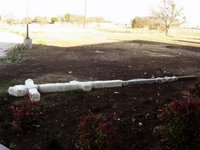 The following pics were taken today when I went to church for choir practice -- we practiced in the new building, so I got to click around and see all the new stuff (thanks, Matushka, for facilitating the "tour" of the great new altar we've got (see below). The first picture is the approx. ten-foot cross that will go on top of the huge gold-leaf dome which will go on top of the building. It is, as you can see, wrapped in what appears to be Saran Wrap. Huh.
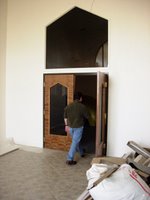 Next up is the pic of the doors leading from the narthex to the nave. These are nice, wooden doors that work really well with the tile that is, as you can see, stylishly covering the concrete slab that we all stood on during the Abp's blessing visit on 12/4. Yes, that's Nick again.
 From inside the doors, here's a pic from the back of the nave -- actually, it's sort of a "second narthex," since the two walls there are there to mark the back of the nave and, being moveable, will help us accommodate lots of folks for Pascha, etc. We're looking at the four quarters of the gold cupola, which are still awaiting the gold leaf. Once that gets here, the dome will be leafed and placed on top of the building! In the background you see the red-carpeted amvon and the just-made, traditional wooden altar.
 This is a shot of the cupola quarters from the side. The thing is huge; it's probably about 10-12 feet high from base to tip, then add another 10 feet or so for that cross that's outside...whoo, boy...
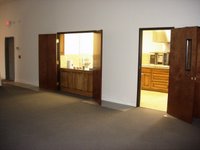 Off to the side, opposite the cupola, is our new kitchen. Huge thing, this kitchen, which is great for us; we'll be able to properly facilitate our Old Country Christmas sales, which require much preparation of baked goods and pierogi...mmm...pierogi... {drools}
 Interior of the very roomy kitchen, complete with nice wooden cabinets and cabinets, sinks...
 ...a range, an oven, and lots of other good stuff.
 This is a classroom that's on the other side of the nave from the kitchen. This'll be used for everything from Church school to Adult Education.
 The amvon, with Nick and Matushka sitting on the steps, waiting for the rest of the choir to get here...altar there in the background...
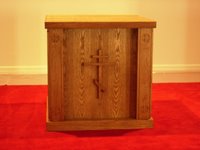 And now a close-up of the altar! This altar was made for us and paid for completely by donations (thanks be to God). It's a traditionally made altar for an Orthodox Church, which--aside from the three-bar cross on front--dictates that it be made entirely out of wood. No metal parts or tools or anything. No clue why that is, but the altar's gorgeous nonetheless. One of our altar servers (Steve!) asked if there was any way we could leave this uncovered for liturgies...unfortunately, no, but I felt the same desire myself while looking at it...
 Matushka is showing us the reliquary in the top of the center of the altar; each Orthodox altar must have on it a relic of some saint in order to be used--I can't remember whose relics are on our current one. Next to the hole is a plastic bag with four wooden pegs that go in the corners of the altar once it's consecrated.
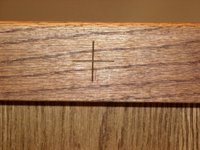 This small cross is on the side of the "lid" of the altar, on the side that is to face the people.
 This is a storage unit we had built into the back of the altar (facing away from the faithful). It'll just be used to store some of the Holy Vessels, I think--chalice etc.
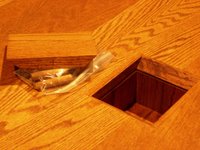 Close-up of the reliquary, pegs, and reliquary lid (also with cross engraved into front side of lid).
Phase 1
Phase 2
Phase 3
Phase 4
Phase 5
Phase 6
Phase 7
Phase 8
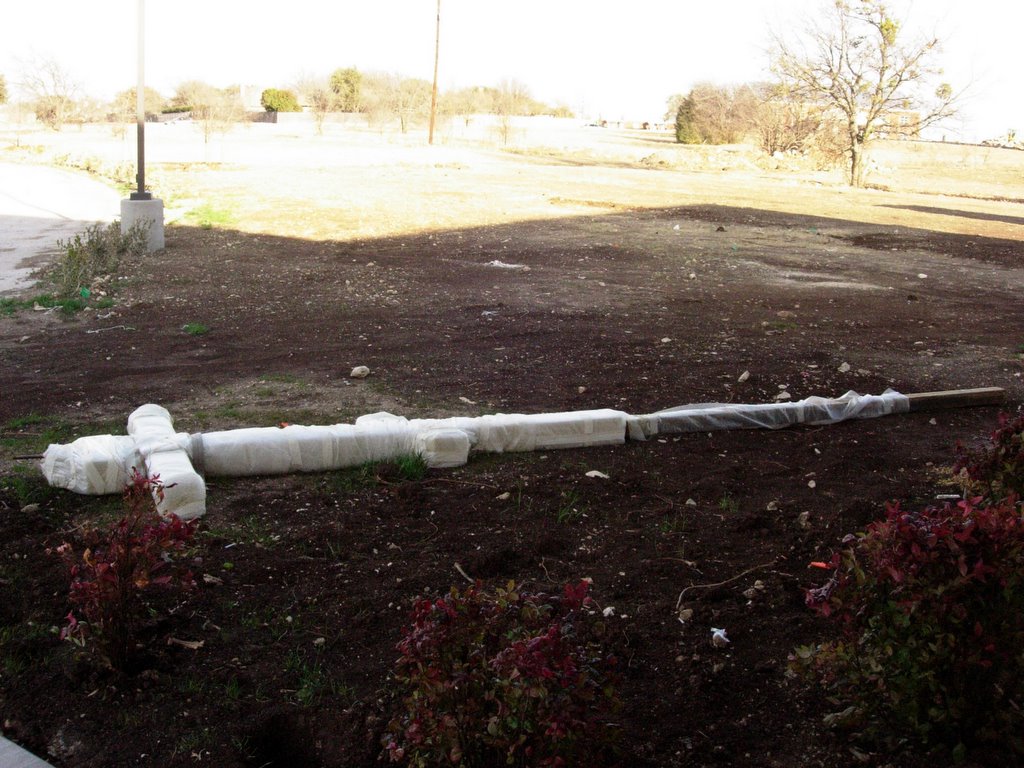 The following pics were taken today when I went to church for choir practice -- we practiced in the new building, so I got to click around and see all the new stuff (thanks, Matushka, for facilitating the "tour" of the great new altar we've got (see below). The first picture is the approx. ten-foot cross that will go on top of the huge gold-leaf dome which will go on top of the building. It is, as you can see, wrapped in what appears to be Saran Wrap. Huh.
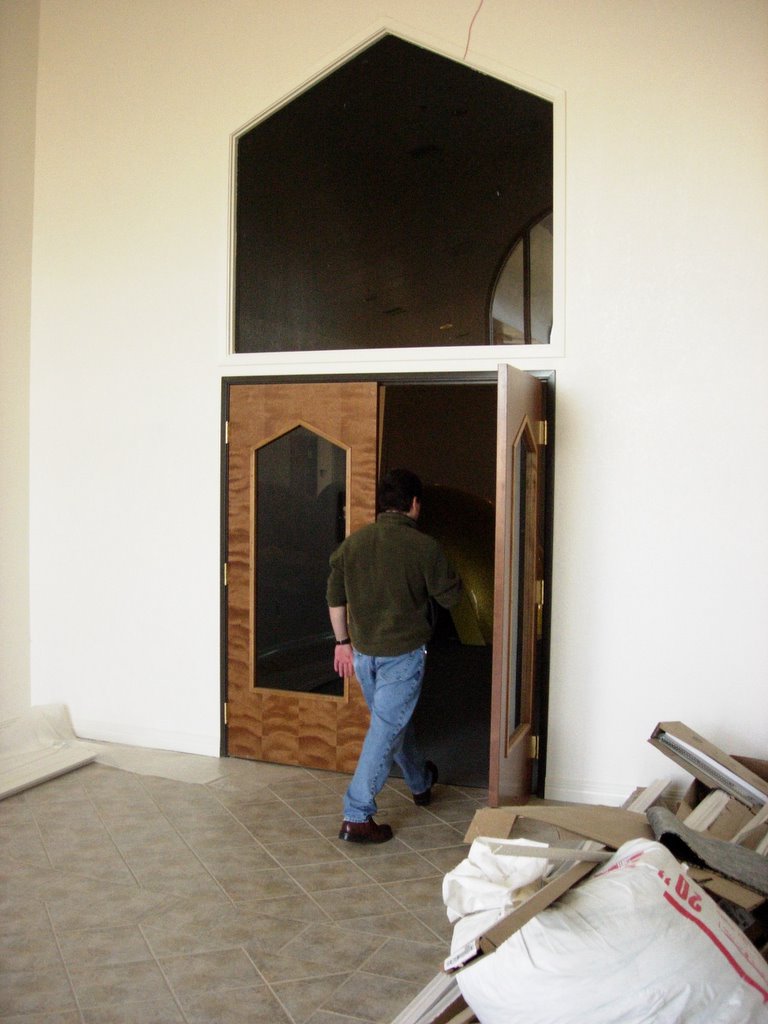 Next up is the pic of the doors leading from the narthex to the nave. These are nice, wooden doors that work really well with the tile that is, as you can see, stylishly covering the concrete slab that we all stood on during the Abp's blessing visit on 12/4. Yes, that's Nick again.
 From inside the doors, here's a pic from the back of the nave -- actually, it's sort of a "second narthex," since the two walls there are there to mark the back of the nave and, being moveable, will help us accommodate lots of folks for Pascha, etc. We're looking at the four quarters of the gold cupola, which are still awaiting the gold leaf. Once that gets here, the dome will be leafed and placed on top of the building! In the background you see the red-carpeted amvon and the just-made, traditional wooden altar.
 This is a shot of the cupola quarters from the side. The thing is huge; it's probably about 10-12 feet high from base to tip, then add another 10 feet or so for that cross that's outside...whoo, boy...
 Off to the side, opposite the cupola, is our new kitchen. Huge thing, this kitchen, which is great for us; we'll be able to properly facilitate our Old Country Christmas sales, which require much preparation of baked goods and pierogi...mmm...pierogi... {drools}
 Interior of the very roomy kitchen, complete with nice wooden cabinets and cabinets, sinks...
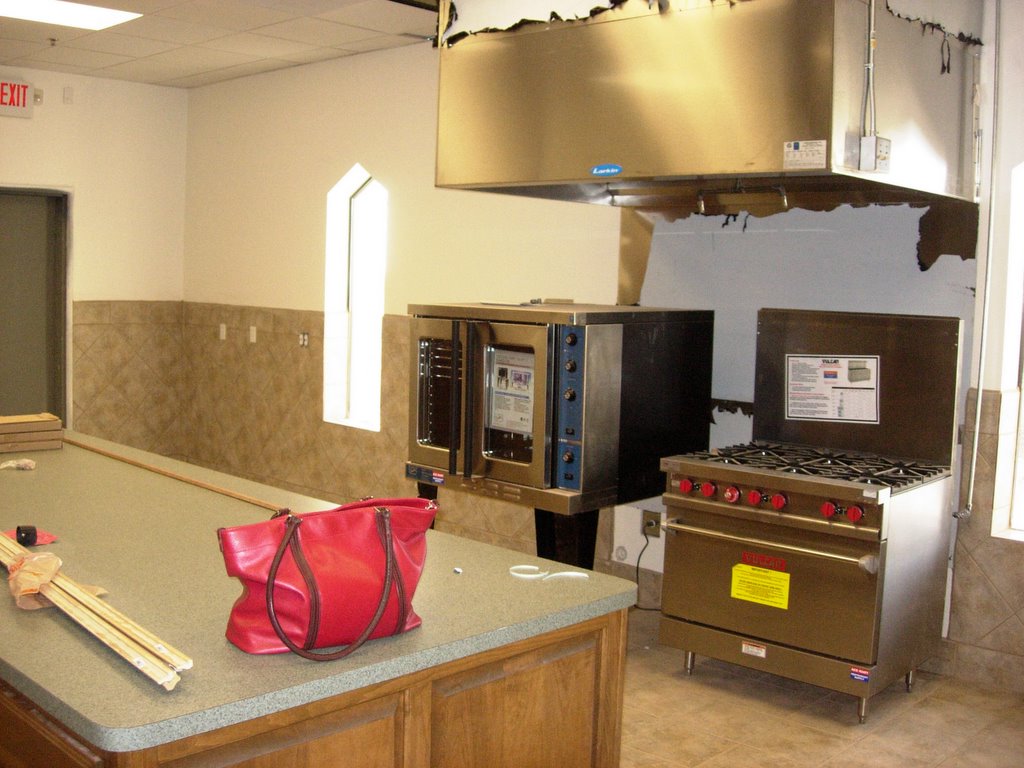 ...a range, an oven, and lots of other good stuff.
 This is a classroom that's on the other side of the nave from the kitchen. This'll be used for everything from Church school to Adult Education.
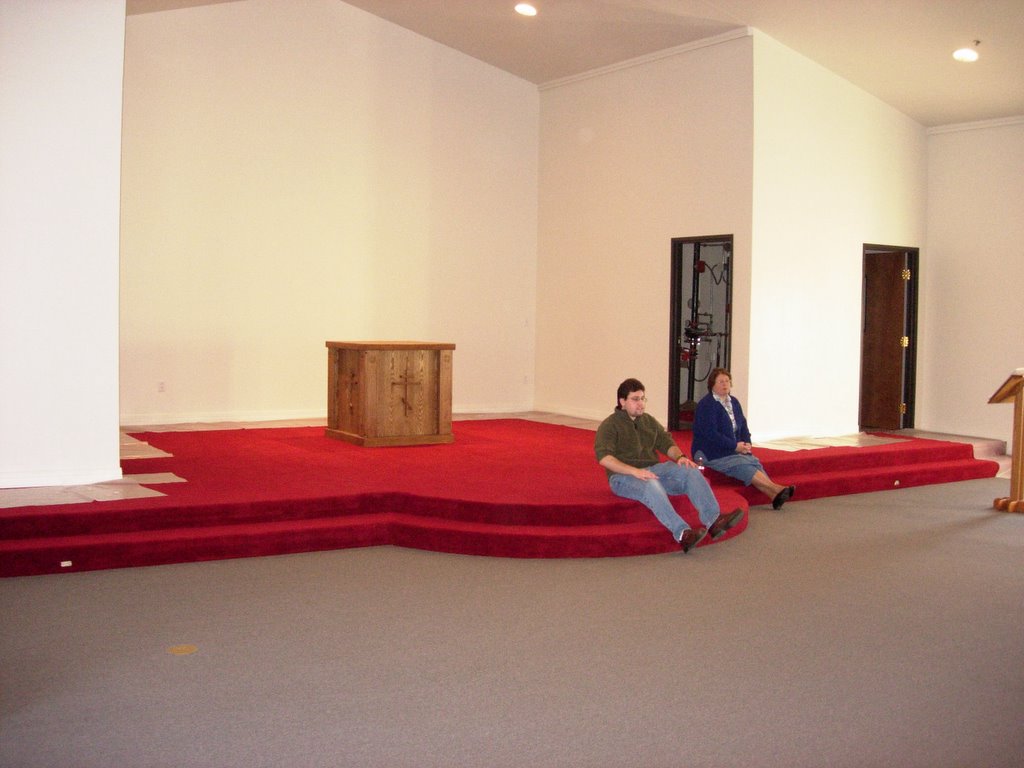 The amvon, with Nick and Matushka sitting on the steps, waiting for the rest of the choir to get here...altar there in the background...
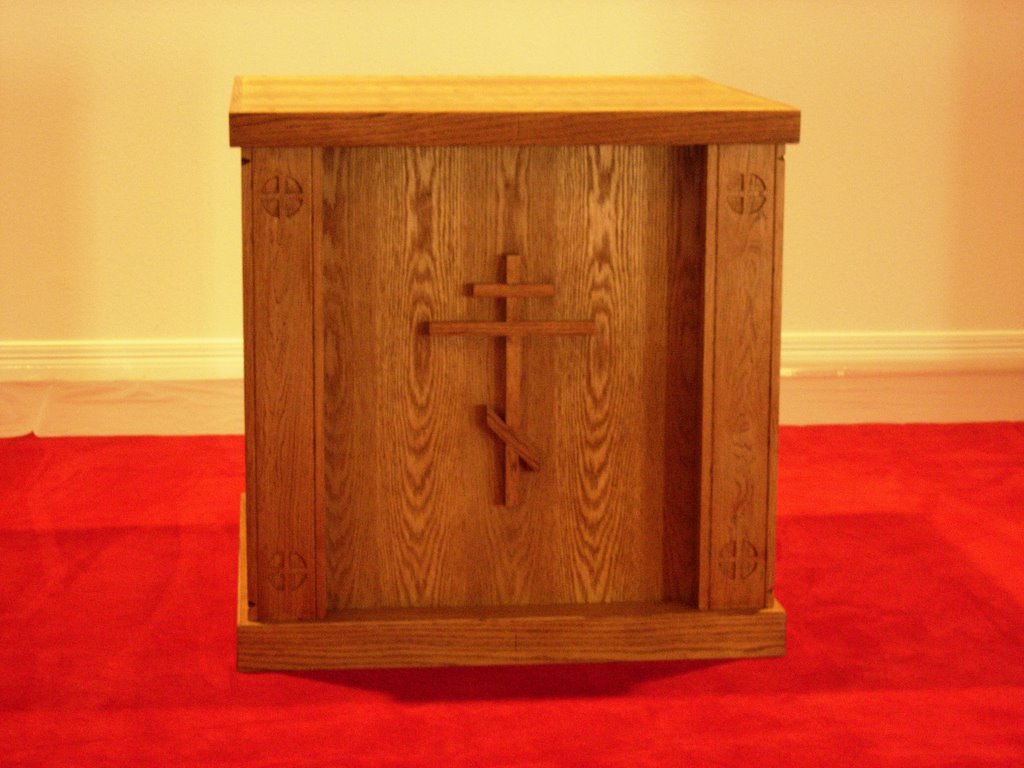 And now a close-up of the altar! This altar was made for us and paid for completely by donations (thanks be to God). It's a traditionally made altar for an Orthodox Church, which--aside from the three-bar cross on front--dictates that it be made entirely out of wood. No metal parts or tools or anything. No clue why that is, but the altar's gorgeous nonetheless. One of our altar servers (Steve!) asked if there was any way we could leave this uncovered for liturgies...unfortunately, no, but I felt the same desire myself while looking at it...
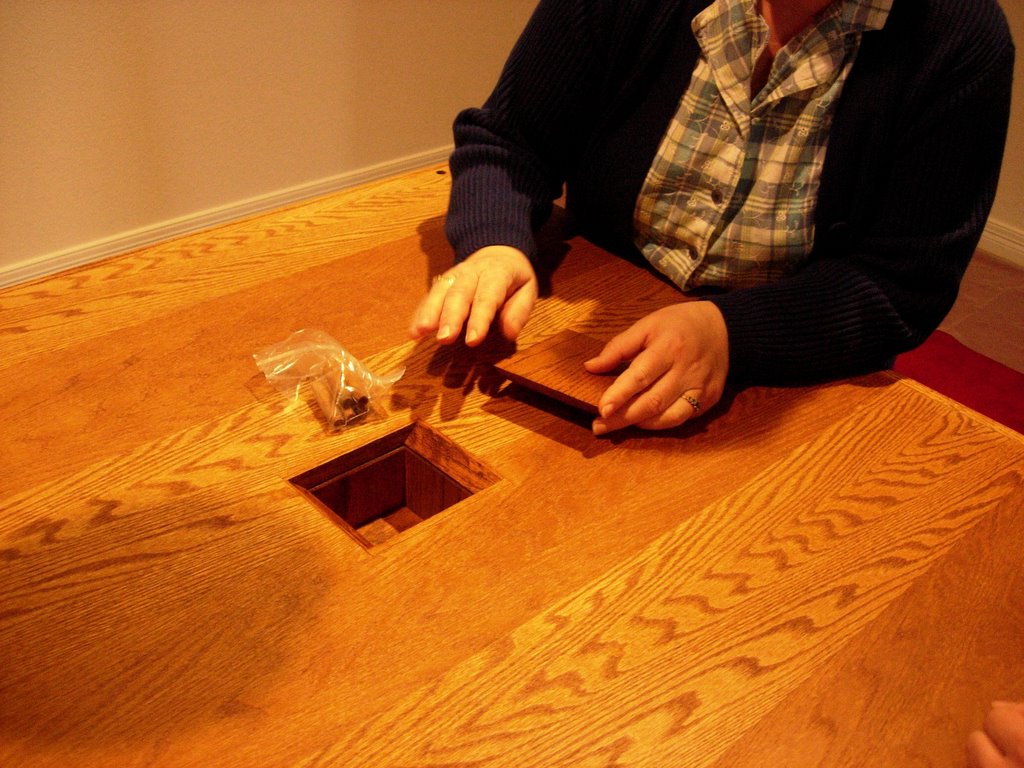 Matushka is showing us the reliquary in the top of the center of the altar; each Orthodox altar must have on it a relic of some saint in order to be used--I can't remember whose relics are on our current one. Next to the hole is a plastic bag with four wooden pegs that go in the corners of the altar once it's consecrated.
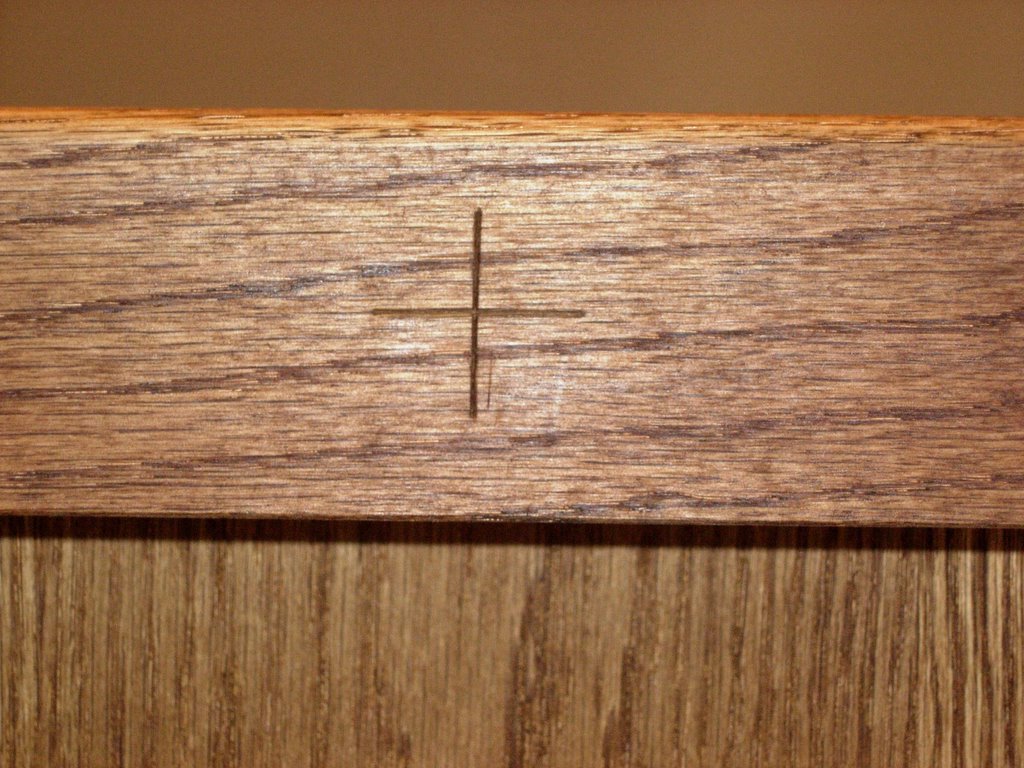 This small cross is on the side of the "lid" of the altar, on the side that is to face the people.
 This is a storage unit we had built into the back of the altar (facing away from the faithful). It'll just be used to store some of the Holy Vessels, I think--chalice etc.
 Close-up of the reliquary, pegs, and reliquary lid (also with cross engraved into front side of lid).
The Church Fathers (long!)
The following is a reply to a friend of mine who wanted to know what I thought about this article...basically an article about what Protestants are to make of the Church Fathers. You can read my response below, or go to the post itself, read it (it's long, too) and read what's here underneath in the comments section. Anyways, enjoy!
OK, so I really liked the first part of Steve's article, where he basically sets up how to approach the Fathers: things like "The church fathers have all the potential values and limitations of any historical observer," and "the chronological distance between the historical event and the historical witness is highly germane to the quality of his historical testimony" are both very good points, w/ which I obviously agree.
I also agree with the idea that "a heretic can be...an unwitting witness to the very thing he denies," though perhaps for different reasons than the author does. I see things such as belief in apostolic succession of bishops and the Church's preservation from institutional apostasy in the writings of Tertullian, for example, both pro in the writings made when he was a Christian, and contra when he was a Montanist. By this we can see that these two doctrines were held by the early orthodox Christians and denied by heretics.
Statement #4, about Eusebius, Hippolytus, and Julius Africanus, is good. Nice to know the author is willing to give these post-apostolic fathers a place.
Using the doctrine of the Real Presence of Christ in the Eucharist, the author says that "the mere fact that A knew B is quite insufficient to connect a particular belief of A with a particular belief of B unless that connection is explicitly made by the party in question." This is true. However, given the extensive nature of the training all of the sub-apostolic bishops had to have received from the Apostles, it's not at all likely that every last one of them would have misunderstood such a crucial doctrine, much less that they all would have erred on the side of insisting on the Real Presence instead of some being memorialists, some being consubstantialists, etc. The uniformity of the sub-apostolic witness on this subject--hardly a family reunion with arguing siblings or a woman slapping her forehead about questions missed--is too great to dismiss with an argument from silence.
#7 is one I hear a lot -- that the apostles misunderstood Christ's teachings, and the Church misunderstood the Apostles. Christ knew the former, which is why He promised the Spirit, which would bring all things to their remembrance and guide them into all truth. He also predicted the latter, as did St. Paul, that false prophets would come...yet the prediction about the gates of hell not prevailing, that the whole Church would not be led into error, stands, largely due to the authority of the appointed leaders of the Church to teach and instruct, that error may be overcome and the Church may continue to "grow up in all things into Him who is the head—Christ" (Eph. 4:15). That troubles would come is seen in Revelation, in the letters to the Churches, but as long as one lampstand remained (as was obviously the case), the apostolically-ordained community of the Church would continue.
The last sentence of Steve's article, which said that "a generic appeal to the church fathers can never trump grammatico-historical exegesis on this or that verse of Scripture," is interesting because, imo, the ante-nicean fathers *are themselves* the historical half of said exegesis! I assume, then, a father-by-father breakdown regarding specific mentionings of specific doctrines would help move away from such "generic" appeals...I do, btw, agree that too many people in Catholic and Orthodox circles simply say "The Fathers say..." with about as much readiness (and as little proof) as many fundamentalist Protastants who say "The Bible says..."
Der Fuerspreche's main idea--that the well-documented institutional apostasy of OT Israel paves the way for a similar NT Church institutional apostasy--is definitely one that seems as though it could easily be true--the NT Church was made up of people no less human than those who comprised OT Israel--but I do not see that specific prophecy made anywhere in Scripture. Indeed, the Isrealites are told in advance, by Moses himself, that they would indeed betray God as a nation and go after other gods, be punished, and return to Him. The NT Church is given no such prophecy by our Lord. Instead, the NT Church is called "His body, the fulness of Him that filleth all in all" (Eph. 1:23). Instead of doing things on behalf of all the people (as the OT Levites did), the NT priesthood (the Apostles, ordained by the Great High Priest from the line of Melchizedek) were sent out to do what only God could do: forgive and retain the sins of men, and bind and loose with divine authority. Surely this would not be given to an ekklesia who, being just as brittle as OT Israel, would fall away so soon into obvious apostasy, or merely given to one generation of men (the Apostles), with the understanding that it was to be passed no further.
Christ's rebuttal of the Pharisees and Sadducees with written Scripture is also often used as a tactic in debates to say that one can do the same with extra-biblical Catholic and Orthodox teaching. Two thoughts on this: One--Christ had the benefit of being the Logos incarnate; it's a rather safe bet that His knowledge of the proper interpretation of Scripture would be *somewhat* thorough. Two--Protestants in any age cannot claim this, as they are simply men and women who read the Bible and come to (often very different) ideas of how the Catholic and Orthodox churches have strayed from biblical truth. This is hardly the authoritative voice we hear coming from Christ. Rather, we should look at how the Scriptures were received by the earliest Christians and, if there is, as St. Vincent of Lerins said, universality, antiquity, and consent displayed in the witness of these early men with respect to a particular interpretation of said Scripture, we can ascertain with reasonable certainty the original, historical theological meaning of said passage.
Friday, February 03, 2006
A Wondrous Extrapolation...
Thursday, February 02, 2006
A Strange Meeting Day
 Took the day off from school to attend the Divine Liturgy at church today for the Meeting of the Lord in the Temple. A beautiful service, full of light--and a very light feeling to it, as well--it was good to take a moment out of the middle of the week and touch Heaven for a moment.
Funny how those days can turn on you...the rest of the day seemed to be a blur of futility, one of those days where nothing gets done that needs (or so we think) getting done. Audra and I went to consolidate our insurance policies (car, house, etc), and a process that should have taken fifteen minutes took an hour and a half due to a talkative (but, admittedly, very amiable) agent. Then, up to school to have a pizza party for the Whiz Quiz kids I helped coach this year. I'd made announcements for the past three days. How many kids came out of the ten or so that participated? Two. Sigh. Looks like I've got lots of leftover pizza for lunches...
Yet the part that beat all came after about 3:30, when I realized my sub hadn't come up to my room to bring back the folder I'd left with instructions, assignments, etc. (we'd been down in the library that day). This was because said folder was still in my desk!! Not only had the substitute barely shown up in time to meet the kids in the library, but she had not followed my specific instructions to come up to my room first and get the folder to use for the day. This means playing catch-up on Monday with these classes (we're on block schedule). Double sigh.
Good day. Seriously. Especially in the light of the coming Pre-Lenten and Lenten season (this Sunday is Zacchaeus Sunday, folks! Pre-Lent is almost here!)...one of those "trial" days where we have the uncomfortable opportunity to continually hold before our souls the words of St. Simeon: "Lord, now lettest Thou Thy servant depart in peace, according to Thy word: for mine eyes have seen Thy salvation..."
Saturday, January 28, 2006
García Márquez's Quixotic Love Story
Just finished Gabriel García Márquez's first novel in ten years, Memorias de Mis Putas Tristes (see sidebar), or, in the English version, Memories of My Melancholy Whores. GGM won the Nobel Prize for Literature in '82, largely due to his short stories and Cien Años de Soledad, a circular, confusing, but breathtaking novel about love, life, death, magic realism--in all their earthiness.
Memorias is not so profound a work as it is sadly quixotic--the main character, a 90-year old, retired columnist who's spent his life going from brothel to brothel for sexual encounters, decides to celebrate his 90th birthday by spending a night with an adolescent virgin. He spends that night, however, merely looking at the nude, sleeping girl, entranced by her pure beauty. The rest of the book details his repeated requests to spend night after night--an entire year--looking at the one he considers the only girl he's ever loved. Yet it's clear he merely loves the idea of her--at one point she briefly wakes and says something, and he decides immediately that he likes her better asleep--and is determined to remain ignorant even of her real name: his ideal woman--he calls her Delgadina for lack of an actual name--is really his Dulcinea. Sadder, pues, because, unlike Quijote, it is clear that our unnamed protagonist knowingly and overtly chooses to favor his idealism over that which is in front of him, yet still reminiscent of the Don, as his choosing to escape the imposition of his age (imposed by all around him, from co-workers to total strangers) through finding youthful feelings he'd never before experienced and tenaciously clinging to this surreal fantasy, states that one truly can be only as old as one feels.
Not his best work--the description is somewhat drier than Cien Años--but the earthy theme of falling for the young, virginal (and exploited) purity is faithfully visited yet again. An overall enjoyable read.
Memorias is not so profound a work as it is sadly quixotic--the main character, a 90-year old, retired columnist who's spent his life going from brothel to brothel for sexual encounters, decides to celebrate his 90th birthday by spending a night with an adolescent virgin. He spends that night, however, merely looking at the nude, sleeping girl, entranced by her pure beauty. The rest of the book details his repeated requests to spend night after night--an entire year--looking at the one he considers the only girl he's ever loved. Yet it's clear he merely loves the idea of her--at one point she briefly wakes and says something, and he decides immediately that he likes her better asleep--and is determined to remain ignorant even of her real name: his ideal woman--he calls her Delgadina for lack of an actual name--is really his Dulcinea. Sadder, pues, because, unlike Quijote, it is clear that our unnamed protagonist knowingly and overtly chooses to favor his idealism over that which is in front of him, yet still reminiscent of the Don, as his choosing to escape the imposition of his age (imposed by all around him, from co-workers to total strangers) through finding youthful feelings he'd never before experienced and tenaciously clinging to this surreal fantasy, states that one truly can be only as old as one feels.
Not his best work--the description is somewhat drier than Cien Años--but the earthy theme of falling for the young, virginal (and exploited) purity is faithfully visited yet again. An overall enjoyable read.
Thursday, January 19, 2006
Finally...More Building Pics....
First things first...links to the previous phases of the building program:
Phase 1
Phase 2
Phase 3
Phase 4
Phase 5
Phase 6
Phase 7
These are actually not representative of the most recent changes (I keep forgetting to bring the camera with me to church!), so those will be forthcoming (floors tiled, etc.); this is mostly of the blessing done by the Archbishop on his recent (12/4/o5) trip to our parish.
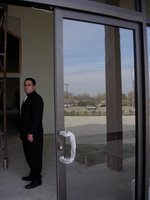
The first thing that's noticeable is the big glass doors at the main entrance! (That's Nick, the choir director and son of Fr. Basil, giving me his always-pleasant look...;-))
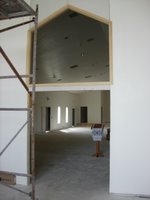
Once inside there's the drywalled entrance from the narthex into the nave (with glass panel above)...
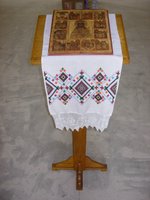
Upon entering the nave we were greeted with the icon of our parish's heavenly patroness, St. Barbara the Holy Martyr.
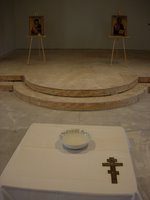
Table with cross and holy water for the bishop's blessing of the building, with icons of the Lord and Theotokos on the ambon.
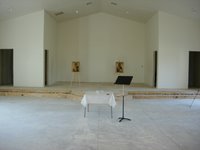 A wide shot of the ambon w/icons, and the table.
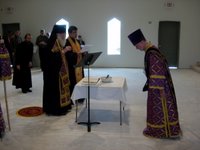
 The Archbishop and Fr. Basil prepare for the blessing.
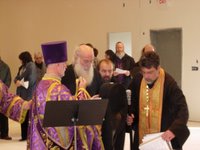
 Protodeacon Patrick bows to Vladyka to begin the blessing.
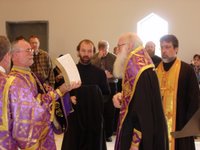 His Eminence reads the gospel.
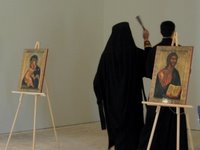 The Archbishop proceeds around the church, sprinkling it with holy water, while the choir sings, "When Thou, O Lord, wast baptized in the Jordan, the worship of the Trinity was made manifest! For the voice of the Father bore witness to Thee, and called Thee His beloved Son! And the Spirit in the form of a dove confirmed the truthfulness of His word. O Christ our God, Who hast revealed Thyself and hast enlightened the world, glory to Thee!"
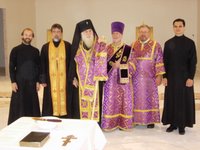 The clergy lined up for a photo op after the blessing.
Phase 1
Phase 2
Phase 3
Phase 4
Phase 5
Phase 6
Phase 7
These are actually not representative of the most recent changes (I keep forgetting to bring the camera with me to church!), so those will be forthcoming (floors tiled, etc.); this is mostly of the blessing done by the Archbishop on his recent (12/4/o5) trip to our parish.
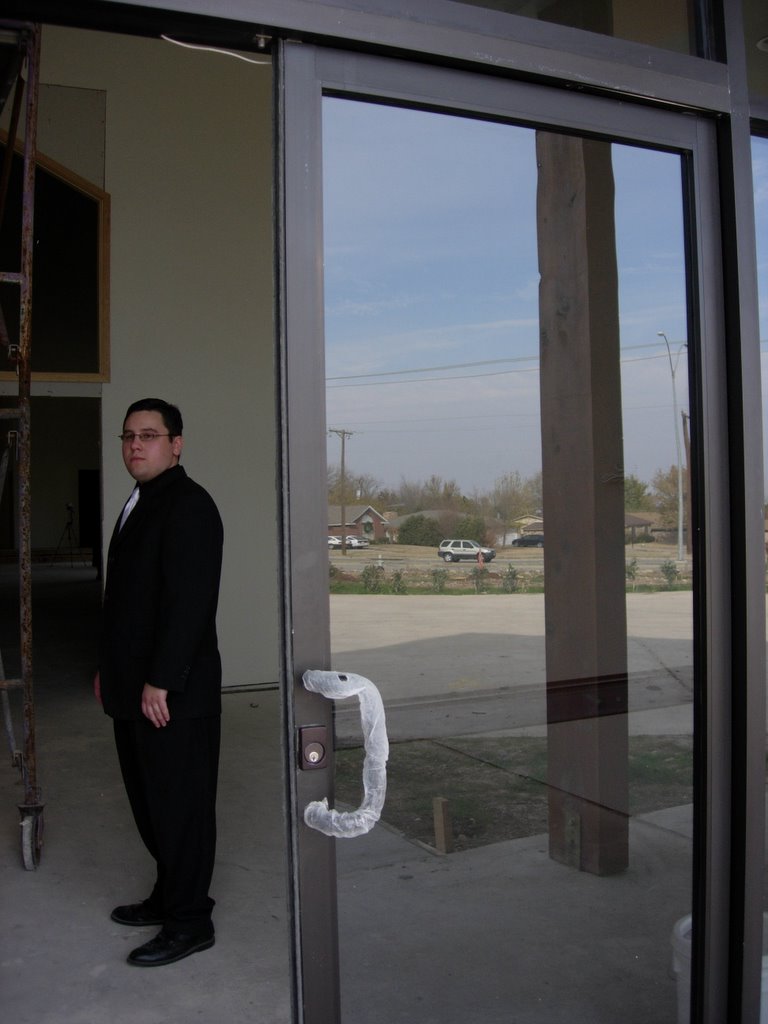
The first thing that's noticeable is the big glass doors at the main entrance! (That's Nick, the choir director and son of Fr. Basil, giving me his always-pleasant look...;-))

Once inside there's the drywalled entrance from the narthex into the nave (with glass panel above)...
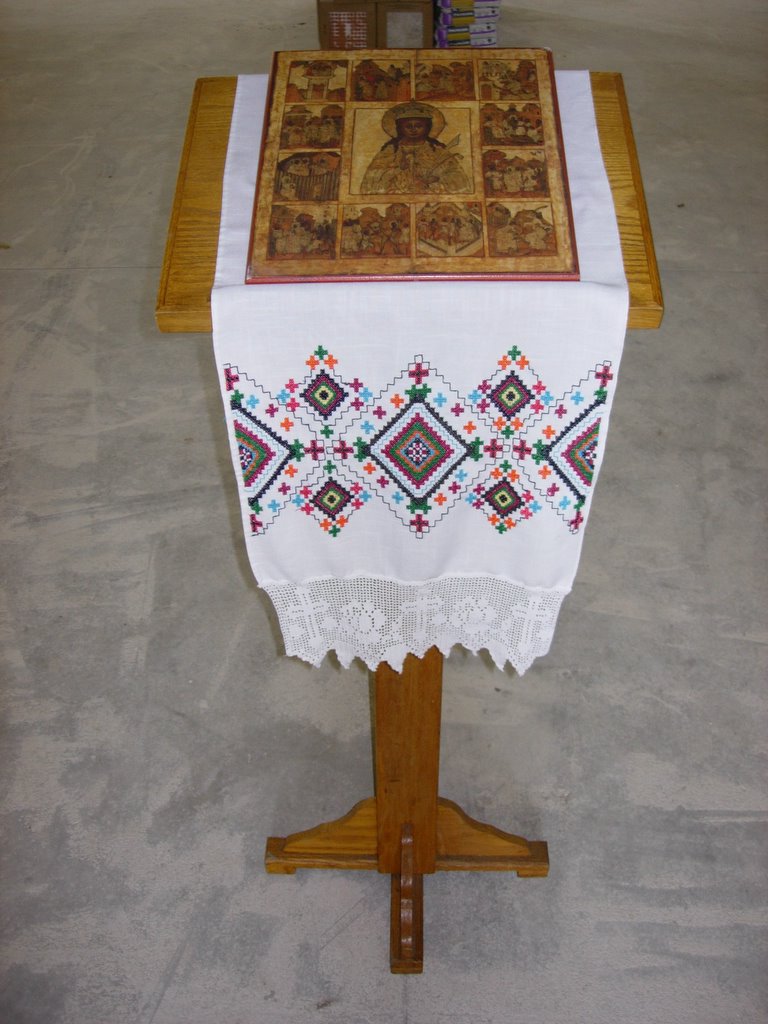
Upon entering the nave we were greeted with the icon of our parish's heavenly patroness, St. Barbara the Holy Martyr.
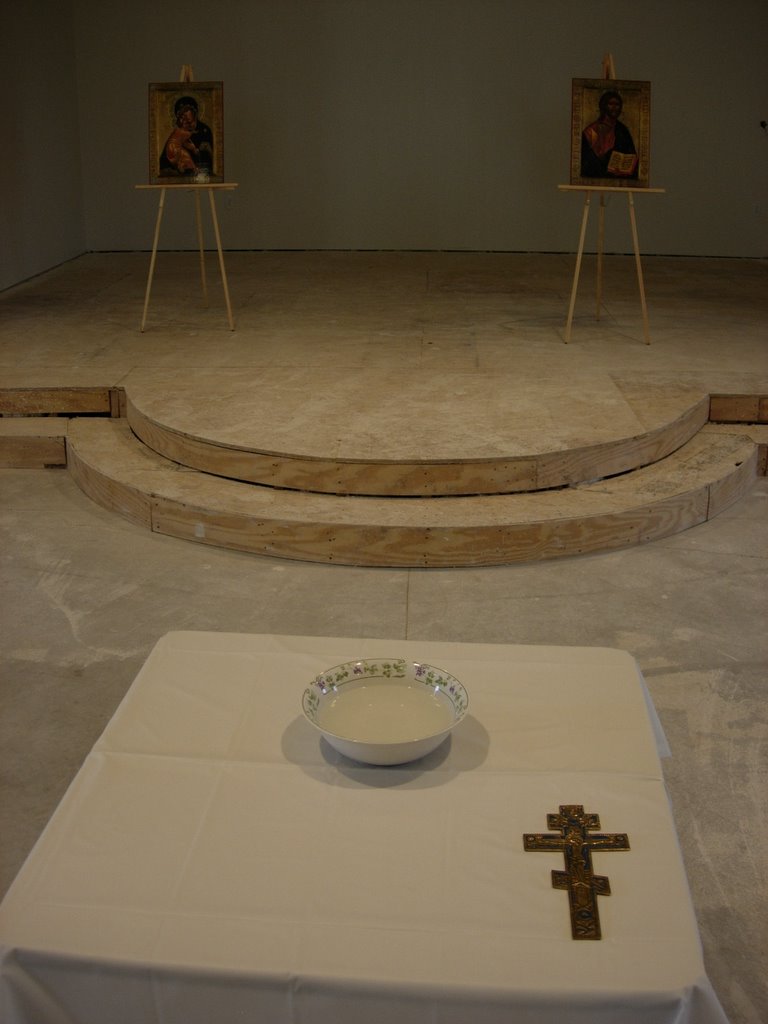
Table with cross and holy water for the bishop's blessing of the building, with icons of the Lord and Theotokos on the ambon.
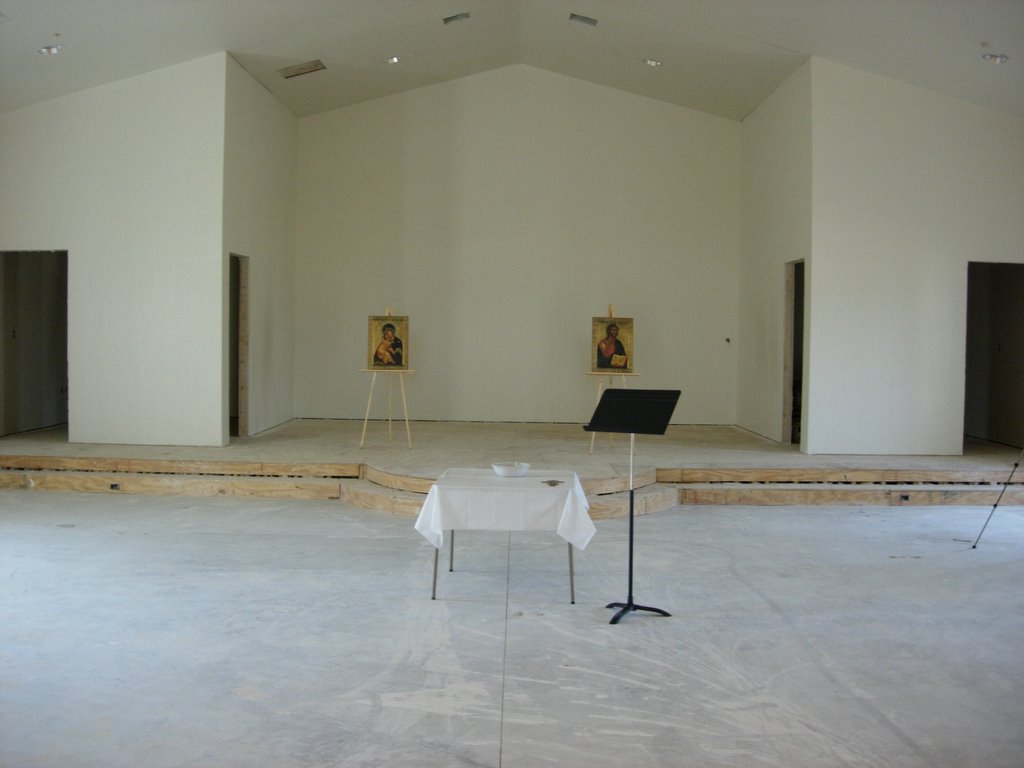 A wide shot of the ambon w/icons, and the table.
 The Archbishop and Fr. Basil prepare for the blessing.
 Protodeacon Patrick bows to Vladyka to begin the blessing.
 His Eminence reads the gospel.
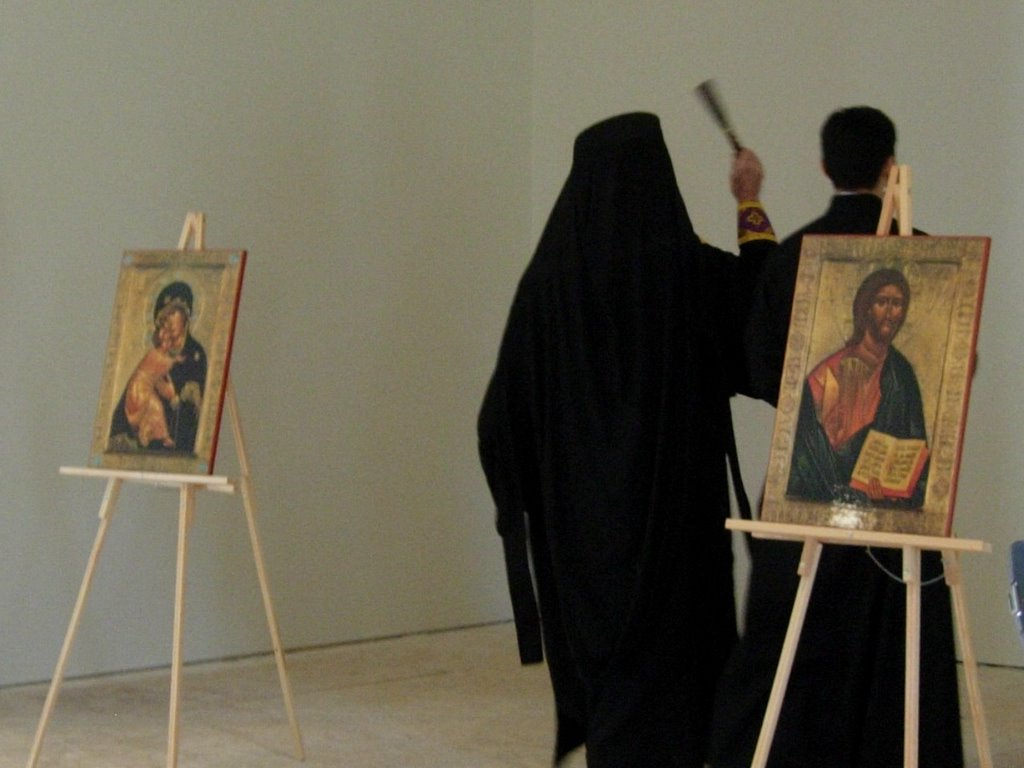 The Archbishop proceeds around the church, sprinkling it with holy water, while the choir sings, "When Thou, O Lord, wast baptized in the Jordan, the worship of the Trinity was made manifest! For the voice of the Father bore witness to Thee, and called Thee His beloved Son! And the Spirit in the form of a dove confirmed the truthfulness of His word. O Christ our God, Who hast revealed Thyself and hast enlightened the world, glory to Thee!"
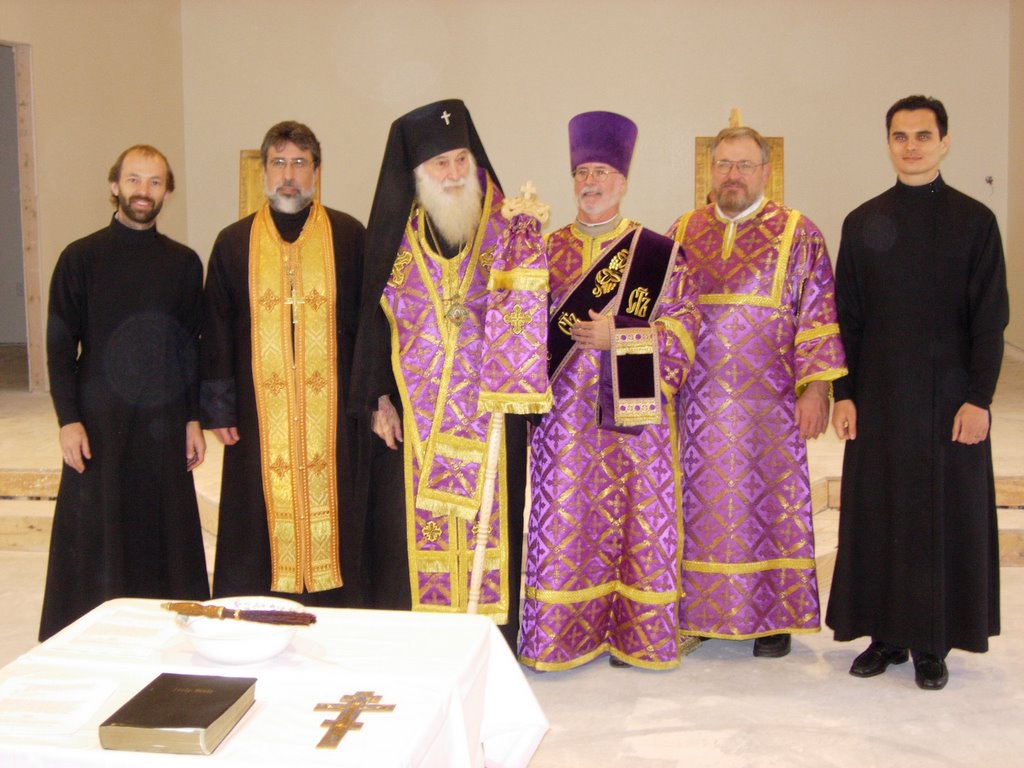 The clergy lined up for a photo op after the blessing.
You know what's not fair?
 So Audra and I are with Hope last night, in her room, doing our shortened rule for Evening Prayers with her, and I'm trying to focus on the Trisagion Prayers or whatever I happened to be on, and I notice a little snickering coming from Audra, who's holding Hope. I look over and see, basically, what you're seeing to the right here. She not only has this onery grin on her face, but has reached over and grabbed my shirt sleeve and, with all the eloquence she can muster, declares the following:
"Aaaaah? AAAAAAAah! Nnn-GUH!"
We, of course, had to fight to keep from giggling through the benediction, but I, for one, would like to know exactly how one is supposed to clear one's mind and focus on the All-Holy Trinity when this little stinker is up to stuff like this. Makes me realize why bishops and monks are childless...
What's With That Middle Flag?
EDIT: Since the writing of this post, I have since come to hold a different opinion than the one expressed in this post. While it is still true that the Civil War was about many different issues, none of these issues would have been issues sufficient to start a war in the first place had chattel slavery not been in place.
Yes, it concerned the right to secede. Yes, it concerned the issue of states' sovereignty vs. federal centralization. But, in 1860, what it meant to be concerned about those issues was that you desired to secede and exercise states' rights in order to keep other human beings in bondage. Thus, while the issues of states' rights and secession continue to be viable political issues in some (small) corners of the country today, one should not and must not cite the CSA as some sort of heroic precedent regarding these issues; such a citation would and does only lead to an implicit, if not explicit, excusing of chattel slavery, which is now exclusively a moral issue in today's society, not a primarily economic one, as it was in that of the 1860s. Such a position is inexcusable in today's world.
Nevertheless, I am keeping the words up for posterity; I do hope that those who find resonance with what I wrote below would stop, reflect, and reconsider what waving the Stars and Bars, however culturally one might feel about it, says today. I continue to recognize that those who fought for the South (my paternal great-great-grandfathers included) did so mostly in a short-sighted attempt to defend their parcel of land and their immediate families, which they were told were being threatened by "Damn Yankees." Many of them did not own slaves (mine did at some point, I believe), and many willingly manumitted them once they saw that they could fight like the men that they were and are. Nevertheless, in our contemporary dialogue on democratic structure, let us allow the past to remain in the past, in a context that is wholly its own, and let us draw from it those lessons we can and should, without the unfortunate wholesale adoption of its truly lost cause, as many misguidedly do today. May God truly bless and save the South, and the North, and all mankind. ~ Fr. David Wooten, Sept. 7, 2012.
Some of you may be wondering about the middle flag of the three beneath my profile on the blog's main page, having easily recognized the American flag and (perhaps not as easily recognized) the Texas flag on the right.
The flag (seen here to the right) is the first national flag of the Confederate States of America, or the South ("Dixie") in the War Between the States. It's here on this blog for more than one reason.
First of all, it's here because I'm a person who has lived his whole life in OK and TX (not considered Dixie by some, but still) and who sympathizes with the secession of the southern states from the USA in 1861. In spite of the horrible stain of slavery--which is undeniably a reason, but not the only reason, WHY THE SOUTH SECEDED-- the fact of the matter is that the North (which still held slaves before, during, and after the War) had absolutely no right to force a group of states to remain in a union whose Constitution it no longer had any desire to support. The North, then, left us no other alternative to dealing with its illegal and unconstitutional actions against us in many areas other than (and, alas including) slavery. I simply seek to remember and honor the brave men and women who supported and died in the ultimately futile struggle to preserve the actual ideals of the Bill of Rights, Declaration of Independence, and the Constitution itself. I think our country would do well to listen to all the other things the South was trying to say about how to run this country when she left the union.

Secondly, the "Stars and Bars" (the flag at the top of the post, under which is the "Bonnie Blue Flag") is much less controversial than the so-called "Rebel Flag," or, Confederate Battle Flag/Naval Jack, pictured here, and so the former flag is displayed instead of the latter. I have no problem myself with this symbol; fact is, this flag doesn't represent slavery nor does it represent KKK sympathies any more than the American flag. In fact, the American flag (which is the official flag of the KKK, by the way) has an even longer association with both slave trade and the Klan than the Confederate Battle Flag). However, the meaning of the Star Spangled Banner has changed--we've acknowledged the presence of genocide and oppression in its history and have sought to make amends while continuing to fly it for different reasons in this day and age, in spite of the fact that hate groups like the Klan might still want to use it for their ignorant purposes. For us to say that the American flag can experience this unquestioned redemption of its meaning, while groups like the Sons of Confederate Veterans--which is about as close to an official voice of the now-defunct Confederacy as you can get these days--cannot be allowed by popular culture to acknowledge the sins of their fathers, while at the same time honoring and remembering what was and is good and right about these symbols and struggles, seems to me to be a double standard that has no basis in history or fact, but rather media hype and ignorance of that fateful time in our nation's (nations' ?) history.
Nevertheless--for the sake of charity and others' feelings, I've stuck with the more "neutral" flag so that people aren't turned off immediately by a symbol that, admittedly and unnecessarily, still angers many.

Picked the birthday of this guy to the right--Gen. Robert E. Lee, the commander of the Confederate armies who, interestingly enough, freed every slave that was ever given to him (and that was before the war), while Gen. Grant of the North owned slaves even afterwards--to put this up.
Let's honor all history. Reject that which is evil, cling to that which is good...


(The Confederate National Anthem, "God Save the South")
DEO VINDICE

The flag (seen here to the right) is the first national flag of the Confederate States of America, or the South ("Dixie") in the War Between the States. It's here on this blog for more than one reason.
First of all, it's here because I'm a person who has lived his whole life in OK and TX (not considered Dixie by some, but still) and who sympathizes with the secession of the southern states from the USA in 1861. In spite of the horrible stain of slavery--which is undeniably a reason, but not the only reason, WHY THE SOUTH SECEDED--
 the fact of the matter is that the North (which still held slaves before, during, and after the War) had absolutely no right to force a group of states to remain in a union whose Constitution it no longer had any desire to support. The North, then, left us no other alternative to dealing with its illegal and unconstitutional actions against us in many areas other than (and, alas including) slavery. I simply seek to remember and honor the brave men and women who supported and died in the ultimately futile struggle to preserve the actual ideals of the Bill of Rights, Declaration of Independence, and the Constitution itself. I think our country would do well to listen to all the other things the South was trying to say about how to run this country when she left the union.
Secondly, the "Stars and Bars" (the flag at the top of the post, under which is the "Bonnie Blue Flag") is much less controversial than the so-called "Rebel Flag," or, Confederate Battle Flag/Naval Jack, pictured here, and so the former flag is displayed instead of the latter. I have no problem myself with this symbol; fact is, this flag doesn't represent slavery nor does it represent KKK sympathies any more than the American flag. In fact, the American flag (which is the official flag of the KKK, by the way) has an even longer association with both slave trade and the Klan than the Confederate Battle Flag). However, the meaning of the Star Spangled Banner has changed--we've acknowledged the presence of genocide and oppression in its history and have sought to make amends while continuing to fly it for different reasons in this day and age, in spite of the fact that hate groups like the Klan might still want to use it for their ignorant purposes.
 For us to say that the American flag can experience this unquestioned redemption of its meaning, while groups like the Sons of Confederate Veterans--which is about as close to an official voice of the now-defunct Confederacy as you can get these days--cannot be allowed by popular culture to acknowledge the sins of their fathers, while at the same time honoring and remembering what was and is good and right about these symbols and struggles, seems to me to be a double standard that has no basis in history or fact, but rather media hype and ignorance of that fateful time in our nation's (nations' ?) history.
Nevertheless--for the sake of charity and others' feelings, I've stuck with the more "neutral" flag so that people aren't turned off immediately by a symbol that, admittedly and unnecessarily, still angers many.
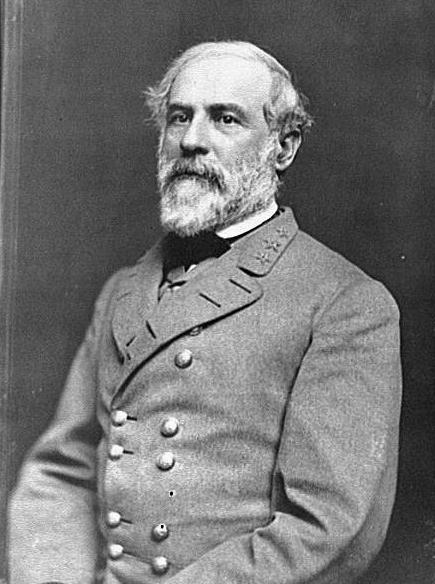
Picked the birthday of this guy to the right--Gen. Robert E. Lee, the commander of the Confederate armies who, interestingly enough, freed every slave that was ever given to him (and that was before the war), while Gen. Grant of the North owned slaves even afterwards--to put this up.
Let's honor all history. Reject that which is evil, cling to that which is good...
DEO VINDICE
Wednesday, January 18, 2006
Liturgical Colors
Normal: Blog header/footer 710,
Body background ccc,
profile-container background 999
Lent: Blog header/footer/prof 8B008B,
Body background DDA0DD
Lazarus: head/foot/prof.: 663300
Body Backgr: CC9966
Holy Week: head/foot/pro 000000
body backgr 202020
Theotokos: head/foot/prof 6495ED
body backgr ADD8E6
Pascha: head/foot/prof FFFAFA, text fff-->000
body backgr DCDCDC
Pentecost: head/foot/prof 347C17
body backgr 99C68E
Body background ccc,
profile-container background 999
Lent: Blog header/footer/prof 8B008B,
Body background DDA0DD
Lazarus: head/foot/prof.: 663300
Body Backgr: CC9966
Holy Week: head/foot/pro 000000
body backgr 202020
Theotokos: head/foot/prof 6495ED
body backgr ADD8E6
Pascha: head/foot/prof FFFAFA, text fff-->000
body backgr DCDCDC
Pentecost: head/foot/prof 347C17
body backgr 99C68E


Wednesday, January 11, 2006
The Psalms of David -- Psalm 23
I had no idea where this was until I found it here a while back; I still get flashbacks of my first Pascha when Fr. George banged on the doors of the church from outside and shouted the proclamation below, answering the question asked from inside by one of the men who (quickly) went about changing the candle holders'/cloths' colors while we sang "Thy Resurrection" outside...
7 Lift up your heads, O you gates!Christ is risen!
And be lifted up, you everlasting doors!
And the King of glory shall come in.
8 Who is this King of glory?
The LORD strong and mighty,
The LORD mighty in battle.
9 Lift up your heads, O you gates!
Lift up, you everlasting doors!
And the King of glory shall come in.
10 Who is this King of glory?
The LORD of hosts,
He is the King of glory.
Sunday, January 08, 2006
New Hope Elizabeth Pics!
Stacy commented on Hope Elizabeth in the last post's comments section just as I was updating said site! Click on "this little one" in my profile, then go to "December and Christmas 05" to see the most recent stuff.
Oh, and Stacy...Vladyka (Abp. +DMITRI) is doing great as always, thanks be to God. How are you acquainted with him?
Oh, and Stacy...Vladyka (Abp. +DMITRI) is doing great as always, thanks be to God. How are you acquainted with him?
Faith as Encounter
Being alums of Oral Roberts University who converted to the Orthodox Christian faith has made my wife and me, along with the many others who've come in with us over a period of about five to ten years, pseudo-celebrities of sorts when visiting other parishes. "Oh, you're one of them!" we seem to hear more often than not. And it's true, it is notable that several students from one of the most well-known protestant/charismatic universities in the world moved from that lifestyle to embrace the ancient faith of the Apostles. Yet, something has been happening lately to some of us that has made me thoughtful. It all started with a conversation on AIM a few weeks ago...
I was talking with one of my fellow ORU converts, who told me quite frankly that he wasn't really attending church anymore, that he wasn't really any kind of a Christian anymore. He named several people from "our group" (we all, of course, bonded well there in Tulsa, going through our similar situations as we were) who felt much the same way, according to him: scattered attendance, general lack of interest in Orthodoxy in particular and Christianity in general. And while this was not, by any means, characteristic of the whole group, the fact that it was more than just a handful bothered me. I began to ask myself why a move to Orthodoxy (or any purposeful move from one confession to another) would, in fact, hinder spiritual growth rather than help it.
Without judging the individuals who converted with me, I'll just speak from my own experience, and from general trends I've noticed. Converting to Orthodoxy from, say, Evangelical Protestantism, as I did, requires that one receive--either through a priest's patient catechism or one's own reading--the equivalent of a couple of courses in Christian Church History and/or the Early Church Fathers if one is to intelligently understand and be able to defend one's move. Things like sacraments--specifically,
What is it, then, that keeps my faith, personally, from going the way of the dusty textbook? Of course, God's grace, for some reason, has been given to me again and again (Why? Anybody's guess), and has initiated, followed and (Lord willing) will complete my journey of faith, as I walk along with Christ. There is, however, one specific characteristic of my faith (as contrasted with "cerebral" adherance) that, I believe, is absolutely necessary for Christians (of any stripe, but particularly those with "much ornamentation" like us Orthodox) to keep in mind in order to continue in a personally meaningful relationship of faith with the Holy Trinity: Faith as Encounter.
For example: Why do we have icons in our churches? Is it merely because St. Theodora decreed that icons were to be used in churches, thereby ending the centuries-long conflict between the iconoclasts and the iconodules (the latter personified by St. John of Damascus) through empirical decree, the commemoration of which on the Church's calendar is the first Sunday of Great Lent? Or is it something more? Is it because God uses windows to meet us? Is it because His holy ones, worship--really worship!--our God with us through their presence in their windows? Or, to compare it another way: Are icons simply "a visible manifestation of the Church's awareness of the Incarnation, of Christ's being the eikon of the invisible God," or are they also a celebration of the fact that the command against making images of the deity has been forever and irrevocably reversed, for we can now know that God is with us, and the fact that we can have His precious image with us, at all times, joyously complete, bears glorious witness to this truth that should transform our lives, make our lives "windows into heaven"--in short, make us into living icons?
This is only one example, but I hope I've been clear in my illustration: we, as Orthodox Christians (and, I would add, especially converts like myself who come from confessions with fewer or no "liturgical accoutrements"), have to be wary of the idolatry of seeing the priest's stole in confession as merely an end in itself, of seeing icons as no more than the proper response to a historical and christological (read: largely academic) dilemma, of seeing the Real Presence and Baptismal Regeneration as only fidelity to apostolic doctrines--instead of seeing all these things as very real keys to our life in and with Christ, who gives us the Holy Spirit, who brings us blameless to the Father. All our "things" and doctrinal stances in Orthodoxy, beautiful and tangible and physical though they are (and must) be, must also "become transparent"--or, rather, be connected with the spiritual reality that is the Kingdom of Heaven--so that we may revel in the grateful knowledge that "of him, and through him, and to him, are all things: to whom be glory for ever. Amen." (Rom. 11:36).
I was talking with one of my fellow ORU converts, who told me quite frankly that he wasn't really attending church anymore, that he wasn't really any kind of a Christian anymore. He named several people from "our group" (we all, of course, bonded well there in Tulsa, going through our similar situations as we were) who felt much the same way, according to him: scattered attendance, general lack of interest in Orthodoxy in particular and Christianity in general. And while this was not, by any means, characteristic of the whole group, the fact that it was more than just a handful bothered me. I began to ask myself why a move to Orthodoxy (or any purposeful move from one confession to another) would, in fact, hinder spiritual growth rather than help it.
Without judging the individuals who converted with me, I'll just speak from my own experience, and from general trends I've noticed. Converting to Orthodoxy from, say, Evangelical Protestantism, as I did, requires that one receive--either through a priest's patient catechism or one's own reading--the equivalent of a couple of courses in Christian Church History and/or the Early Church Fathers if one is to intelligently understand and be able to defend one's move. Things like sacraments--specifically,
- that baptism is not just a motion gone through in obedience but rather the moment where our initial faith is fully kindled and blossoms,
- that confession to an apostolically-decended priest or bishop is also a part of confession of one's sins, that individual confession, while good, is not enough,
- that communion is not just a "memorial meal" of mere bread and wine but the very Body and Blood of Christ,
- that one cannot simply "be called" to start his/her own denomination with varying degrees of agreement with other groups, but that one must be appointed by the abovementioned apostolically-succeeded bishop,
What is it, then, that keeps my faith, personally, from going the way of the dusty textbook? Of course, God's grace, for some reason, has been given to me again and again (Why? Anybody's guess), and has initiated, followed and (Lord willing) will complete my journey of faith, as I walk along with Christ. There is, however, one specific characteristic of my faith (as contrasted with "cerebral" adherance) that, I believe, is absolutely necessary for Christians (of any stripe, but particularly those with "much ornamentation" like us Orthodox) to keep in mind in order to continue in a personally meaningful relationship of faith with the Holy Trinity: Faith as Encounter.
For example: Why do we have icons in our churches? Is it merely because St. Theodora decreed that icons were to be used in churches, thereby ending the centuries-long conflict between the iconoclasts and the iconodules (the latter personified by St. John of Damascus) through empirical decree, the commemoration of which on the Church's calendar is the first Sunday of Great Lent? Or is it something more? Is it because God uses windows to meet us? Is it because His holy ones, worship--really worship!--our God with us through their presence in their windows? Or, to compare it another way: Are icons simply "a visible manifestation of the Church's awareness of the Incarnation, of Christ's being the eikon of the invisible God," or are they also a celebration of the fact that the command against making images of the deity has been forever and irrevocably reversed, for we can now know that God is with us, and the fact that we can have His precious image with us, at all times, joyously complete, bears glorious witness to this truth that should transform our lives, make our lives "windows into heaven"--in short, make us into living icons?
This is only one example, but I hope I've been clear in my illustration: we, as Orthodox Christians (and, I would add, especially converts like myself who come from confessions with fewer or no "liturgical accoutrements"), have to be wary of the idolatry of seeing the priest's stole in confession as merely an end in itself, of seeing icons as no more than the proper response to a historical and christological (read: largely academic) dilemma, of seeing the Real Presence and Baptismal Regeneration as only fidelity to apostolic doctrines--instead of seeing all these things as very real keys to our life in and with Christ, who gives us the Holy Spirit, who brings us blameless to the Father. All our "things" and doctrinal stances in Orthodoxy, beautiful and tangible and physical though they are (and must) be, must also "become transparent"--or, rather, be connected with the spiritual reality that is the Kingdom of Heaven--so that we may revel in the grateful knowledge that "of him, and through him, and to him, are all things: to whom be glory for ever. Amen." (Rom. 11:36).
Friday, January 06, 2006
The Psalms of David -- Psalm 22
aka "The 23rd Psalm" to the rest of the world...
It's a short one, but one having many meanings lost on me growing up as a Baptist...
He leads me beside quiet waters...of baptism, where I am renewed.
He anoints my head with oil...of gladness, of chrismation, of the Holy Spirit.
He prepares a table before me...on which is the food of His Body and Blood...in the presence of...the unseen enemies of my soul.
I will dwell in the house of the LORD forever...which is, of course, not only the Orthodox churches where He is made present, but also--and this, too, by His mercy--our bodies, fashioned into suitable temples of His Spirit, which shall not be dissolved for good at death, but shall rise as incorruptible temples both for the glory of God, and in which we shall dwell, unto the ages of ages.
It's a short one, but one having many meanings lost on me growing up as a Baptist...
He leads me beside quiet waters...of baptism, where I am renewed.
He anoints my head with oil...of gladness, of chrismation, of the Holy Spirit.
He prepares a table before me...on which is the food of His Body and Blood...in the presence of...the unseen enemies of my soul.
I will dwell in the house of the LORD forever...which is, of course, not only the Orthodox churches where He is made present, but also--and this, too, by His mercy--our bodies, fashioned into suitable temples of His Spirit, which shall not be dissolved for good at death, but shall rise as incorruptible temples both for the glory of God, and in which we shall dwell, unto the ages of ages.
Wednesday, January 04, 2006
Prayer Requests...
For the health of Ariel Sharon and the salvation of his soul, let us pray to the Lord...Lord, have mercy...
For the health of our parish priest, Basil, who has come down with the flu, let us pray to the Lord...Lord, have mercy...
For the health of our parish priest, Basil, who has come down with the flu, let us pray to the Lord...Lord, have mercy...
Sunday, January 01, 2006
Holy New Year!
No, it's not the Boy Wonder's new catch phrase. Stay with me; I'll 'splain. But first, these messages...
If you're ever in Louisville, KY, I recommend stopping by St. Michael's (the link is a few posts below). A thriving parish with folks of all ages and from all walks of life. Very multi-ethnic, and the priest is no-nonsense when it comes to doing what the Church is called to do: to guide and direct our lives, and to save our souls (NOT to be an infrequently-attended social club, which is something he slammed several times in his homily today).
He also wished us a HOLY New Year, as opposed to a HAPPY New Year, for, "If you are holy, you will be happy." So Holy New Year to all of you; may Christ our God Who was circumcised on the eighth day bless you, through the holy prayers of His servant Basil the Great, whom we commemorate today.
If you're ever in Louisville, KY, I recommend stopping by St. Michael's (the link is a few posts below). A thriving parish with folks of all ages and from all walks of life. Very multi-ethnic, and the priest is no-nonsense when it comes to doing what the Church is called to do: to guide and direct our lives, and to save our souls (NOT to be an infrequently-attended social club, which is something he slammed several times in his homily today).
He also wished us a HOLY New Year, as opposed to a HAPPY New Year, for, "If you are holy, you will be happy." So Holy New Year to all of you; may Christ our God Who was circumcised on the eighth day bless you, through the holy prayers of His servant Basil the Great, whom we commemorate today.
 http://photos1.blogger.com/x/blogger/1775/794/400/481325/shepherd.jpg
Saturday, December 31, 2005
The Psalms of David -- Psalm 21
The first words of this psalm were the words on Christ's lips on the cross: "My God, My God, why hast Thou forsaken Me?" The crucifixion ended with a verse from Psalm 30--"Into Thy hands I commit my spirit"--so the thought arose in Christian sentiment, Fr. Patrick informs us, that while on the cross Christ silently recited all ten of these psalms. An excellent Great and Holy Friday exercise, imo.
Most notable are the exact descriptions of the crucifixion within this psalm, seen in vv. 7-8 (cf. Matt. 27:39-43), v. 15 (cf. Jn. 19:28) and v. 18 (cf. Jn. 19:23-4).
Fr. Patrick draws our attention to the quotation of this psalm found in the second chapter of the epistle to the Hebrews, where the Passion is given its proper context of "the Lord's sharing our flesh and blood so that 'through death He might destroy him who had the power of death' (2:14). Quoting Psalm 21 in this context of the Passion, the author tells us that Jesus 'is not ashamed to call them brethren, saying, "I will declare Your name to my brethren; / In the midst of the assembly I will sing praise to You"' (2:11,12)."
Appropriate that this psalm ends in the same manner as did our Lord's predictions of His crucifixion: with the victory of His Resurrection (cf. Mk. 8:31; 9:31; 10:34). "My spirit lives for Him; my seed will serve Him," the psalm declares. "The coming generation shall be herald for the Lord, declaring His righteousness to a people yet unborn, whom the Lord created."
Most notable are the exact descriptions of the crucifixion within this psalm, seen in vv. 7-8 (cf. Matt. 27:39-43), v. 15 (cf. Jn. 19:28) and v. 18 (cf. Jn. 19:23-4).
Fr. Patrick draws our attention to the quotation of this psalm found in the second chapter of the epistle to the Hebrews, where the Passion is given its proper context of "the Lord's sharing our flesh and blood so that 'through death He might destroy him who had the power of death' (2:14). Quoting Psalm 21 in this context of the Passion, the author tells us that Jesus 'is not ashamed to call them brethren, saying, "I will declare Your name to my brethren; / In the midst of the assembly I will sing praise to You"' (2:11,12)."
Appropriate that this psalm ends in the same manner as did our Lord's predictions of His crucifixion: with the victory of His Resurrection (cf. Mk. 8:31; 9:31; 10:34). "My spirit lives for Him; my seed will serve Him," the psalm declares. "The coming generation shall be herald for the Lord, declaring His righteousness to a people yet unborn, whom the Lord created."
The Psalms of David -- Psalm 20
Esp. vv. 3-4: "For You meet him with the blessings of goodness; You set a crown of pure gold upon his head. He asked life from You, and You gave it to him--Length of days forever and ever."
The first thing, of course, that jumped out at this married man was the fact that this is the prokeimenon sung at weddings before the reading of the epistle. It's usually mentioned by the priest in every homily I've ever heard at Orthodox weddings (my own included), and it's interesting to consider what it means to a married couple and to then compare it to what it means when this psalm is taken in a christological sense. Those crowns they put on our heads (see My Big Fat Greek Wedding for an example of the crowns if you've never seen an Orthodox wedding...though that wedding left much to be desired from an Orthodox standpoint, but I digress!) are seen to be crowns of martyrdom, both in submitting to each other and laying down our lives one for another, but also in the sense that we are to assist each other in our salvation, a life of "white martyrdom" that revolves around presenting our bodies as living sacrifices to God (Romans 12:1) together, and urging each other on to further good works.
Taken in the sense that this psalm speaks of Christ, however, this verse refers to His crown, not of thorns, but of "pure gold" (the common translation in our prokeimenon is "of precious stones"), speaking not of His Passion on the Cross, but of His glorious Resurrection and victory over death. "By reason of His Resurrection," says Fr. Patrick, "Jesus reigns as King.... And because He is King, He is crowned." The phrase that follows His coronation, then--"He asked life of You"--what sort of life did Christ ask of the Father while enduring His Passion? "The mere survival of His earthly body?" Fr. Patrick asks. "Hardly. The object of Jesus' prayer was, rather, the total life that stands forever victorious over death, the irruption of the divine life into the world by reason of His own passage through death to glory." How fitting, then, that spouses should look to each other--the ones to whom we have been crowned in anticipation, even before the struggle's end--as the ones with whom we can journey through this life, side by side, enduring together in a passion of our own--one that has little, if anything, to do with what this world defines as "marital passion"--so that they may "finally, by [God's] mercy, [be accounted] worthy of everlasting life"--the life asked for and obtained by Christ on our behalf--and that, through union with Him, we might share in the true reality of the crowns we wore and for which we now strive.
The first thing, of course, that jumped out at this married man was the fact that this is the prokeimenon sung at weddings before the reading of the epistle. It's usually mentioned by the priest in every homily I've ever heard at Orthodox weddings (my own included), and it's interesting to consider what it means to a married couple and to then compare it to what it means when this psalm is taken in a christological sense. Those crowns they put on our heads (see My Big Fat Greek Wedding for an example of the crowns if you've never seen an Orthodox wedding...though that wedding left much to be desired from an Orthodox standpoint, but I digress!) are seen to be crowns of martyrdom, both in submitting to each other and laying down our lives one for another, but also in the sense that we are to assist each other in our salvation, a life of "white martyrdom" that revolves around presenting our bodies as living sacrifices to God (Romans 12:1) together, and urging each other on to further good works.
Taken in the sense that this psalm speaks of Christ, however, this verse refers to His crown, not of thorns, but of "pure gold" (the common translation in our prokeimenon is "of precious stones"), speaking not of His Passion on the Cross, but of His glorious Resurrection and victory over death. "By reason of His Resurrection," says Fr. Patrick, "Jesus reigns as King.... And because He is King, He is crowned." The phrase that follows His coronation, then--"He asked life of You"--what sort of life did Christ ask of the Father while enduring His Passion? "The mere survival of His earthly body?" Fr. Patrick asks. "Hardly. The object of Jesus' prayer was, rather, the total life that stands forever victorious over death, the irruption of the divine life into the world by reason of His own passage through death to glory." How fitting, then, that spouses should look to each other--the ones to whom we have been crowned in anticipation, even before the struggle's end--as the ones with whom we can journey through this life, side by side, enduring together in a passion of our own--one that has little, if anything, to do with what this world defines as "marital passion"--so that they may "finally, by [God's] mercy, [be accounted] worthy of everlasting life"--the life asked for and obtained by Christ on our behalf--and that, through union with Him, we might share in the true reality of the crowns we wore and for which we now strive.
Friday, December 30, 2005
The Psalms of David -- Psalm 19
"May the LORD hearken to you..."
I'll just offer an outline of Fr. Patrick's dissection of this matins psalm in the Orthodox Church:
I'll just offer an outline of Fr. Patrick's dissection of this matins psalm in the Orthodox Church:
- This psalm is a prayer of the Church to Christ Himself, an "Amen to the redemptive work of Christ."
- "...the line that reads, 'All your sacrifices'...is the 'Amen' of the Church to the pouring out of the redemptive blood..."
- "When we say, 'May He give you according to your heart's desire'...it is once again the 'Amen' of the Church to the prayer Christ makes for her benefit" (Jn. 17:20-4).
- "When we say, 'May the LORD fulfill all your requests,' it is especially the 'Amen' of the Church to such petitions as (Luke 23:34; Jn. 17:11).
- "When we say to Him, 'We shall exult in Your salvation'...thus does she (the Church) exult... (Rev. 5:9-10, 12)."
- When the Prophet David (as well as Isaiah--31:1; 36:9) says that "some trust in chariots, and some in horses," Fr. Patrick notes that "Holy Scripture wil finally describe these horses as white and carrying a conqueror, as red and bearing a warrior, as black and transporting famine, as pale and ridden by Death" in an ultimate betrayal of those who put their trust in anyone other than God.
- While our psalm states, in agreement with Heb. 7:25 and 9:12, that "Now I know that the LORD has saved His Christ," it also confesses, along with 1 Jn. 3:2, that "We shall be magnified" ultimately at some point in the future.
Thursday, December 29, 2005
The Psalms of David -- Psalm 18
"The heavens declare the glory of God; And the firmament shows His handiwork" (vs. 1).
"The Christian faith," Fr. Patrick begins, "recognizes two ways in which God has made His revelation to us: through nature and through grace. 'Through Creation and through Scripture' is another way of saying the same thing." In a well-known verse in this psalm, sung often in the Divine Liturgy of Orthodox services (the prokeimenon before the epistle and in other places) the Prophet David states, referring to all the wonders of nature, that "Their sound has gone out through all the earth, And their words to the end of the world" in declaring the glory of God (vs. 4).
St. Paul takes up this line in the New Testament, saying that the missionaries who take the message of the gospel out to those who do not know Christ are working, as it were, hand in hand with nature. He asks the believers in Rome, "have they [the people of the world] not heard? Yes indeed: 'Their sound has gone out to all the earth, and their words to the ends of the world'" (10:8). "Paul is saying," notes Fr. Patrick, "that the Gospel is as cosmic as the cosmos."
This is one aspect of God's revelation of Himself--as well as our part in that revealing of Him to our fellow man--that has always fascinated me, as well as put me at odds with many (though by no means all) Evangelicals when I was in that camp. It's been refreshing to come into a confession of Christianity which strongly affirms our link with the rest of creation, sentient as we humans are, or not. The universe, though groaning as in the pains of childbirth and waiting for Christ, Who is our Life, to appear and complete our adoption as sons and our (as well as its own) full redemption (Rom. 8:21-23; Col. 3:4), yet does a more faithful job of declaring steadfastly that there is a God, that He sends down rain on the just and the unjust, that He is a creative Creator and that He provides for us, in cycles of death and resurrection, a witness of His plan to sustain us and help us grow. We, the supposed crown jewel of Creation (we are; the "supposed" comes from our lack of living up to our potential), sputter and stall in our inconsistent efforts to praise Him and make Him known. Our glory--that we are made in the image and likeness of God--has been the source of our greater fall; would that we could observe the glory of God made manifest through our fellow creations and become worthier icons ourselves. Lord, have mercy.
"The Christian faith," Fr. Patrick begins, "recognizes two ways in which God has made His revelation to us: through nature and through grace. 'Through Creation and through Scripture' is another way of saying the same thing." In a well-known verse in this psalm, sung often in the Divine Liturgy of Orthodox services (the prokeimenon before the epistle and in other places) the Prophet David states, referring to all the wonders of nature, that "Their sound has gone out through all the earth, And their words to the end of the world" in declaring the glory of God (vs. 4).
St. Paul takes up this line in the New Testament, saying that the missionaries who take the message of the gospel out to those who do not know Christ are working, as it were, hand in hand with nature. He asks the believers in Rome, "have they [the people of the world] not heard? Yes indeed: 'Their sound has gone out to all the earth, and their words to the ends of the world'" (10:8). "Paul is saying," notes Fr. Patrick, "that the Gospel is as cosmic as the cosmos."
This is one aspect of God's revelation of Himself--as well as our part in that revealing of Him to our fellow man--that has always fascinated me, as well as put me at odds with many (though by no means all) Evangelicals when I was in that camp. It's been refreshing to come into a confession of Christianity which strongly affirms our link with the rest of creation, sentient as we humans are, or not. The universe, though groaning as in the pains of childbirth and waiting for Christ, Who is our Life, to appear and complete our adoption as sons and our (as well as its own) full redemption (Rom. 8:21-23; Col. 3:4), yet does a more faithful job of declaring steadfastly that there is a God, that He sends down rain on the just and the unjust, that He is a creative Creator and that He provides for us, in cycles of death and resurrection, a witness of His plan to sustain us and help us grow. We, the supposed crown jewel of Creation (we are; the "supposed" comes from our lack of living up to our potential), sputter and stall in our inconsistent efforts to praise Him and make Him known. Our glory--that we are made in the image and likeness of God--has been the source of our greater fall; would that we could observe the glory of God made manifest through our fellow creations and become worthier icons ourselves. Lord, have mercy.
The Psalms of David -- Psalm 17
These psalm meditations, as you can imagine, were a large part of where the name change, blog change, etc. came from...
This psalm, says Fr. Patrick, is best seen in the context of Christ's trial before Pilate. Most important to remember, however, is that in verses like vv. 37-42--
--we must remind ourselves of who "the real villians in this psalm" are: "the satanic spirits, the true enemies who consipred against the Holy and Righteous One. Consequently, it is the fallen angels that we should see referenced in so many lines of this psalm" instead of the Jews or the Romans, "for against them [the spirits] our Lord waged a combat without quarter."
This psalm, says Fr. Patrick, is best seen in the context of Christ's trial before Pilate. Most important to remember, however, is that in verses like vv. 37-42--
"37 I have pursued my enemies and overtaken them; Neither did I turn back again till they were destroyed.
38 I have wounded them, So that they could not rise; They have fallen under my feet.
39 For You have armed me with strength for the battle; You have subdued under me those who rose up against me.
40 You have also given me the necks of my enemies, So that I destroyed those who hated me.
41 They cried out, but there was none to save; Even to the LORD, but He did not answer them.
42 Then I beat them as fine as the dust before the wind; I cast them out like dirt in the streets."
--we must remind ourselves of who "the real villians in this psalm" are: "the satanic spirits, the true enemies who consipred against the Holy and Righteous One. Consequently, it is the fallen angels that we should see referenced in so many lines of this psalm" instead of the Jews or the Romans, "for against them [the spirits] our Lord waged a combat without quarter."
Wednesday, December 28, 2005
The Past Few Days and Weeks
Well, it is good to be back posting. This post comes to you from the small town of Radcliff, KY, which is nestled between Ft. Knox and Elizabethtown (yes, the town the recent movie is based on). This is Audra's hometown, and most likely near where we'll be moving in a couple of years to be around her family.
MUCH travel the past week or so; drove out here from Ft. Worth (15 hours, thankyouverymuch) on the 22nd after school let out (Audra and Hope had flown out the Sat. before). Uneventful, except for two things...in order to make the trip in one day, I had to leave CRAZY early in the morning, and this meant much fog...it's interesting to watch the low-lying, rolling fog go over people's crops; it almost looks as if they're growing fog. The other event--not so picturesque--were the two traffic snarls which literally stopped traffic. Fortunately, I called my navigator in KY, who hopped online and, over the cell phone, found me a way around them. Made the trip in good time regardless, thanks be to God. Will drive back on the 2nd, stopping to meet with a friend in Nashville for lunch. The girls will fly back the following day. Your prayers would be appreciated.
More driving to see father-in-law's fam in Hopkinsville, and mom-in-law's fam in Sturgis. Easy conversation; very warm people. Good to see them again, even some new faces. Very welcoming. Spent Christmas Day morning in the Cumberland Presbyterian Church there in Sturgis--not Orthodox, of course, but at least none of this "let's-close-because-it's-Christmas-Day-and-people-should-be-with-their-families-instead-of-in-church" nonsense (yes, people should be with their families, but let's remember where our true family, is, ¿no?).
Speaking of true family, confession before leaving for Kentucky was, as far as I could perceive, a very reflective, honest (and relatively long) one. While my own heart's estimation may not do justice to the reality of my heart's state (for God's knowledge of me is greater than even my heart's--1 Jn. 3:20), it did, at least, pave the way for a much more attentive vespers service that night. God be praised for His forgiveness and for His help in overcoming our weaknesses. Will commune at St. Michael Orthodox Church in Louisville on Sunday, Lord willing. Always good to connect with brethren around the country.
Other things...the new church building is almost ready to be moved into! Pictures of the blessing by the archbishop will be forthcoming (once I get back to FW, Lord willing), as well as of the consecration shortly after (whenever THAT is). Much excitement over this new chapter in our life as a parish family; may God grant us increase as we make room for more souls to come into His true Church, to share in His true Banquet.
Hope is sitting up on her own and eating strained solid foods! What a mujercita! She, of course, is the darling of every house we take her to; not only is she getting spoiled by all the attention and people carrying her around, but we as her parents are getting spoiled by having so many live-in, on-call, free babysitters! 'Twill be a rude awakening for all parties involved when we return to normal, Ft. Worth life and all the work involved. If we can pry her away from the grandparents, that is....
It is amazing, though, to have Hope as a living, breathing, wriggling example of what our Lord looked like as an infant. To think: our Creator, the One Who spoke worlds that before were not, Who holds the whole universe in the hollow of His hand, became one of these chubby, squealing, grinning little wonders--helpless, humanly speaking, and sucking at His holy mother's breast. In that one act, our God provided for our nature, for our race, a way out of its destiny of decay and thus moved all of human nature from enmity to friendship ("compatibility," as my much-more-computer-savvy friend would say) with God. What was once impossible (the renewal of our nature and the salvation of our individual souls), regardless of how much we obeyed, has now been made possible by a cooing, peaceful, and gloriously divine infant resting in a cave, born of a spotless virgin, given flesh and blood in order to be the firstfruits of our salvation, flesh and blood of which we would all partake, for the forgiveness of our sins, and the healing of our souls and bodies.
As always, grateful for the chance to deny myself for forty days--learning through both the times when I succeed in this and when I fail--and thus to remind myself that He is the One thing needful in my life. Would that we would remember Him thus always.
MUCH travel the past week or so; drove out here from Ft. Worth (15 hours, thankyouverymuch) on the 22nd after school let out (Audra and Hope had flown out the Sat. before). Uneventful, except for two things...in order to make the trip in one day, I had to leave CRAZY early in the morning, and this meant much fog...it's interesting to watch the low-lying, rolling fog go over people's crops; it almost looks as if they're growing fog. The other event--not so picturesque--were the two traffic snarls which literally stopped traffic. Fortunately, I called my navigator in KY, who hopped online and, over the cell phone, found me a way around them. Made the trip in good time regardless, thanks be to God. Will drive back on the 2nd, stopping to meet with a friend in Nashville for lunch. The girls will fly back the following day. Your prayers would be appreciated.
More driving to see father-in-law's fam in Hopkinsville, and mom-in-law's fam in Sturgis. Easy conversation; very warm people. Good to see them again, even some new faces. Very welcoming. Spent Christmas Day morning in the Cumberland Presbyterian Church there in Sturgis--not Orthodox, of course, but at least none of this "let's-close-because-it's-Christmas-Day-and-people-should-be-with-their-families-instead-of-in-church" nonsense (yes, people should be with their families, but let's remember where our true family, is, ¿no?).
Speaking of true family, confession before leaving for Kentucky was, as far as I could perceive, a very reflective, honest (and relatively long) one. While my own heart's estimation may not do justice to the reality of my heart's state (for God's knowledge of me is greater than even my heart's--1 Jn. 3:20), it did, at least, pave the way for a much more attentive vespers service that night. God be praised for His forgiveness and for His help in overcoming our weaknesses. Will commune at St. Michael Orthodox Church in Louisville on Sunday, Lord willing. Always good to connect with brethren around the country.
Other things...the new church building is almost ready to be moved into! Pictures of the blessing by the archbishop will be forthcoming (once I get back to FW, Lord willing), as well as of the consecration shortly after (whenever THAT is). Much excitement over this new chapter in our life as a parish family; may God grant us increase as we make room for more souls to come into His true Church, to share in His true Banquet.
Hope is sitting up on her own and eating strained solid foods! What a mujercita! She, of course, is the darling of every house we take her to; not only is she getting spoiled by all the attention and people carrying her around, but we as her parents are getting spoiled by having so many live-in, on-call, free babysitters! 'Twill be a rude awakening for all parties involved when we return to normal, Ft. Worth life and all the work involved. If we can pry her away from the grandparents, that is....
It is amazing, though, to have Hope as a living, breathing, wriggling example of what our Lord looked like as an infant. To think: our Creator, the One Who spoke worlds that before were not, Who holds the whole universe in the hollow of His hand, became one of these chubby, squealing, grinning little wonders--helpless, humanly speaking, and sucking at His holy mother's breast. In that one act, our God provided for our nature, for our race, a way out of its destiny of decay and thus moved all of human nature from enmity to friendship ("compatibility," as my much-more-computer-savvy friend would say) with God. What was once impossible (the renewal of our nature and the salvation of our individual souls), regardless of how much we obeyed, has now been made possible by a cooing, peaceful, and gloriously divine infant resting in a cave, born of a spotless virgin, given flesh and blood in order to be the firstfruits of our salvation, flesh and blood of which we would all partake, for the forgiveness of our sins, and the healing of our souls and bodies.
As always, grateful for the chance to deny myself for forty days--learning through both the times when I succeed in this and when I fail--and thus to remind myself that He is the One thing needful in my life. Would that we would remember Him thus always.
Tuesday, December 27, 2005
Christ is born! Glorify Him!

Troparion - Tone 4
Your
Nativity, O Christ our God,
Has shone to the world the Light of wisdom!
For by it, those who worshipped the stars,
Were taught by a Star to
adore You,
The Sun of Righteousness,
And to know You, the Orient from on
High.
O Lord, glory to You!
Kontakion - Tone 3
Today the
Virgin gives birth to the Transcendent One,
And the earth offers a cave to
the Unapproachable One!
Angels with shepherds glorify Him!
The wise men
journey with a star!
Since for our sake the Eternal God was born as a Little
Child!
Sunday, December 04, 2005
Tonsured
The following pictures are of my tonsuring, which took place today. More pics will be forthcoming after Nativity.
For those of you who've followed this blog for a while know that Peter was my name in the Church. I "took" the name David today when I was tonsured a reader, for several reasons. One, my given first name is David, so tradition would dictate that I would "baptize" the name I've always had. I was planning on being chrismated as David, but my then-priest recommended that I consider Peter, which I did, for various reasons that had to do with my first confession and with certain hurdles I had upon coming into the Church which were overcome by meditating on certain events in St. Peter's life. So, for that time, St. Peter was a wonderful companion, and his icons will remain in our house always, but it seems time to "get back to my roots" and reclaim the name I've always had. Plus. the Prophet David is commemorated on the Sunday following Nativity, which is on or around my birthday, Dec. 27th. As I had a very difficult and premature birth, it seems to fit that he'd be looking out for me. Plus...reader of psalms, named after the writer of psalms who was said to be a man after God's own heart...it was just time, I thought.
Plus..."the reeder Peeder"...come on, now... ::wink::
Enjoy the photos; see you after the Feast of Nativity!
For those of you who've followed this blog for a while know that Peter was my name in the Church. I "took" the name David today when I was tonsured a reader, for several reasons. One, my given first name is David, so tradition would dictate that I would "baptize" the name I've always had. I was planning on being chrismated as David, but my then-priest recommended that I consider Peter, which I did, for various reasons that had to do with my first confession and with certain hurdles I had upon coming into the Church which were overcome by meditating on certain events in St. Peter's life. So, for that time, St. Peter was a wonderful companion, and his icons will remain in our house always, but it seems time to "get back to my roots" and reclaim the name I've always had. Plus. the Prophet David is commemorated on the Sunday following Nativity, which is on or around my birthday, Dec. 27th. As I had a very difficult and premature birth, it seems to fit that he'd be looking out for me. Plus...reader of psalms, named after the writer of psalms who was said to be a man after God's own heart...it was just time, I thought.
Plus..."the reeder Peeder"...come on, now... ::wink::
Enjoy the photos; see you after the Feast of Nativity!


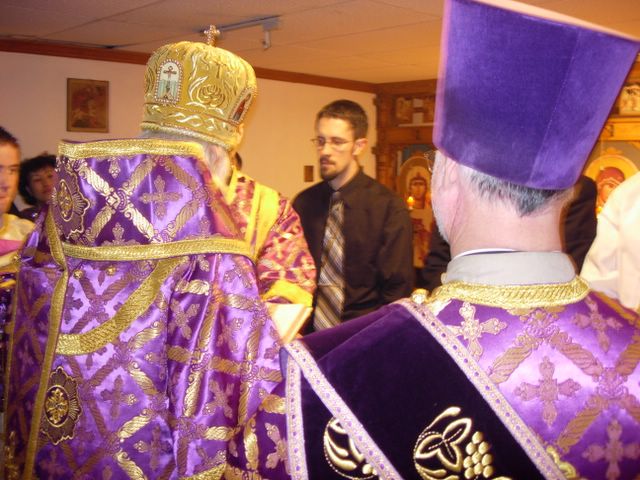
Subscribe to:
Posts (Atom)