


Colossians 3:15: "And let the peace of God rule in your hearts, to which also you were called in one body; and be thankful."Yesterday had to have been a record high for N. Texas--80-something at the end of February--and today is looking like the same with a high of 87! Sunny, warm weather's bound to put anybody in a good mood, but doubly so* with me because of several reminders...
I am Thankful...Not only did that put things in a better perspective (and prompt meditation on the Scripture verse above), but immediately after reading this I got a call from Audra (and Hope, of course) who wanted to go for a walk in this beautiful weather...so I went home, changed, and we walked--the four of us (large, sweet dog included)--to Sonic for ice cream. Warm breeze in the face; good conversation with a beautiful, giving woman; gigantic, two-toothed baby-smiles and squeals; thick coldness on the tongue (God bless cheese week!)--truly much to be thankful for.
For the wife who says it's hot dogs tonight, because she is home with me, and not out with someone else.
For the husband who is on the sofa being a couch potato, because he is home with me and not out at the bars.
For the teenager who is complaining about doing dishes, because it means she is home, not on the streets.
For the taxes I pay, because it means I am employed.
For the mess to clean after a party, because it means I have been surrounded by friends.
For the clothes that fit a little too snug, because it means I have enough to eat.
For my shadow that watches me work, because it means I am out in the sunshine.
For a lawn that needs mowing, windows that need cleaning, and gutters that need fixing, because it means I have a home.
For all the complaining I hear about the government, because it means we have freedom of speech.
For the parking spot I find at the far end of the parking lot, because it means I am capable of walking and I have been blessed with transportation.
For my huge heating bill, because it means I am warm. For the lady behind me in church who sings off key, because it means I can hear.
For the pile of laundry and ironing, because it means I have clothes to wear.
For the weariness and aching muscles at the end of the day, because it means I have been capable of working hard.
For the alarm that goes off in the early morning hours, because it means I am alive!
The Shokey Pokey
O proud left foot, that ventures quick within
Then soon upon a backward journey lithe.
Anon, once more the gesture, then begin:
Command sinistral pedestal to writhe.
Commence thou then the fervid Hokey-Poke,
A mad gyration, hips in wanton swirl.
To spin! A wilde release from Heavens yoke.
Blessed dervish! Surely canst go, girl.
The Hoke, the poke -- banish now thy doubt
Verily, I say, 'tis what it's all about.
-- by William Shakespeare (Jeff Brechlin, Potomac Falls)
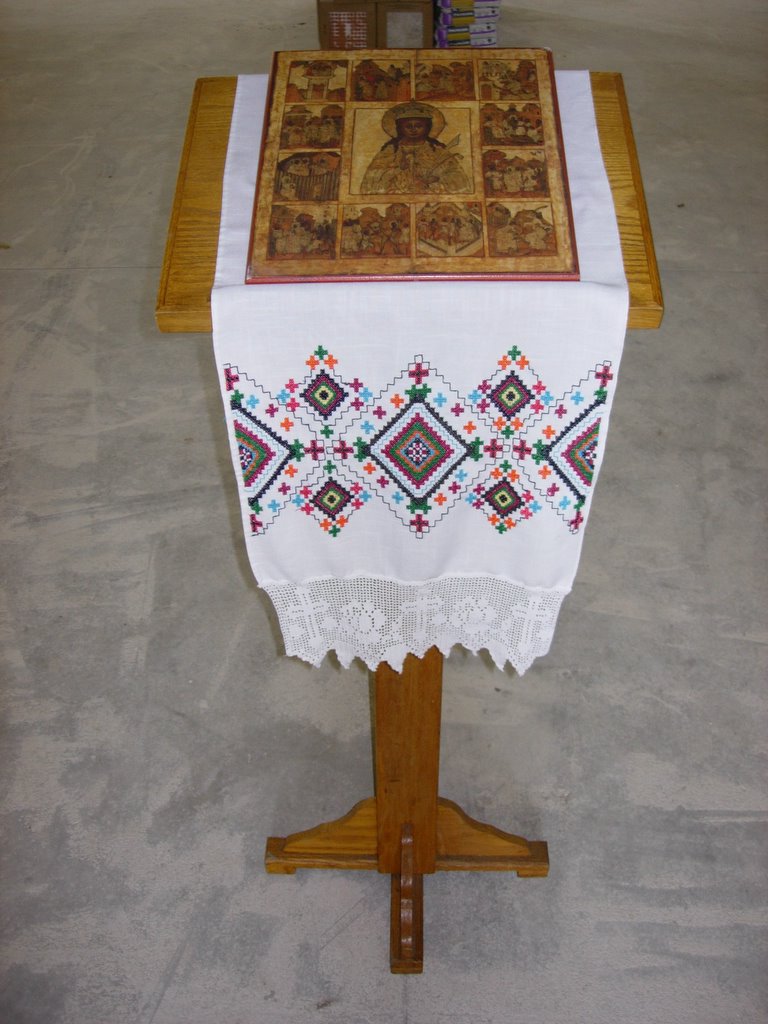
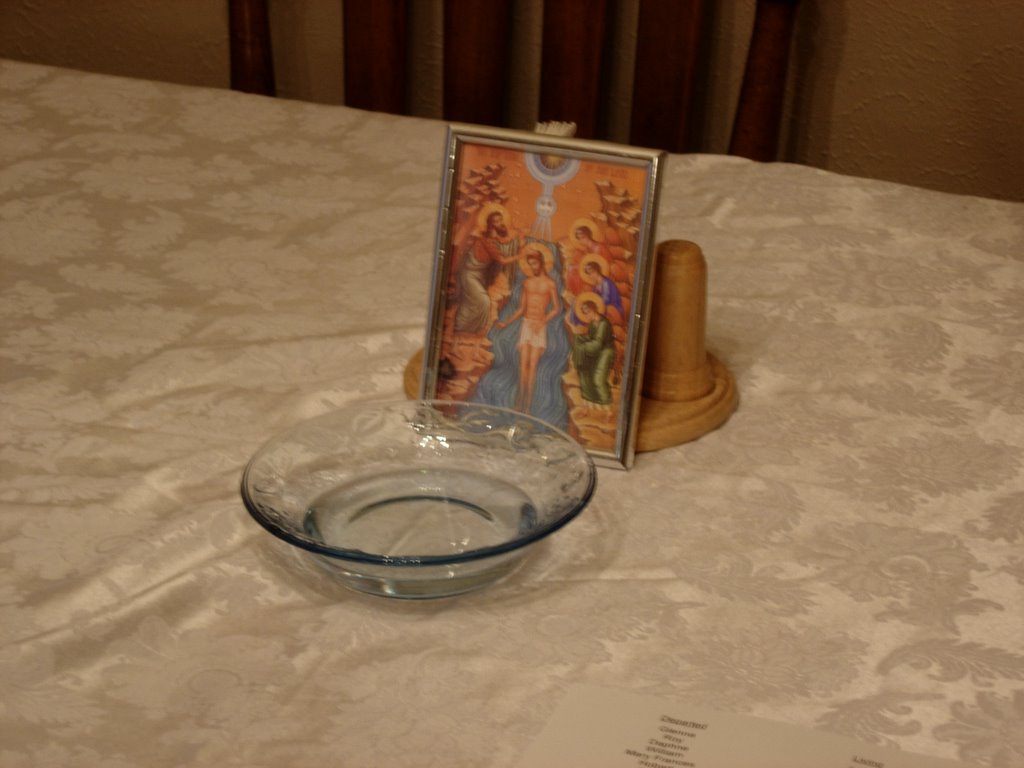 The icon (propped up on salt and pepper shakers, of course!) of the Theophany--the revelation of God as Trinity, seen in Baptism of Christ--in front of the bowl which would hold the holy water, laid out on a white tablecloth, as per Orthodox custom.
 Fr. Basil and Nick with Hope--Nick's "mean-muggin'" here...
 A nicer Nick w/Hope...awww...
 Matushka bouncing Hope on her lap while Hope had a serious conversation with her and Father, mostly along the lines of, "AwahwahWAH!!"
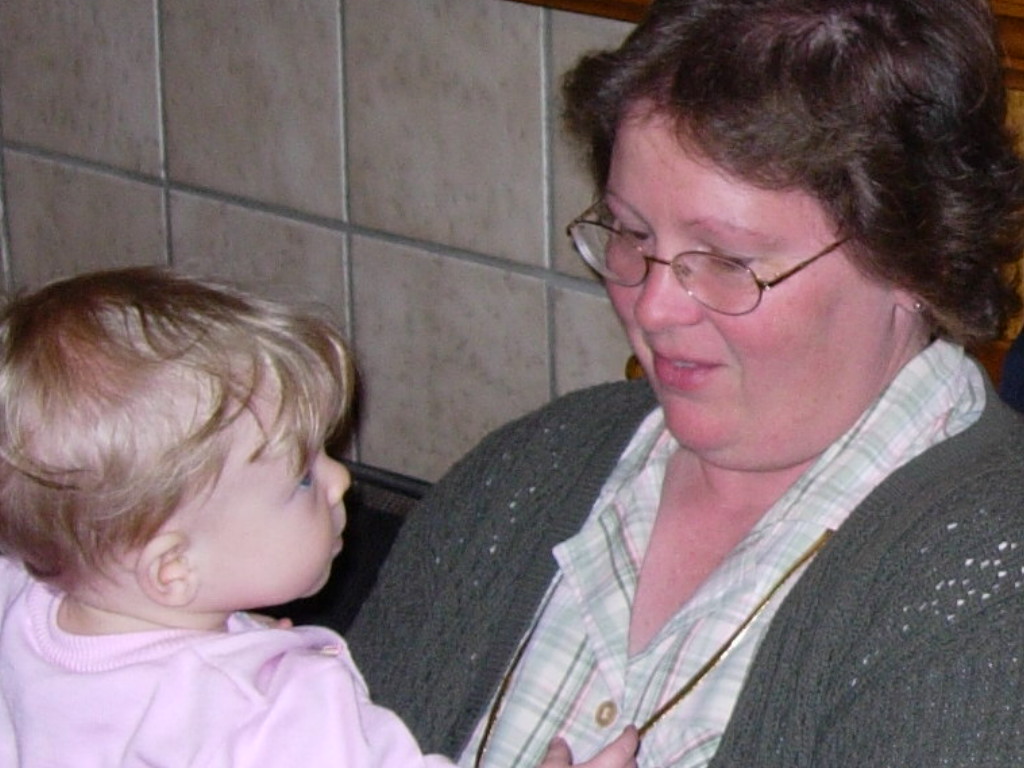 Close-up of Matushka and Hope.
 This picture is cool. It would be cool to pray here.
 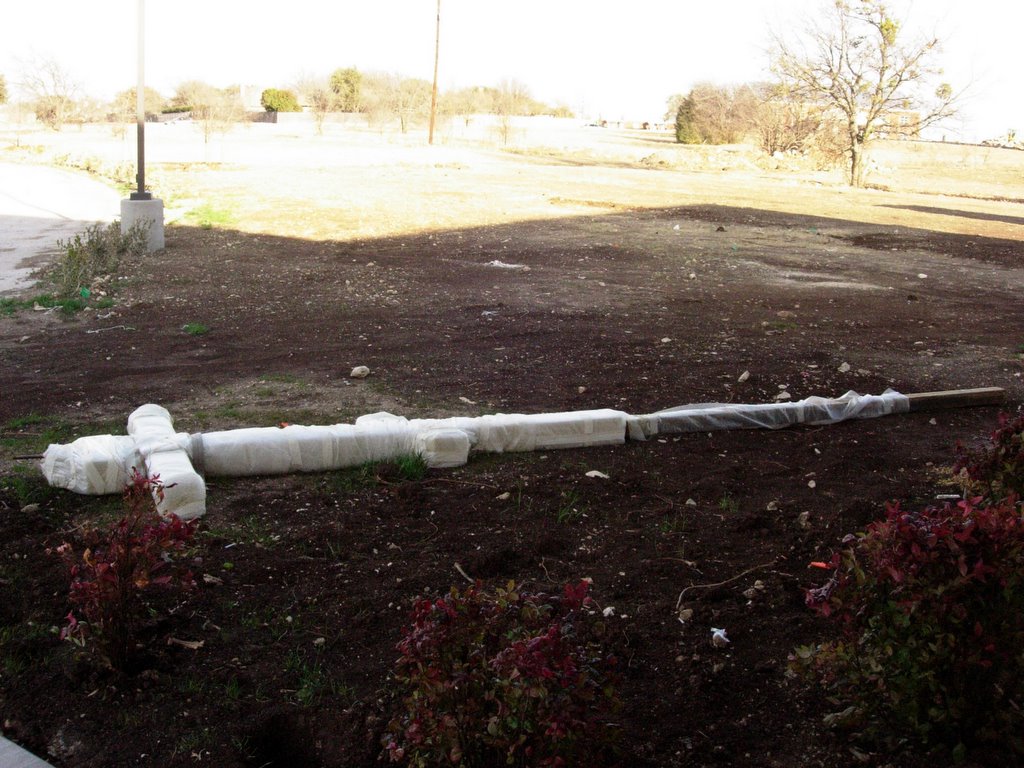 The following pics were taken today when I went to church for choir practice -- we practiced in the new building, so I got to click around and see all the new stuff (thanks, Matushka, for facilitating the "tour" of the great new altar we've got (see below). The first picture is the approx. ten-foot cross that will go on top of the huge gold-leaf dome which will go on top of the building. It is, as you can see, wrapped in what appears to be Saran Wrap. Huh.
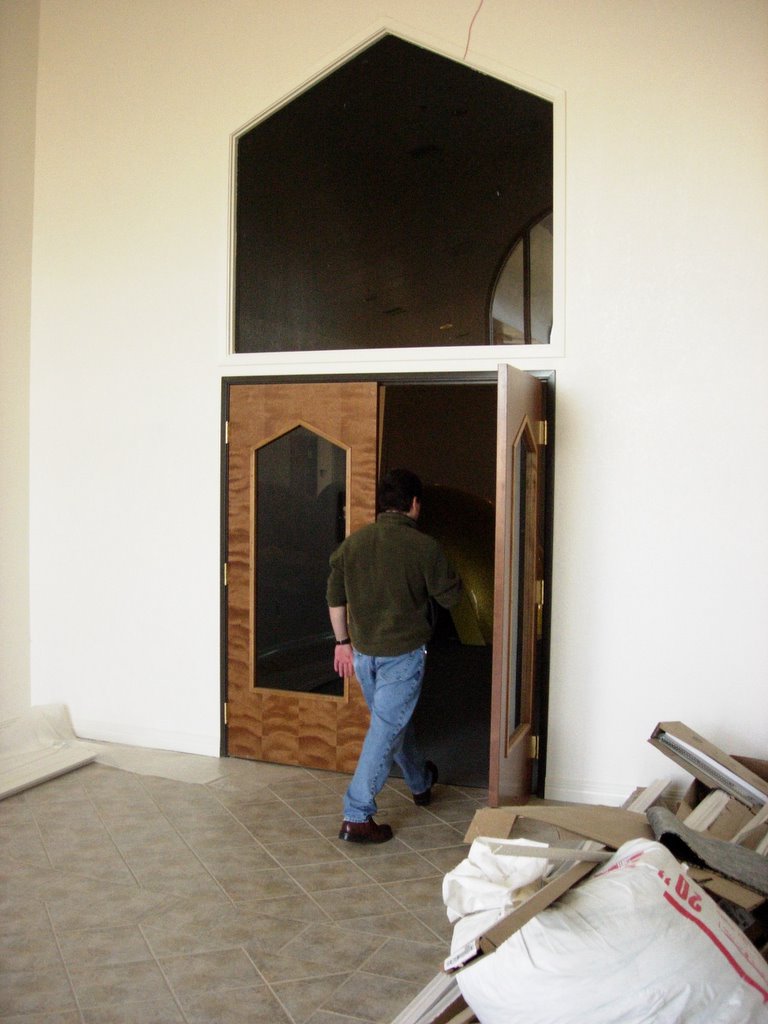 Next up is the pic of the doors leading from the narthex to the nave. These are nice, wooden doors that work really well with the tile that is, as you can see, stylishly covering the concrete slab that we all stood on during the Abp's blessing visit on 12/4. Yes, that's Nick again.
 From inside the doors, here's a pic from the back of the nave -- actually, it's sort of a "second narthex," since the two walls there are there to mark the back of the nave and, being moveable, will help us accommodate lots of folks for Pascha, etc. We're looking at the four quarters of the gold cupola, which are still awaiting the gold leaf. Once that gets here, the dome will be leafed and placed on top of the building! In the background you see the red-carpeted amvon and the just-made, traditional wooden altar.
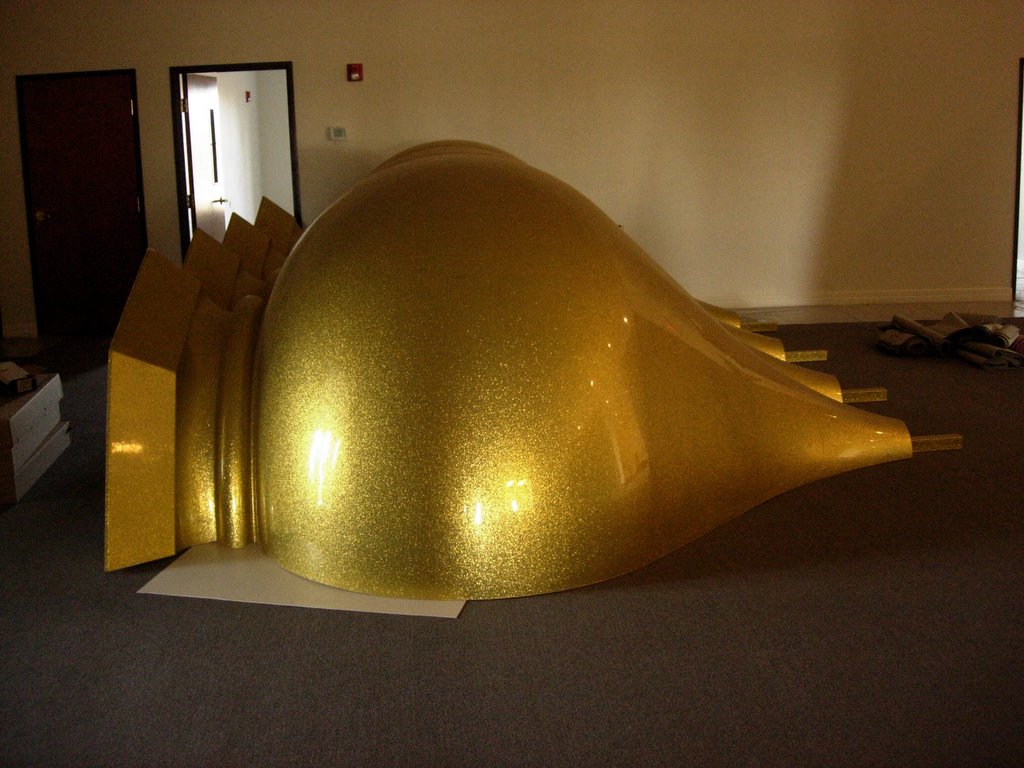 This is a shot of the cupola quarters from the side. The thing is huge; it's probably about 10-12 feet high from base to tip, then add another 10 feet or so for that cross that's outside...whoo, boy...
 Off to the side, opposite the cupola, is our new kitchen. Huge thing, this kitchen, which is great for us; we'll be able to properly facilitate our Old Country Christmas sales, which require much preparation of baked goods and pierogi...mmm...pierogi... {drools}
 Interior of the very roomy kitchen, complete with nice wooden cabinets and cabinets, sinks...
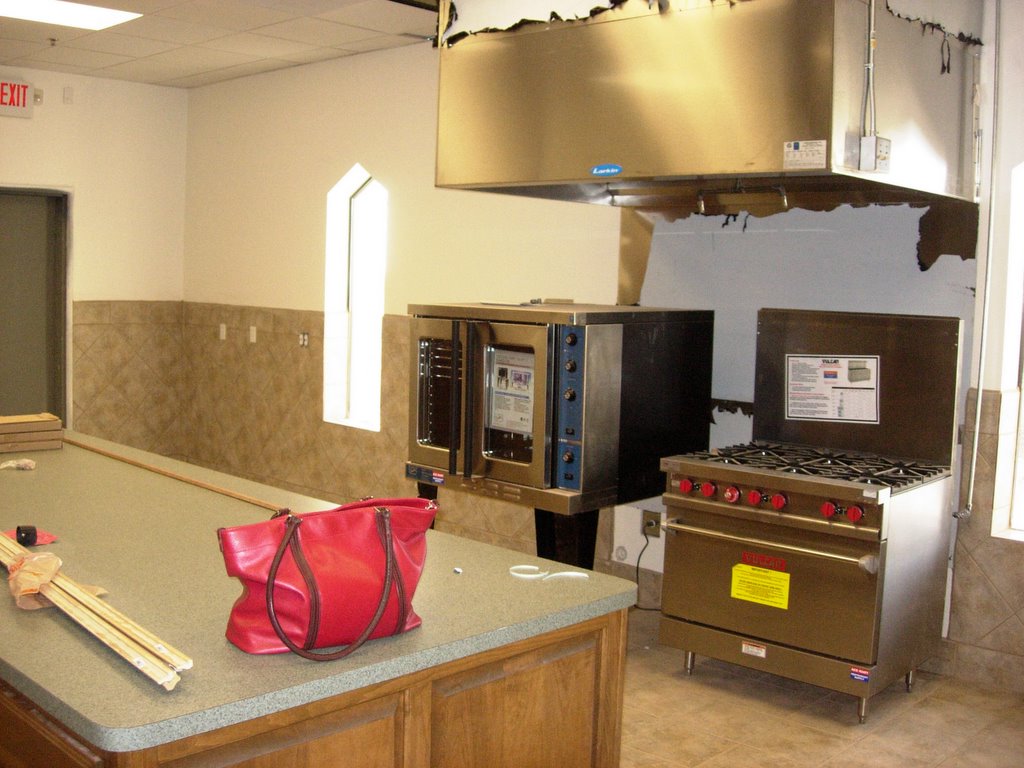 ...a range, an oven, and lots of other good stuff.
 This is a classroom that's on the other side of the nave from the kitchen. This'll be used for everything from Church school to Adult Education.
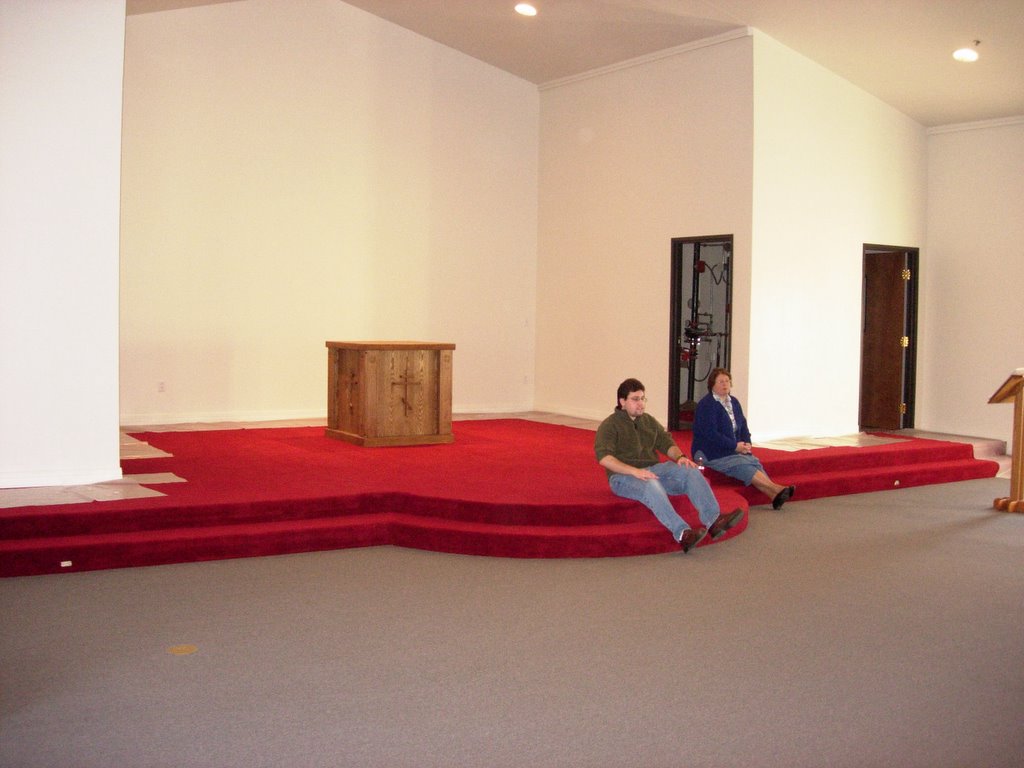 The amvon, with Nick and Matushka sitting on the steps, waiting for the rest of the choir to get here...altar there in the background...
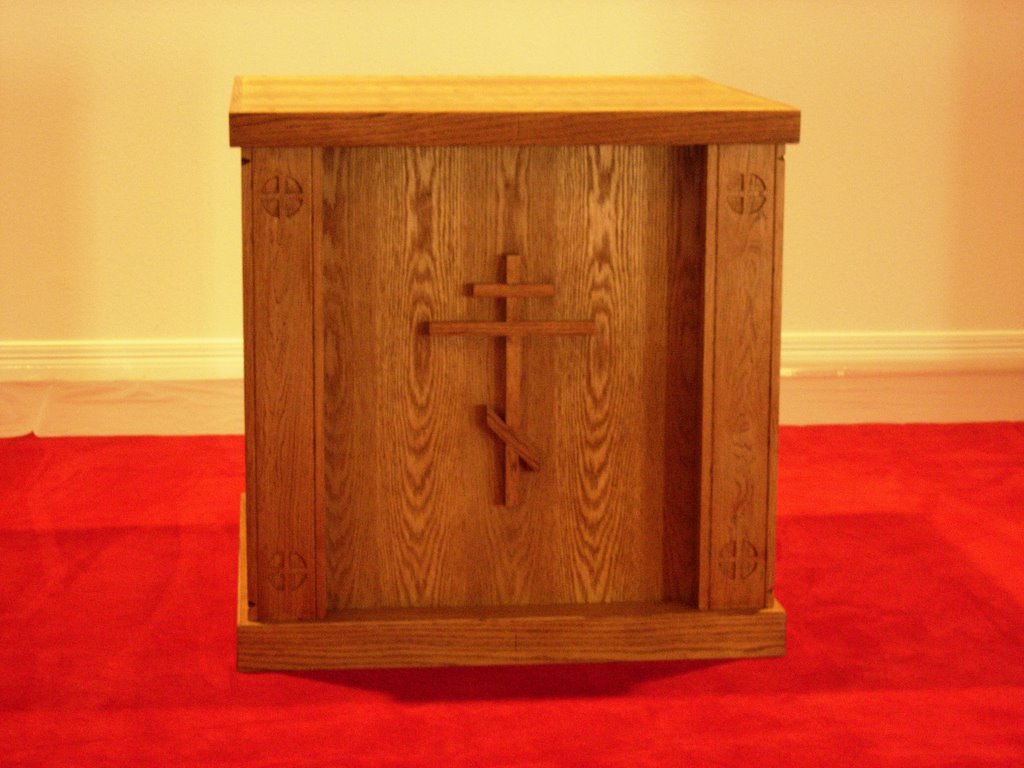 And now a close-up of the altar! This altar was made for us and paid for completely by donations (thanks be to God). It's a traditionally made altar for an Orthodox Church, which--aside from the three-bar cross on front--dictates that it be made entirely out of wood. No metal parts or tools or anything. No clue why that is, but the altar's gorgeous nonetheless. One of our altar servers (Steve!) asked if there was any way we could leave this uncovered for liturgies...unfortunately, no, but I felt the same desire myself while looking at it...
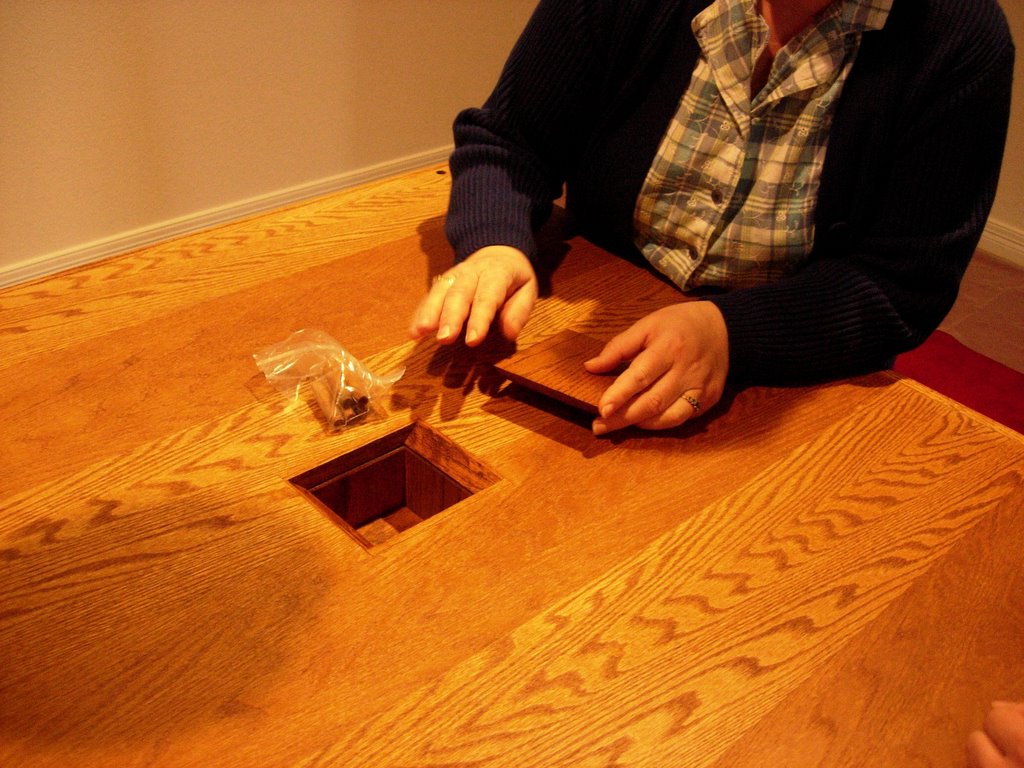 Matushka is showing us the reliquary in the top of the center of the altar; each Orthodox altar must have on it a relic of some saint in order to be used--I can't remember whose relics are on our current one. Next to the hole is a plastic bag with four wooden pegs that go in the corners of the altar once it's consecrated.
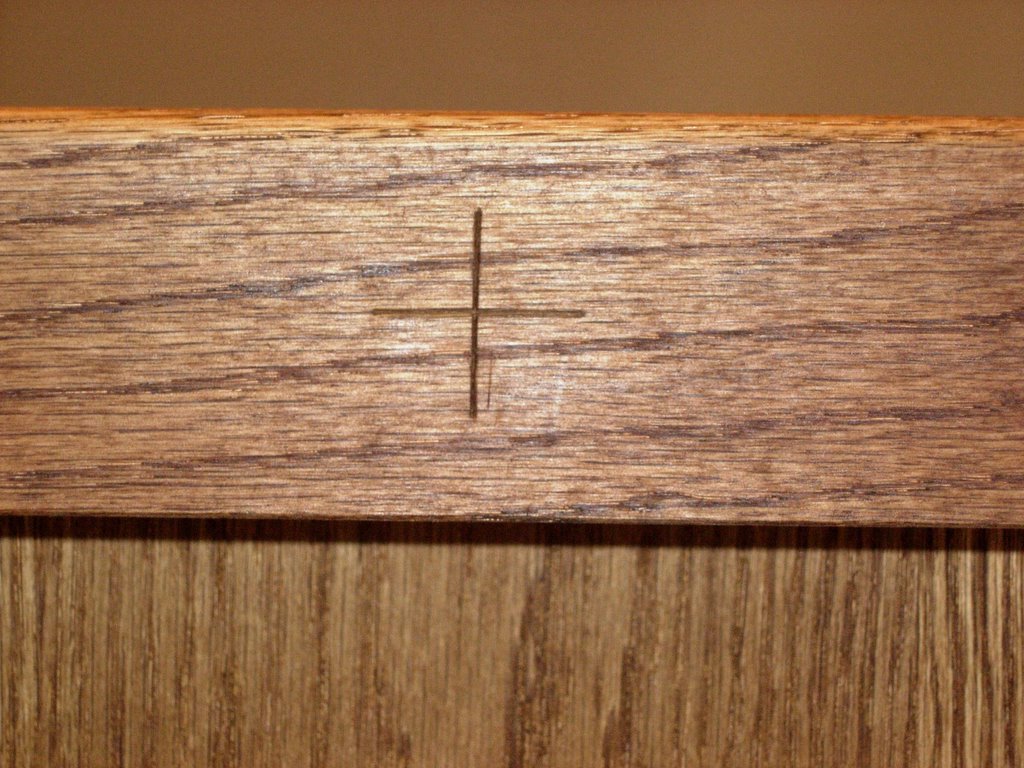 This small cross is on the side of the "lid" of the altar, on the side that is to face the people.
 This is a storage unit we had built into the back of the altar (facing away from the faithful). It'll just be used to store some of the Holy Vessels, I think--chalice etc.
 Close-up of the reliquary, pegs, and reliquary lid (also with cross engraved into front side of lid).
OK, so I really liked the first part of Steve's article, where he basically sets up how to approach the Fathers: things like "The church fathers have all the potential values and limitations of any historical observer," and "the chronological distance between the historical event and the historical witness is highly germane to the quality of his historical testimony" are both very good points, w/ which I obviously agree.
I also agree with the idea that "a heretic can be...an unwitting witness to the very thing he denies," though perhaps for different reasons than the author does. I see things such as belief in apostolic succession of bishops and the Church's preservation from institutional apostasy in the writings of Tertullian, for example, both pro in the writings made when he was a Christian, and contra when he was a Montanist. By this we can see that these two doctrines were held by the early orthodox Christians and denied by heretics.
Statement #4, about Eusebius, Hippolytus, and Julius Africanus, is good. Nice to know the author is willing to give these post-apostolic fathers a place.
Using the doctrine of the Real Presence of Christ in the Eucharist, the author says that "the mere fact that A knew B is quite insufficient to connect a particular belief of A with a particular belief of B unless that connection is explicitly made by the party in question." This is true. However, given the extensive nature of the training all of the sub-apostolic bishops had to have received from the Apostles, it's not at all likely that every last one of them would have misunderstood such a crucial doctrine, much less that they all would have erred on the side of insisting on the Real Presence instead of some being memorialists, some being consubstantialists, etc. The uniformity of the sub-apostolic witness on this subject--hardly a family reunion with arguing siblings or a woman slapping her forehead about questions missed--is too great to dismiss with an argument from silence.
#7 is one I hear a lot -- that the apostles misunderstood Christ's teachings, and the Church misunderstood the Apostles. Christ knew the former, which is why He promised the Spirit, which would bring all things to their remembrance and guide them into all truth. He also predicted the latter, as did St. Paul, that false prophets would come...yet the prediction about the gates of hell not prevailing, that the whole Church would not be led into error, stands, largely due to the authority of the appointed leaders of the Church to teach and instruct, that error may be overcome and the Church may continue to "grow up in all things into Him who is the head—Christ" (Eph. 4:15). That troubles would come is seen in Revelation, in the letters to the Churches, but as long as one lampstand remained (as was obviously the case), the apostolically-ordained community of the Church would continue.
The last sentence of Steve's article, which said that "a generic appeal to the church fathers can never trump grammatico-historical exegesis on this or that verse of Scripture," is interesting because, imo, the ante-nicean fathers *are themselves* the historical half of said exegesis! I assume, then, a father-by-father breakdown regarding specific mentionings of specific doctrines would help move away from such "generic" appeals...I do, btw, agree that too many people in Catholic and Orthodox circles simply say "The Fathers say..." with about as much readiness (and as little proof) as many fundamentalist Protastants who say "The Bible says..."
Der Fuerspreche's main idea--that the well-documented institutional apostasy of OT Israel paves the way for a similar NT Church institutional apostasy--is definitely one that seems as though it could easily be true--the NT Church was made up of people no less human than those who comprised OT Israel--but I do not see that specific prophecy made anywhere in Scripture. Indeed, the Isrealites are told in advance, by Moses himself, that they would indeed betray God as a nation and go after other gods, be punished, and return to Him. The NT Church is given no such prophecy by our Lord. Instead, the NT Church is called "His body, the fulness of Him that filleth all in all" (Eph. 1:23). Instead of doing things on behalf of all the people (as the OT Levites did), the NT priesthood (the Apostles, ordained by the Great High Priest from the line of Melchizedek) were sent out to do what only God could do: forgive and retain the sins of men, and bind and loose with divine authority. Surely this would not be given to an ekklesia who, being just as brittle as OT Israel, would fall away so soon into obvious apostasy, or merely given to one generation of men (the Apostles), with the understanding that it was to be passed no further.
Christ's rebuttal of the Pharisees and Sadducees with written Scripture is also often used as a tactic in debates to say that one can do the same with extra-biblical Catholic and Orthodox teaching. Two thoughts on this: One--Christ had the benefit of being the Logos incarnate; it's a rather safe bet that His knowledge of the proper interpretation of Scripture would be *somewhat* thorough. Two--Protestants in any age cannot claim this, as they are simply men and women who read the Bible and come to (often very different) ideas of how the Catholic and Orthodox churches have strayed from biblical truth. This is hardly the authoritative voice we hear coming from Christ. Rather, we should look at how the Scriptures were received by the earliest Christians and, if there is, as St. Vincent of Lerins said, universality, antiquity, and consent displayed in the witness of these early men with respect to a particular interpretation of said Scripture, we can ascertain with reasonable certainty the original, historical theological meaning of said passage.
 Took the day off from school to attend the Divine Liturgy at church today for the Meeting of the Lord in the Temple. A beautiful service, full of light--and a very light feeling to it, as well--it was good to take a moment out of the middle of the week and touch Heaven for a moment.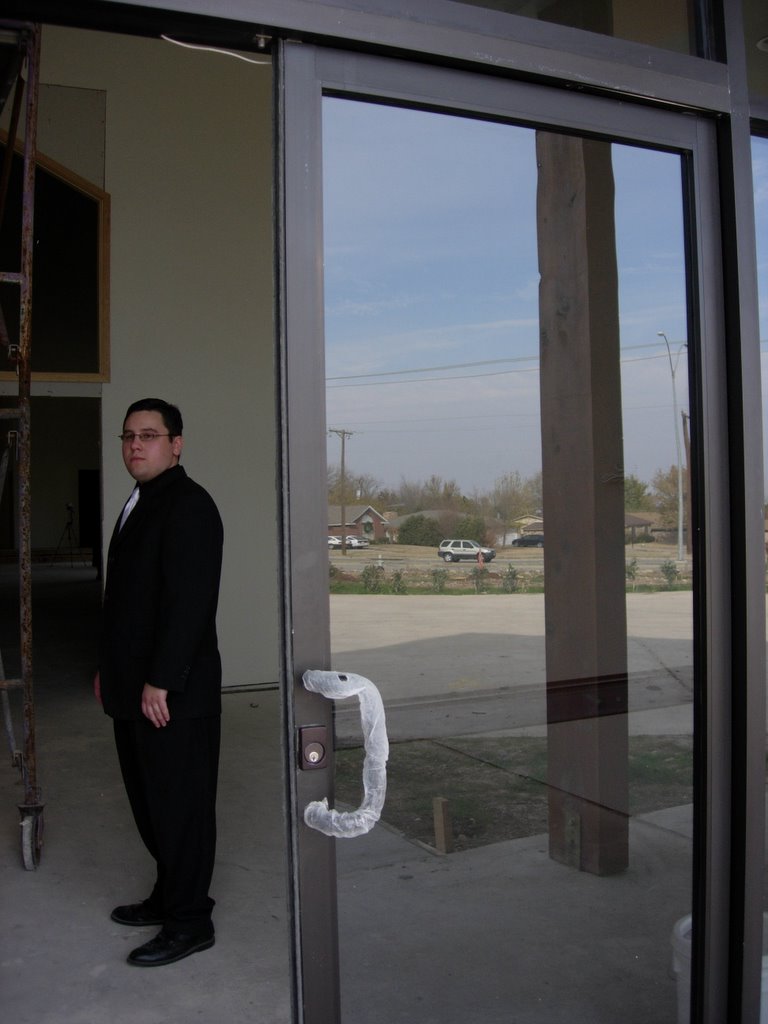
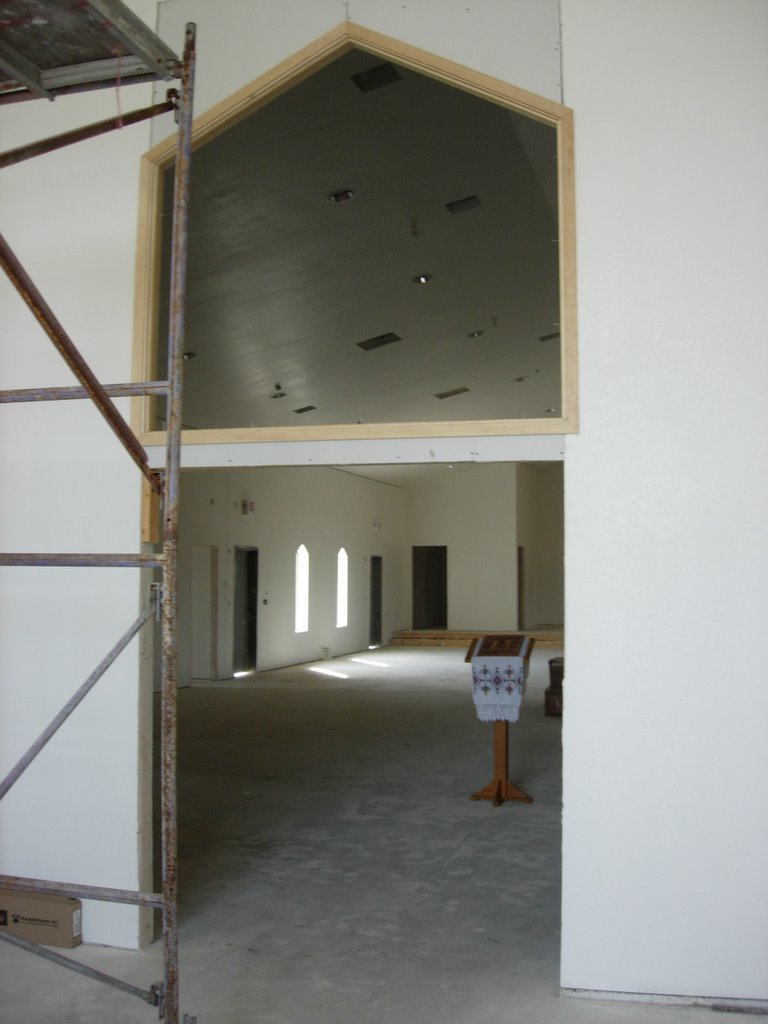
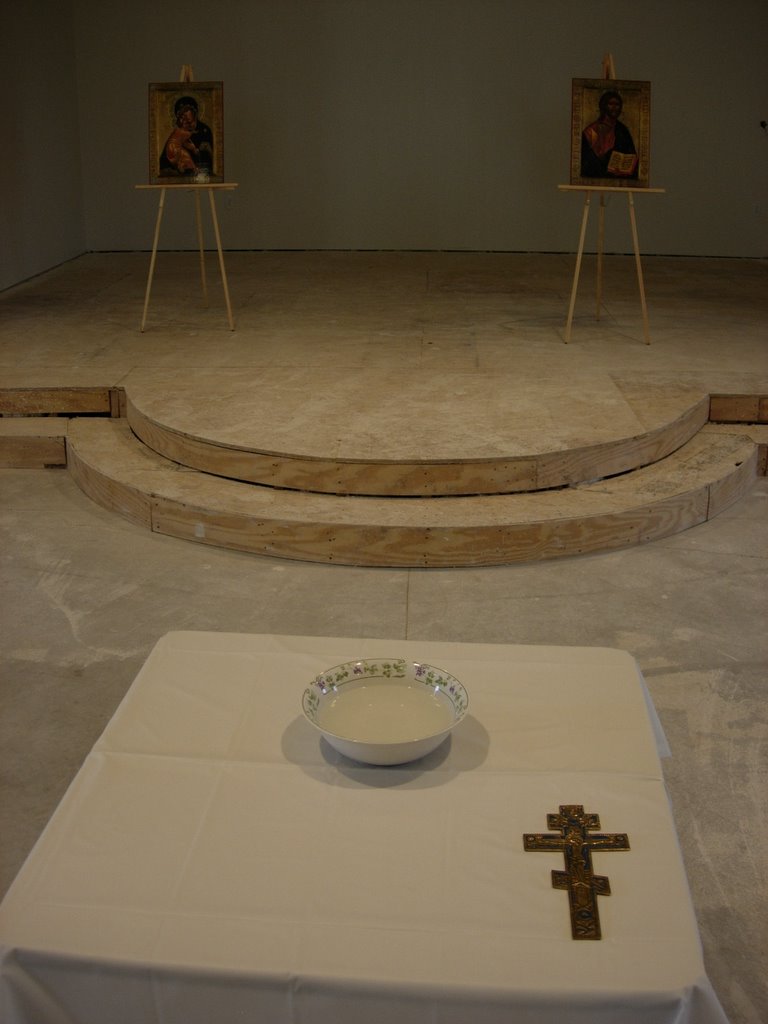
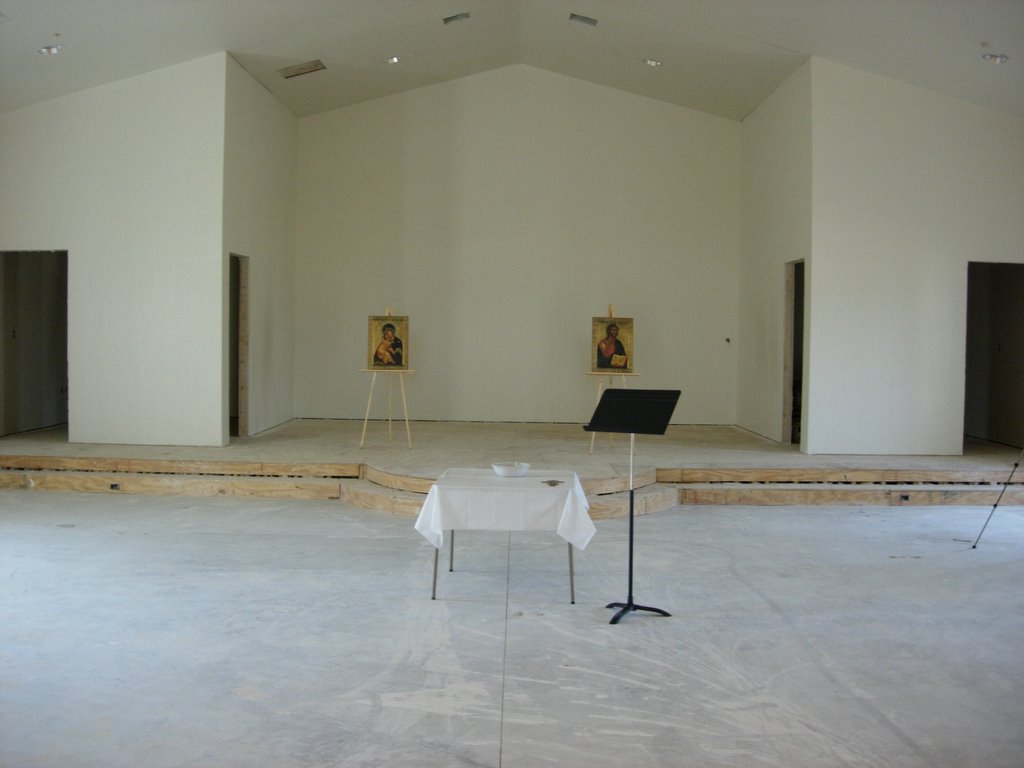 A wide shot of the ambon w/icons, and the table.
 The Archbishop and Fr. Basil prepare for the blessing.
 Protodeacon Patrick bows to Vladyka to begin the blessing.
 His Eminence reads the gospel.
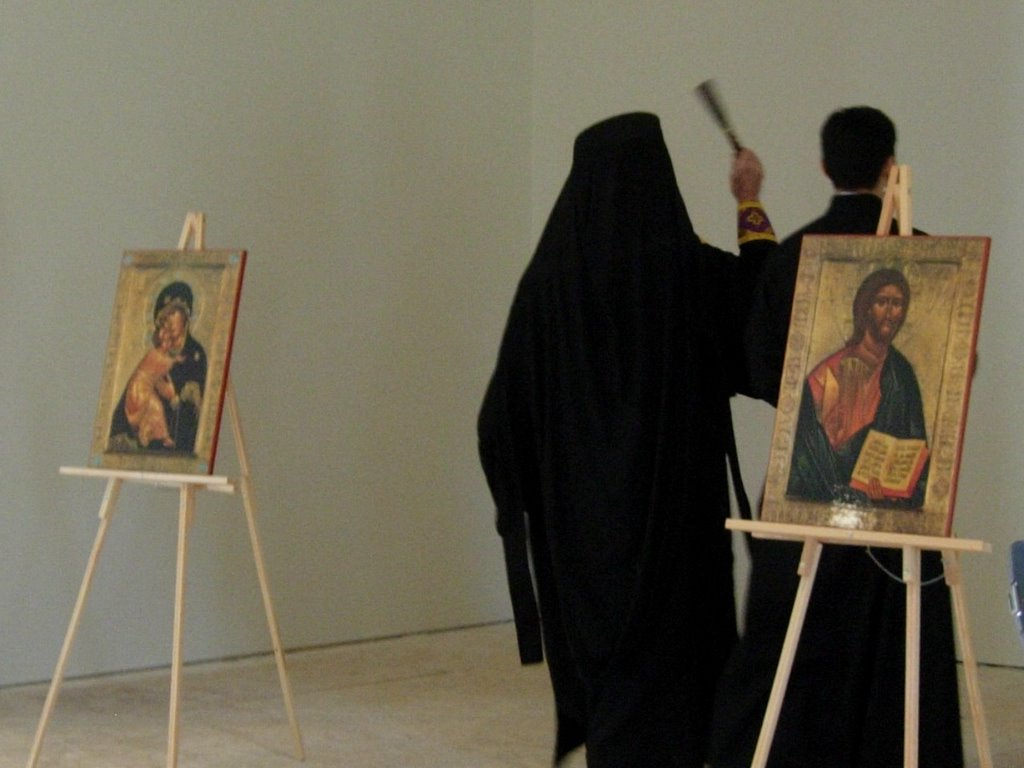 The Archbishop proceeds around the church, sprinkling it with holy water, while the choir sings, "When Thou, O Lord, wast baptized in the Jordan, the worship of the Trinity was made manifest! For the voice of the Father bore witness to Thee, and called Thee His beloved Son! And the Spirit in the form of a dove confirmed the truthfulness of His word. O Christ our God, Who hast revealed Thyself and hast enlightened the world, glory to Thee!"
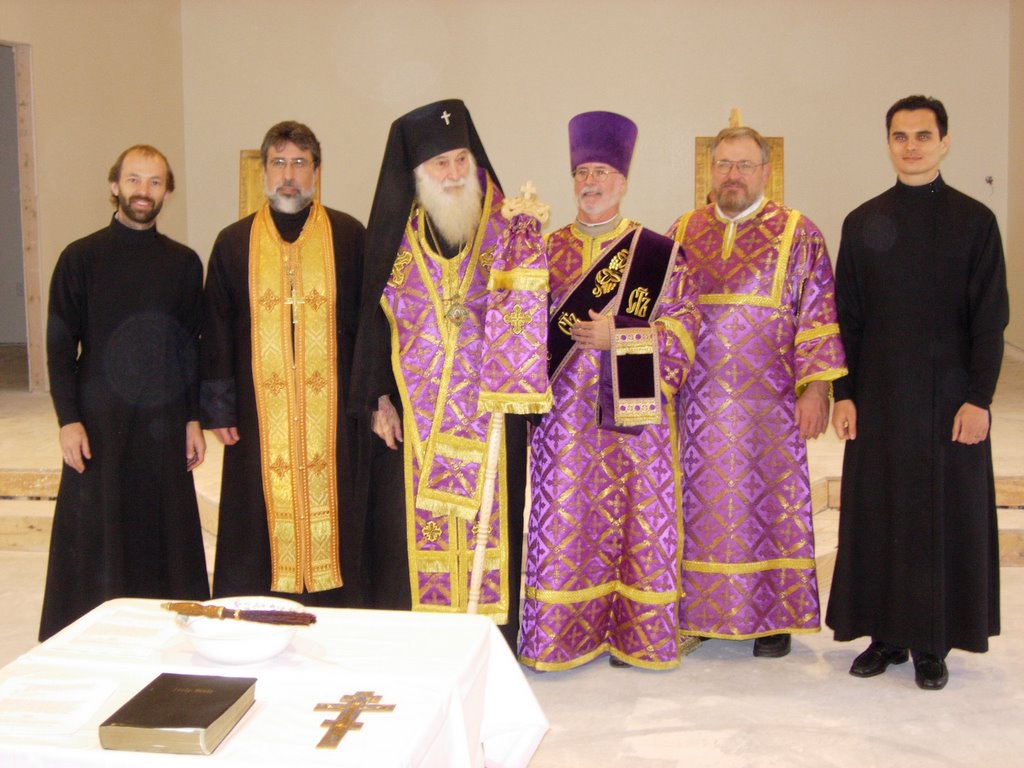 The clergy lined up for a photo op after the blessing.
 So Audra and I are with Hope last night, in her room, doing our shortened rule for Evening Prayers with her, and I'm trying to focus on the Trisagion Prayers or whatever I happened to be on, and I notice a little snickering coming from Audra, who's holding Hope. I look over and see, basically, what you're seeing to the right here. She not only has this onery grin on her face, but has reached over and grabbed my shirt sleeve and, with all the eloquence she can muster, declares the following:
 the fact of the matter is that the North (which still held slaves before, during, and after the War) had absolutely no right to force a group of states to remain in a union whose Constitution it no longer had any desire to support. The North, then, left us no other alternative to dealing with its illegal and unconstitutional actions against us in many areas other than (and, alas including) slavery. I simply seek to remember and honor the brave men and women who supported and died in the ultimately futile struggle to preserve the actual ideals of the Bill of Rights, Declaration of Independence, and the Constitution itself. I think our country would do well to listen to all the other things the South was trying to say about how to run this country when she left the union.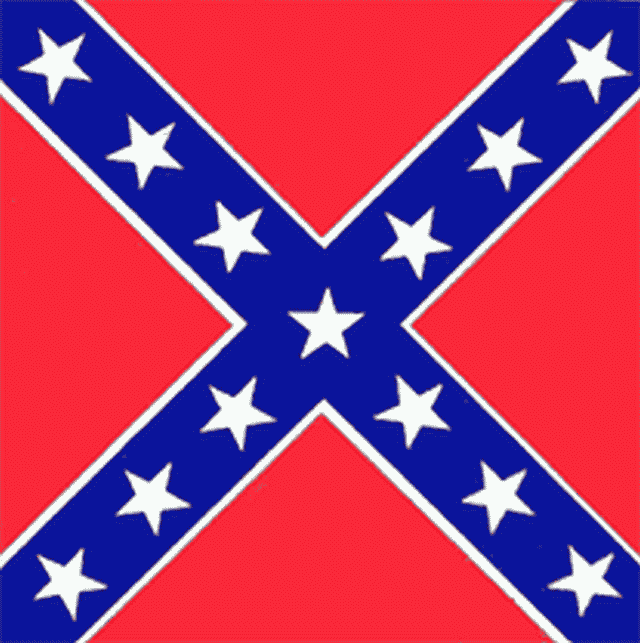
 For us to say that the American flag can experience this unquestioned redemption of its meaning, while groups like the Sons of Confederate Veterans--which is about as close to an official voice of the now-defunct Confederacy as you can get these days--cannot be allowed by popular culture to acknowledge the sins of their fathers, while at the same time honoring and remembering what was and is good and right about these symbols and struggles, seems to me to be a double standard that has no basis in history or fact, but rather media hype and ignorance of that fateful time in our nation's (nations' ?) history.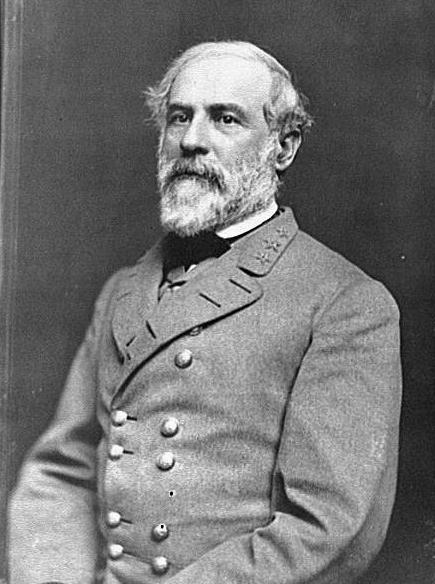


7 Lift up your heads, O you gates!Christ is risen!
And be lifted up, you everlasting doors!
And the King of glory shall come in.
8 Who is this King of glory?
The LORD strong and mighty,
The LORD mighty in battle.
9 Lift up your heads, O you gates!
Lift up, you everlasting doors!
And the King of glory shall come in.
10 Who is this King of glory?
The LORD of hosts,
He is the King of glory.
 http://photos1.blogger.com/x/blogger/1775/794/400/481325/shepherd.jpg